
Intermediate Bulk Container Market to Benefit from Expanding Global Trade and Demand for Large-Volume Shipping Solutions
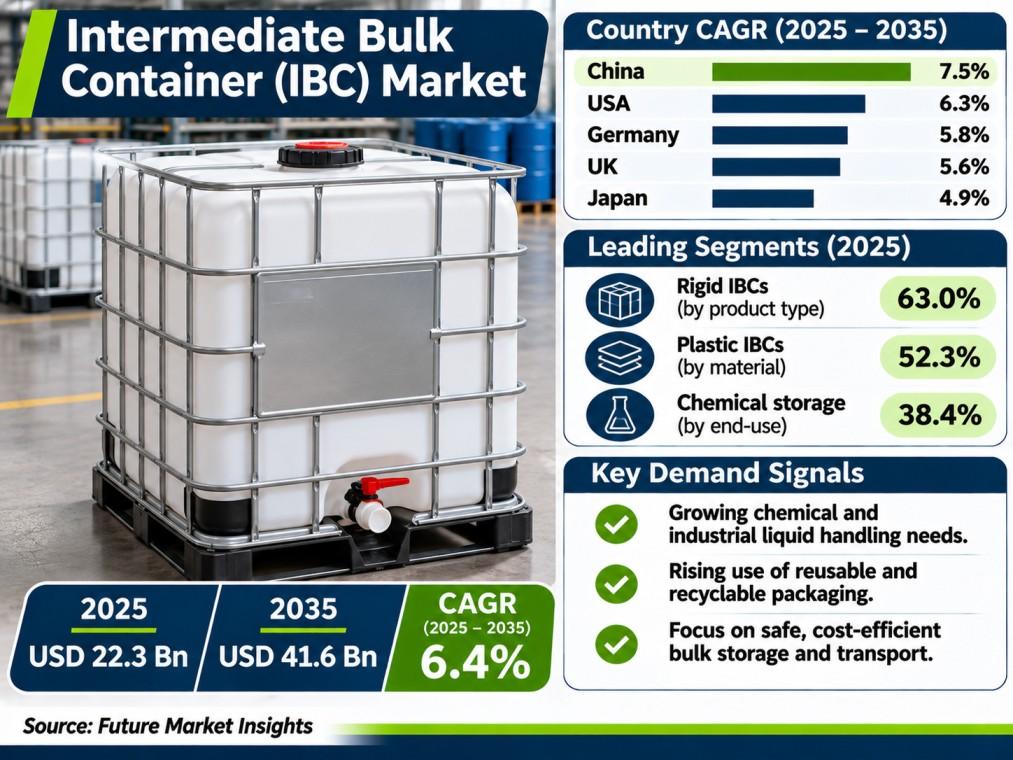
The global intermediate bulk container (IBC) market is projected to reach USD 4.9 billion in 2026 and grow to USD 9.5 billion by 2036, registering a CAGR of 6.8%. Demand is supported by industrial liquid movement, reusable packaging programmes and the need for safer bulk storage and transport.
The short version
- Rigid IBCs lead product demand. They are projected to account for 63.0% of the market in 2026, supported by cage-mounted designs for liquid transport and warehouse stacking.
- Plastic IBCs lead by material. They are expected to hold 52.3% share, as HDPE containers offer chemical resistance with lower handling weight.
- Chemical storage remains the largest application. It is forecast to account for 38.4% of demand in 2026, supported by regular movement of industrial liquids.
Request a sample: Explore market sizing, segment forecasts and country-level opportunities: https://www.futuremarketinsights.com/reports/sample/rep-gb-2036
Three numbers that matter
|
Market indicator |
Value |
|
Global market size in 2026 |
USD 4.9 billion |
|
Forecast market size by 2036 |
USD 9.5 billion |
|
Forecast CAGR, 2026–2036 |
6.8% |
Three segment shares underline the market structure:
- Rigid IBCs: 63.0% by product type.
- Plastic IBCs: 52.3% by material type.
- Chemical storage: 38.4% by application.
All shares refer to 2026.
Where growth is strongest
- United States – 6.2% CAGR: Established chemical and specialty manufacturing operations support demand. Reconditioning networks and reusable tote fleets help reduce repeat packaging costs.
- India – 9.7% CAGR: Chemical clusters and food ingredient processing are increasing the need for bulk liquid handling. Local production also improves supply access.
- China – 8.4% CAGR: Large chemical production volumes and export manufacturing networks support demand for standardised bulk packaging.
- Italy – 6.3% CAGR: Food and beverage processing, chemicals and coatings support IBC adoption. Reconditioning services help manufacturers manage packaging costs.
- Brazil – 7.8% CAGR: Agricultural chemicals and food processing support demand for durable containers across long domestic distribution routes.
Who is moving
Competition centres on container quality, product range, regional production and reconditioning reach. Manufacturers are expanding service networks and developing solutions for chemical, food and industrial liquid handling.
Dated developments reported by FMI:
- January 2025: Schütz and National Plastic Factory Company signed a licence agreement to produce 1,000-litre ECOBULK IBCs in Saudi Arabia.
- January 2025: Time Technoplast announced a Saudi Arabia facility for 1,000-litre IBC and plastic drum production.
- May 2025: Mauser Packaging Solutions introduced stainless steel IBCs in 125- to 550-gallon sizes for demanding industrial applications.
- July 2025: Greif entered an agreement to sell its containerboard business for USD 1.8 billion.
- March 2026: Schütz and BASF signed an agreement for an automated IBC production and storage facility at BASF's Ludwigshafen site.
Key players profiled by FMI:
- Mauser Packaging Solutions
- Greif Inc.
- Schütz Container Systems
- Time Technoplast Ltd.
- Hoover Ferguson Group
- ALPLA Group
Other companies covered in the report include Berry Global Inc., CL Smith, Composite IBC Inc. and Thielmann US LLC.
Where to act
- Reconditioning networks: Build collection, inspection and cleaning services to support repeat container use and customer retention.
- Chemical handling: Focus on durable rigid and composite IBCs for hazardous and non-hazardous liquid movement.
- Food-grade applications: Develop hygienic containers with controlled filling and discharge for liquid ingredients and concentrates.
- Tracking solutions: Use IoT tracking to improve container recovery and visibility across returnable packaging fleets.
- Regional production: Locate supply closer to chemical and food manufacturing clusters to improve delivery times and service access.
- Valve design: Offer suitable outlet and combination valve options for controlled discharge and different liquid requirements.
Where to be careful
- High initial cost: The purchase price of IBCs can slow adoption among smaller manufacturers with irregular shipment volumes.
- Cleaning and inspection: Reuse requires careful residue control and inspection to manage contamination risks.
- Product compatibility: Chemical and hygiene-sensitive liquids require material and compatibility checks before changing container formats.
- Container loss: Missing or delayed returns can weaken the economics of reusable packaging.
- Service coverage: Reconditioning and spare-parts access influence customer retention and repeat purchasing.
Access Detailed Market Insights: https://www.futuremarketinsights.com/reports/intermediate-bulk-container-market
Analyst view
Nandini Roy Choudhury, Lead Consultant for Packaging at FMI, says:
“Intermediate bulk container demand is moving with the industrial need for safer bulk liquid movement.”
FMI's analysis also highlights the role of reconditioning reach, dependable container quality and regional manufacturing. Suppliers that combine container production with collection, inspection and return services can strengthen customer relationships as reusable packaging programmes expand.
Questions for your next planning meeting
- Can our current IBC portfolio meet the handling, material and discharge requirements of chemical, food and pharmaceutical customers?
- Would a stronger reconditioning and tracking network improve container recovery and repeat revenue?
- Which country markets offer the best opportunity for regional production and service expansion?
- Analyst quotation: The short quotation is reproduced from the report page and attributed to Nandini Roy Choudhury, Lead Consultant for Packaging at FMI.
- Related reports: Both links are listed under the report page's Similar Industry Reports section.
- Contact details: The email address, telephone numbers and Newark address are provided in the report page's Quick Contact and company information sections.
Realted Report Of Packaging Industry :
Pump and Dispenser Market: https://www.futuremarketinsights.com/reports/pump-and-dispenser-packaging-market
Consumer Packaging Industry Analysis in Brazil: https://www.futuremarketinsights.com/reports/consumer-packaging-industry-analysis-in-brazil
Polyethylene Furanoate (PEF) Barrier Resin Market: https://www.futuremarketinsights.com/reports/polyethylene-furanoate-pef-barrier-resin-market
MEDIA CONTACT
Contact Person: Media Relations Team
Designation: Corporate Communications
Email: sales@futuremarketinsights.com
Phone: +1-347-918-3531
Website: https://www.futuremarketinsights.com/
ABOUT FUTURE MARKET INSIGHTS
Future Market Insights, Inc. (FMI) is an ESOMAR-certified market research and consulting firm headquartered in Delaware, USA, with offices in the United Kingdom, the United Arab Emirates, and India. FMI delivers syndicated and custom research across food and beverage, healthcare, chemicals, technology, packaging, consumer goods, and industrial sectors. Its research helps organizations assess market opportunities, understand industry developments, and make informed strategic decisions.

 Arabic
 French
 Spanish
 Portuguese
 Deutsch
 Turkish
 Dutch
 Italiano
 Russian
 Romaian
 Portuguese (Brazil)
 Greek
