
Canned Wine Market Expected to Reach USD 3.68 Billion by 2036; Germany Shows 7.0% CAGR
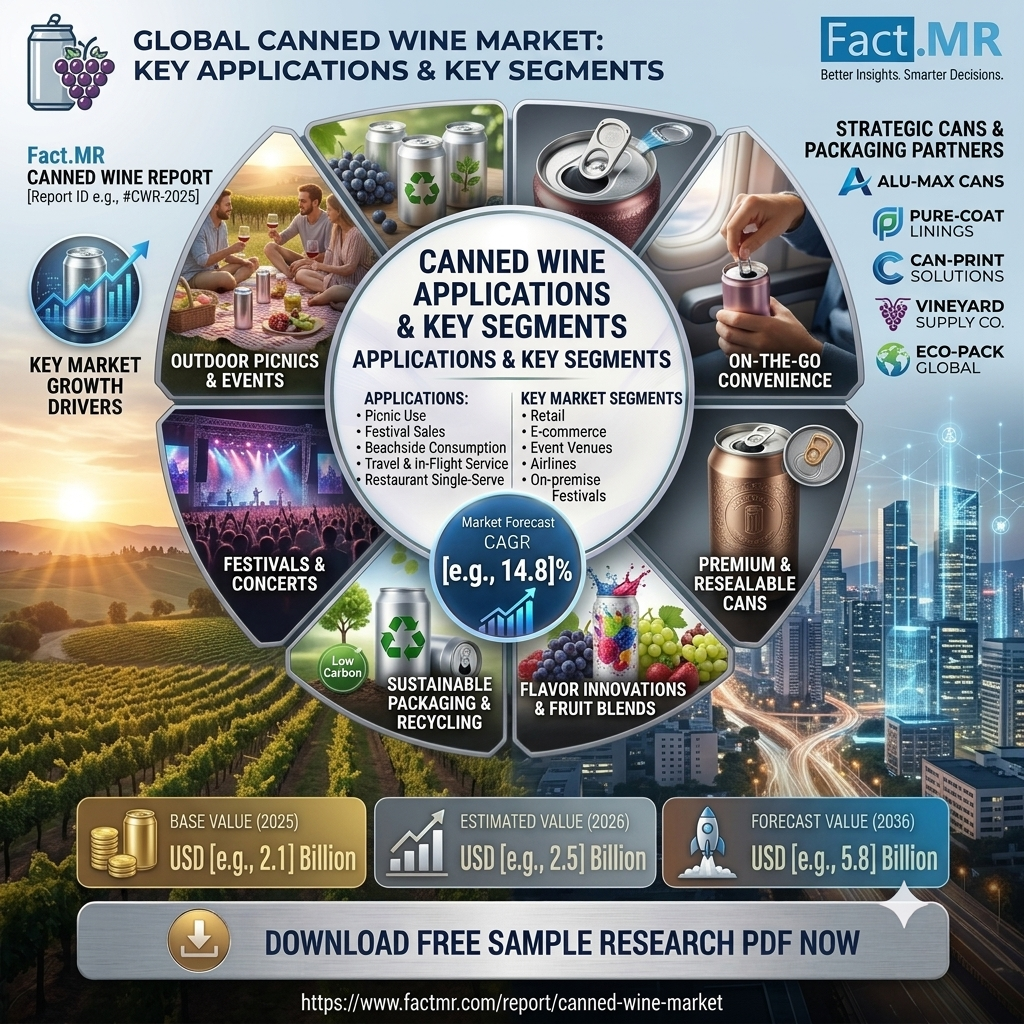
Demand for canned wine is expected to increase steadily as consumers shift toward portable, single-serve alcoholic beverages. The global canned wine market is forecast to expand from USD 1.627 billion in 2026 to USD 3.68 billion by 2036, registering an 8.5% CAGR over the forecast period. Fact.MR attributes this expansion to growing consumer interest in convenient wine packaging, changing preferences among millennial and Gen Z consumers, and increasing adoption of aluminium cans for outdoor consumption and casual social occasions.
The market was valued at USD 1.5 billion in 2025 and is expected to generate an incremental opportunity of USD 2.053 billion between 2026 and 2036. Canned wine is gaining acceptance across retail stores, entertainment venues, and travel-related consumption settings where traditional glass bottles are less practical. Aluminium packaging offers portability, portion control, and recyclability, encouraging wine producers to introduce canned versions of established products.
Get detailed market forecasts, competitive benchmarking, and pricing trends:
https://www.factmr.com/connectus/sample?flag=S&rep_id=8983
Still Wine in Cans Retains Dominant Position
By product type, still wine in cans is expected to account for 38.6% of the canned wine market. Its leading position reflects consumer familiarity with traditional red, white, and rosé wines, which are increasingly being offered in convenient single-serving formats. Standard 250 ml and 375 ml cans allow consumers to purchase smaller portions without opening an entire bottle, supporting adoption for personal consumption and outdoor activities.
Personal consumption represents another major demand category, accounting for 44.1% of application demand. Individual purchases for home consumption, picnics, barbecues, and informal gatherings are supporting this segment. The format also reduces unused wine compared with larger bottles, making it attractive to consumers seeking portion flexibility.
Standard cans account for 46.3% of packaging demand. Their compatibility with established beverage canning infrastructure and relatively economical production requirements support adoption among wine manufacturers. Slim cans and multipack formats are also gaining attention as producers develop packaging suited to premium positioning and planned retail purchases.
Mid-alcohol canned wine holds 49.5% of alcohol-content demand. Meanwhile, off-trade distribution accounts for 52.7% of channel demand, reflecting the importance of supermarkets, convenience stores, and liquor retailers in reaching consumers.
India, China, and Germany Show Strong Growth Potential
India is projected to record the fastest growth among the countries assessed, with canned wine demand increasing at a 12.0% CAGR from 2026 to 2036. The country's developing wine culture, expanding urban consumer base, and increasing interest in convenient beverage packaging are supporting market expansion. Fact.MR reports that India's wine market grew 15% in 2024, citing ISWAI data. Younger urban consumers are showing interest in accessible wine formats, while domestic producers are exploring canned packaging to encourage product trials.
China follows with a projected 10.0% CAGR through 2036. Growing interest in Western beverages, expanding e-commerce distribution, and changing preferences among younger consumers are contributing to demand. Imported beverage channels and cross-border online platforms are introducing canned wine to a wider audience. According to the report, China's wine imports increased 8% in 2024, based on General Administration of Customs data.
Germany is expected to advance at a 7.0% CAGR during the forecast period. Consumer interest in recyclable packaging and organic wine products is supporting the adoption of aluminium cans. Germany's established wine market is gradually incorporating alternative packaging formats as sustainability considerations influence purchasing decisions. Fact.MR cites German Wine Institute data indicating that the country's organic wine market grew 8% in 2024.
The broader market is also influenced by developments in the USA, Mexico, South Korea, and Japan. Mexico is projected to grow at 7.8%, followed by the USA at 7.5%, South Korea at 7.2%, and Japan at 6.0%. North America remains the largest regional market, with the USA generating USD 0.589 billion in canned wine revenue in 2025.
Competitive Landscape
Competition in the canned wine market includes established wine manufacturers, multinational beverage companies, and independent brands specializing in alternative wine packaging. Key companies profiled by Fact.MR include E. and J. Gallo, Treasury Wine Estates, Constellation Brands, Union Wine Co, Precept Wine, The Family Coppola, Canned Wine Co, and Infinite Monkey Theorem.
9. and J. Gallo holds approximately 9.0% of global market revenue, supported by its Barefoot canned wine portfolio and established distribution network. Treasury Wine Estates and Constellation Brands are extending established wine brands into canned formats, while independent producers compete through distinctive packaging, premium positioning, and direct-to-consumer distribution.
Brand recognition, product quality, retail availability, and pricing remain important competitive considerations. Manufacturers are also investing in packaging development and marketing strategies to address consumer perceptions regarding the quality of wine sold in cans.
Premiumization and Sustainable Packaging Shape the Market
The canned wine market is entering a period of product diversification. Fact.MR highlights increasing interest in premium single-origin wines, vintage-specific offerings, and organic canned varieties. Premium products featuring named vineyards and winemaker credentials are helping challenge the perception that canned wine is primarily a lower-priced beverage format.
Organic canned wine represents a particularly promising opportunity. According to Fact.MR, the category is growing at approximately 20% to 25% annually, exceeding conventional canned wine growth. Recyclable aluminium packaging also supports the sustainability positioning of organic wine products.
Wine spritzers and lower-alcohol offerings are attracting attention from consumers interested in lighter beverage options. Producers are developing new flavour combinations and alternative alcohol-content formats to reach different consumption occasions.
Packaging technology remains important. Improvements in protective can linings are helping manufacturers maintain wine quality and reduce concerns about metallic flavour transfer. At the same time, lightweight aluminium cans offer transportation and handling advantages compared with glass bottles.
As wine producers expand their portfolios and consumers become more familiar with alternative packaging, canned wine is expected to strengthen its position across retail, outdoor entertainment, and travel-related consumption channels. Continued product innovation and broader distribution are likely to support market development through 2036.
To View Top Reports
https://adamaamresearch.blogspot.com/2026/11/additive-manufacturing-market-to-cross.html
https://net-pals.com/blogs/63470/Global-Additive-Manufacturing-Market-to-Achieve-USD-53-31-Billion
https://acmingle.com/blogs/34663/Additive-Manufacturing-Market-Expected-to-Hit-USD-53-31-Billion
https://ikofficial.com/blogs/62736/Additive-Manufacturing-Market-Expected-to-Reach-USD-53-31-Billion
About Fact.MR
Fact.MR is a market research and consulting company providing market intelligence, competitive analysis, and forecasting across global industries. Its research supports businesses with data-driven insights into emerging markets, technology trends, competitive dynamics, regional opportunities, and changing demand patterns.

 English
 Arabic
 Spanish
 Portuguese
 Deutsch
 Turkish
 Dutch
 Italiano
 Russian
 Romaian
 Portuguese (Brazil)
 Greek
