
Lubricants Market Expansion Across Major End-Use Industries
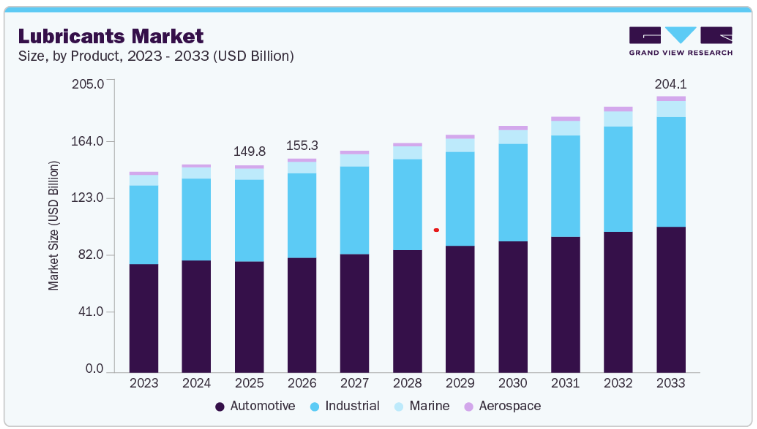
The global Lubricants Market was valued at USD 149.7 billion in 2025 and is projected to increase from USD 155.2 billion in 2026 to USD 204.1 billion by 2033, registering a CAGR of 4.0% from 2026 to 2033. Asia Pacific dominated the market with a 45.4% revenue share in 2025, supported by expanding automotive production, industrial development, and rising demand for lubricants across manufacturing, heavy equipment, marine transport, and power generation. Growing emphasis on equipment protection, operational efficiency, and longer maintenance intervals is also encouraging the adoption of advanced lubricant formulations across major end-use industries.
Lubricants Market Overview
Lubricants play an essential role in reducing friction, controlling heat, protecting machinery, and supporting the reliable operation of vehicles and industrial equipment. Demand is sustained by the expanding global automotive fleet and the continued use of machinery across construction, mining, manufacturing, transportation, and energy-related activities.
The market is also evolving as end users increasingly prioritize high-performance, durable, and thermally stable products. Synthetic and semi-synthetic formulations are gaining attention because of their oxidation resistance, extended service life, and ability to support equipment performance under demanding operating conditions. These product developments are contributing to the broader shift toward efficiency-focused lubricant solutions.
Want to Understand What’s Driving Market Growth? Ask Prism AI for research-backed insights into market size, evolving opportunities
Key Market Trends and Insights
The automotive segment accounted for the largest product share, representing 53.2% of global lubricants market revenue in 2025. This position reflects the continuing requirement for engine oils, transmission fluids, gear oils, brake fluids, coolants, and greases across passenger cars, commercial vehicles, and two-wheelers.
Another important trend is the increasing emphasis on advanced formulations that improve fuel economy, reduce emissions, and extend oil-drain intervals. Regulatory requirements and updated performance standards are encouraging manufacturers to develop lubricants that deliver stronger engine protection and meet changing automotive and industrial specifications.
The market's key indicators include:
- 2025 market size: USD 149.7 billion
- 2026 estimated market size: USD 155.2 billion
- 2033 projected market size: USD 204.1 billion
- Forecast CAGR: 4.0% from 2026 to 2033
- Largest product segment: Automotive, with 53.2% share in 2025
- Largest regional market: Asia Pacific, with 45.4% share in 2025
Factors Supporting Market Growth
Increasing vehicle ownership and regular maintenance requirements continue to support consumption of engine oils and transmission fluids. The global vehicle fleet and annual vehicle production create recurring demand for lubricants, while industrial expansion across construction, mining, and manufacturing adds to the need for machinery oils, greases, and specialized fluids.
Download a free sample report or claim your copy of this full market intelligence report
Emission regulations and industrial efficiency standards are also influencing product demand. Requirements such as Euro VI in Europe, EPA standards in the U.S., and Bharat Stage VI in India are encouraging the use of low-viscosity and synthetic lubricants designed to improve fuel efficiency and reduce emissions. Updated performance specifications from industry bodies, including API and ACEA, further raise expectations for engine protection and lubricant performance.
Product Landscape
Automotive lubricants remain the leading product category, supported by their use in vehicle engines, transmissions, braking systems, and other components. Engine oils are particularly important because they help reduce friction, dissipate heat, and protect engines against wear. Different viscosity grades are used to meet varying engine designs, operating conditions, and OEM requirements.
Industrial lubricants serve manufacturing and heavy-duty operations through products such as process oils, general industrial oils, metalworking fluids, industrial engine oils, and greases. These formulations support machinery reliability, machining precision, cooling, and protection under high-load conditions.
Marine lubricants are used in vessel engines, hydraulic systems, gears, turbines, and other onboard equipment. Aerospace lubricants include gas turbine oils, piston engine oils, hydraulic fluids, and specialized products designed for demanding aviation operating conditions.
Regional Market Outlook
Asia Pacific led the global lubricants market with a 45.4% revenue share in 2025. Strong automotive manufacturing, industrial production, construction activity, and transportation demand support the region's leading position. China accounted for 42.2% of the Asia Pacific market in 2025, reflecting its extensive automotive and industrial base, refining and blending infrastructure, and demand across manufacturing, construction, transportation, and marine sectors.
Europe represented 18.8% of global market revenue in 2025. Demand is supported by advanced automotive engineering, industrial manufacturing, and the adoption of high-performance and environmentally responsible formulations. Germany remains an important contributor because of its automotive industry, precision engineering capabilities, and focus on energy efficiency.
North America accounted for 18.2% of the market in 2025. Automotive servicing, industrial machinery, construction equipment, and commercial transportation contribute to regional demand. The U.S. represented 80.2% of the North American market, supported by its established automotive maintenance ecosystem and adoption of synthetic and high-performance lubricants.
Latin America, and the Middle East and Africa, offer additional demand opportunities through infrastructure development, construction, manufacturing, transportation, and energy-sector activities. However, some Middle Eastern and African markets continue to face limitations in domestic refining and blending capacity.
Market Challenges and Competitive Environment
The lubricants market faces challenges from crude oil price fluctuations, environmental regulations, and the rising cost of producing low-emission and high-efficiency formulations. Compliance with performance standards and quality certifications increases testing and production expenses. Technical requirements related to extreme temperatures, oxidation stability, and product compatibility also add to formulation complexity.
Competition is shaped by product performance, technological capabilities, distribution networks, brand strength, and customer partnerships. Established multinational producers and specialty lubricant manufacturers are investing in synthetic products, advanced formulations, and environmentally responsible solutions. Emerging and mid-sized participants are also strengthening their positions through capacity expansion, technology upgrades, and specialized product development.
Future Outlook
The global lubricants market is expected to maintain steady growth through 2033 as automotive maintenance, industrial production, and heavy-equipment operations sustain demand. Continued development of synthetic and semi-synthetic products, increasing focus on energy efficiency, and specialized lubricant requirements for advanced mobility applications are likely to influence product innovation. The market's longer-term direction will depend on manufacturers' ability to balance performance requirements, regulatory compliance, formulation costs, and changing end-use technologies.
Explore Our Research & Intelligence Solutions
Grand View Signal: Understand the Factors Shaping Commodity Prices – Explore the Platform

 English
 French
 Spanish
 Portuguese
 Deutsch
 Turkish
 Dutch
 Italiano
 Russian
 Romaian
 Portuguese (Brazil)
 Greek
