
Luxury Watch Market Forecast and Competitive Landscape
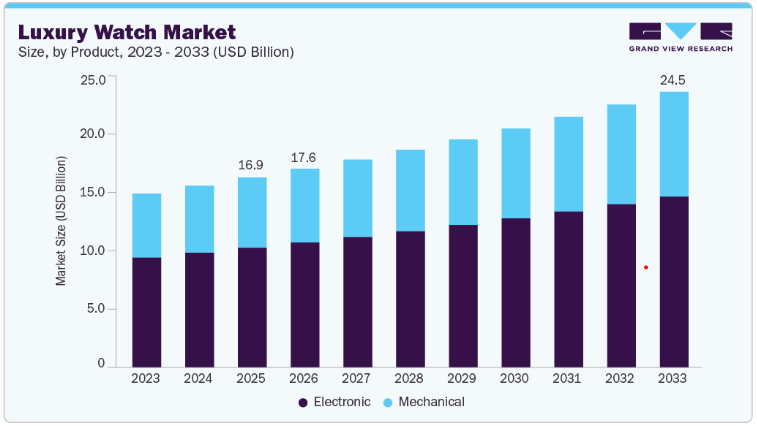
The global Luxury Watch Market size was valued at USD 16.9 billion in 2025 and is projected to grow from USD 17.6 billion in 2026 to USD 24.5 billion by 2033, registering a CAGR of 4.8% from 2026 to 2033. Asia Pacific dominated the global market with a revenue share of 54.3% in 2025. Increasing demand for exclusive timepieces, limited-edition collections, heritage designs, and premium craftsmanship is supporting market expansion. Luxury watches are increasingly perceived as both status symbols and long-term assets, while exclusive boutique experiences and strong resale values continue to influence purchasing decisions.
Luxury Watch Market Overview
The luxury watch industry is shaped by a combination of craftsmanship, brand heritage, product exclusivity, and changing consumer preferences. Buyers increasingly seek watches that offer distinctive designs, technical sophistication, and long-term value. Established brands benefit from their historical reputation and recognizable collections, encouraging consumers to purchase specific models even when availability is limited.
A notable industry trend is scarcity-driven purchasing. Limited-production steel sports models, high-complication watches, and boutique-exclusive releases attract collectors and affluent consumers. Strong secondary-market premiums and resale values further reinforce the perception of luxury watches as investment-oriented purchases. At the same time, mid-tier luxury brands face slower sell-through and higher inventory pressure.
Key Market Trends and Insights
The luxury watch market is experiencing changes across product categories and distribution channels. Electronic luxury watches held the largest product share in 2025, accounting for 63.0% of global revenue. Their demand is supported by convenience, multifunctionality, connectivity features, and the availability of hybrid mechanical-electronic designs.
Want to Understand What’s Driving Market Growth? Ask Prism AI for research-backed insights into market size, evolving opportunities
Mechanical luxury watches are expected to register faster growth, with a projected CAGR of 5.2% from 2026 to 2033. Collectors and enthusiasts continue to value traditional craftsmanship, artisanal finishing, technical complexity, and heritage. Limited editions and the appeal of tangible luxury assets are also supporting demand for mechanical timepieces.
Offline distribution remained the leading sales channel, accounting for 69.1% of the market in 2025. Consumers continue to value in-person product experiences, personalized boutique services, and the prestige associated with purchasing from authorized luxury retailers.
Key market indicators include:
- 2025 market size: USD 16.9 billion
- 2026 estimated market size: USD 17.6 billion
- 2033 projected market size: USD 24.5 billion
- CAGR: 4.8% from 2026 to 2033
- Largest regional market: Asia Pacific, with 54.3% share in 2025
- Leading product segment: Electronic luxury watches, with 63.0% share
- Leading distribution channel: Offline sales, with 69.1% share
Major Factors Driving Market Growth
Brand heritage and reputation remain important factors influencing luxury watch purchases. Consumers often choose established brands because of their craftsmanship, iconic designs, historical significance, and perceived long-term value. Strong brand recognition also encourages buyers to wait for limited editions and specific model allocations.
Download a free sample report or claim your copy of this full market intelligence report
Product exclusivity is another important demand factor. Boutique-only releases, region-specific models, and limited-production collections create a sense of scarcity that increases consumer interest. These purchasing patterns are particularly relevant among collectors and affluent buyers who seek distinctive references and products with strong resale potential.
The luxury watch market is also benefiting from the growing interest in vintage-inspired designs. Consumers looking for a combination of classic aesthetics, modern functionality, and accessible luxury are showing interest in products that reinterpret heritage collections.
Product Segment Analysis
Electronic luxury watches accounted for 63.0% of global market revenue in 2025. Their appeal is associated with multifunctionality, convenience, smart notifications, health-tracking features, and hybrid designs that combine traditional watch aesthetics with electronic capabilities. These products attract younger and urban consumers who value both practicality and premium positioning.
Mechanical luxury watches are project
ed to grow at a CAGR of 5.2% through 2033. Their appeal is closely linked to craftsmanship, precision, artisanal finishing, and the heritage of traditional watchmaking. Collectors and enthusiasts continue to value complicated movements and limited-production models, particularly in established luxury markets.
Distribution Channel Analysis
Offline sales represented 69.1% of the luxury watch market in 2025. High-value purchases often involve physical product inspection, personalized assistance, and direct engagement with boutique representatives. Authorized dealers and luxury retail stores therefore remain important channels for purchasing and gifting.
Online luxury watch sales are expected to grow at a CAGR of 5.3% from 2026 to 2033. Younger affluent consumers are increasingly comfortable with digital shopping, while brand-owned e-commerce platforms provide curated collections and authentication-related assurances. Online channels may also improve access for consumers in locations with limited physical luxury retail availability.
Regional Market Outlook
Asia Pacific held the largest share of the global luxury watch market at 54.3% in 2025. Strong wealth creation, demand for visible luxury products, gifting traditions, and expanding premium retail infrastructure support regional leadership. China accounted for 43.0% of the Asia Pacific market in 2025, driven by affluent consumers, business gifting, and demand across major urban centers.
North America is projected to grow at a CAGR of 5.0% from 2026 to 2033. The U.S. market is expected to register a CAGR of 5.2%, supported by high-income consumers, authorized dealer networks, and demand for watches purchased for status, gifting, and milestone occasions. Canada is projected to grow at a CAGR of 4.7%, with demand concentrated in major cities and supported by premium retail purchases.
Europe is anticipated to grow at a CAGR of 4.7% through 2033. The region benefits from its established watchmaking industry, heritage appreciation, collector communities, and luxury tourism. Germany accounted for 23.4% of the European market in 2025, while the UK and France are projected to grow at CAGRs of 4.8% and 4.5%, respectively.
Central and South America is expected to grow at a CAGR of 3.7% from 2026 to 2033. Demand remains concentrated among affluent consumers and collectors, with import duties and currency volatility influencing purchasing patterns. The Middle East and Africa market is projected to grow at a CAGR of 4.2%, supported by high-income consumers, luxury retail hubs, tourism, and gifting demand.
Future Outlook
The market is expected to maintain moderate growth through 2033. Product innovation, limited-edition launches, mechanical watchmaking, digital distribution, and exclusive retail experiences will continue to influence purchasing decisions. Brand heritage and perceived long-term value are likely to remain central to the industry's competitive positioning.

 English
 Arabic
 French
 Spanish
 Portuguese
 Deutsch
 Turkish
 Dutch
 Italiano
 Russian
 Romaian
 Portuguese (Brazil)
