
How Are Food Safety Regulations Reshaping Vietnam’s Medicated Feed Additives Market?
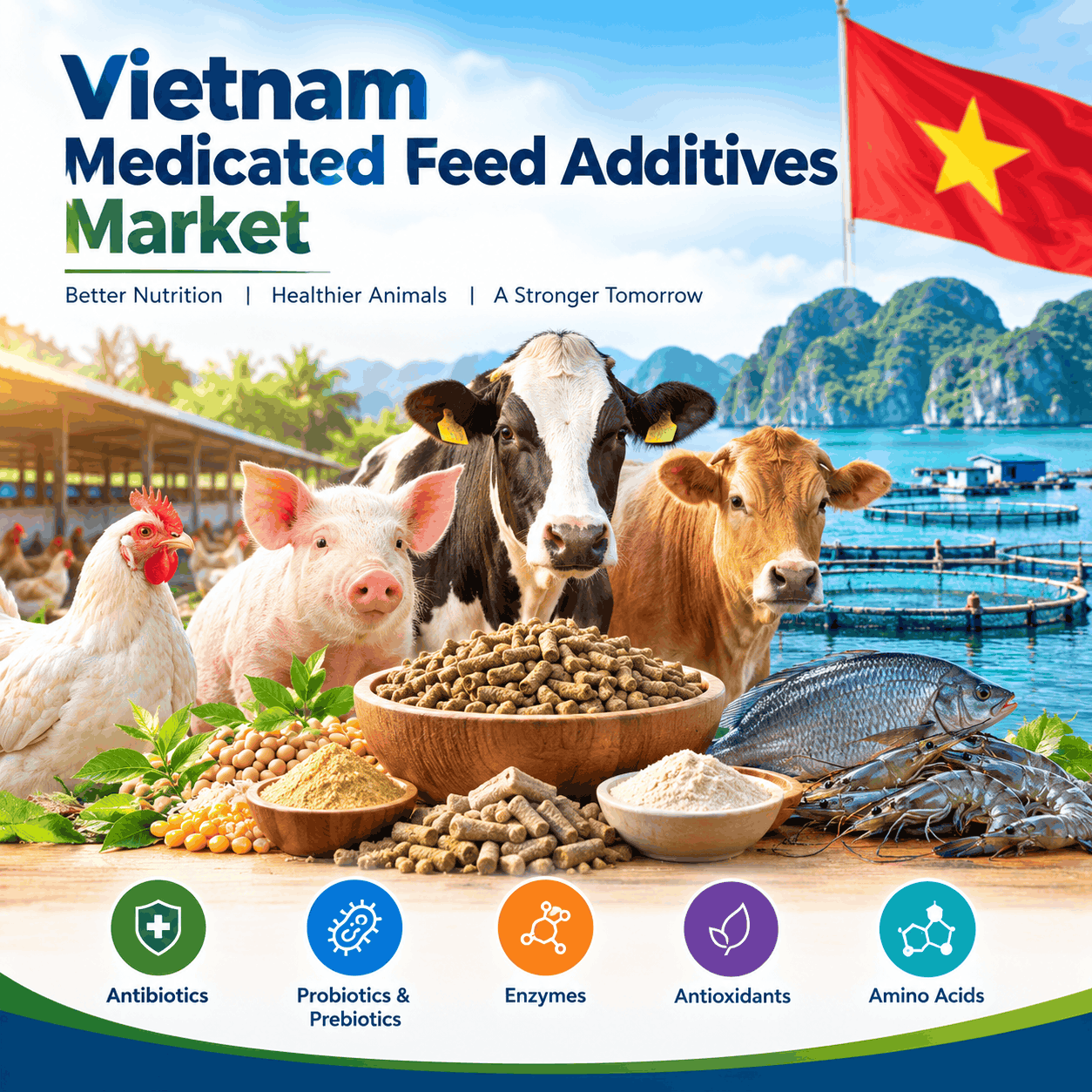
Food safety and animal healthcare have become increasingly important considerations for Vietnam's livestock and aquaculture industries. As the country strengthens its agricultural production capabilities and participates in international food supply chains, manufacturers and farmers are facing growing expectations regarding product quality, veterinary practices, and regulatory compliance. The Vietnam Medicated Feed Additives Market is evolving alongside these developments, with increasing attention to approved ingredients, responsible antimicrobial use, product traceability, and safe animal nutrition. These changes are encouraging businesses to improve manufacturing standards while developing feed additive solutions that address the requirements of modern livestock production.
Medicated feed additives serve different purposes, including supporting animal healthcare, managing specific veterinary conditions, and improving nutritional management. However, their use requires appropriate controls to ensure that animal-derived products meet applicable safety requirements. Regulatory oversight is therefore becoming an important factor influencing product development, distribution, and purchasing decisions across the industry.
Why Are Food Safety Standards Becoming More Important?
Vietnam's livestock sector supplies meat, dairy products, eggs, and seafood to domestic consumers and international markets. Maintaining consumer confidence requires producers to pay attention to animal health throughout the production cycle.
Food safety considerations are influencing the industry in several ways:
-
Consumer Awareness: Buyers are increasingly interested in the quality, safety, and origin of animal-derived products.
-
Export Requirements: International trade requires producers to understand the veterinary drug residue limits and food safety standards applicable in destination markets.
-
Antimicrobial Resistance: Concerns regarding antimicrobial resistance are encouraging more responsible veterinary medicine practices.
-
Product Traceability: Businesses are placing greater emphasis on tracking feed ingredients, manufacturing processes, and animal healthcare records.
-
Quality Assurance: Feed manufacturers are strengthening testing and production controls to maintain product consistency.
These developments are encouraging greater cooperation between feed producers, veterinary professionals, livestock farmers, and regulatory authorities.
How Does Vietnam's Regulatory Environment Influence Feed Additives?
Vietnam's regulatory framework plays an important role in determining which ingredients and products can be manufactured, imported, distributed, and used in animal production.
The Ministry of Agriculture and Environment is an important government authority responsible for agricultural and livestock-related regulatory functions. Applicable legislation and implementing regulations establish requirements concerning animal feed management, veterinary medicines, permitted substances, and product safety.
Businesses operating in this industry need to understand the distinction between nutritional feed additives and veterinary medicinal products. Products intended for nutritional purposes may be subject to different requirements from medicated products used to prevent or treat specific animal diseases.
Manufacturers and distributors should pay particular attention to:
-
Product registration and applicable approval requirements.
-
Permitted ingredients and product formulations.
-
Manufacturing and quality assurance standards.
-
Packaging, labeling, and product information.
-
Veterinary supervision and approved product applications.
-
Import documentation and distribution requirements.
Understanding these requirements helps businesses reduce compliance risks and maintain reliable commercial operations.
Why Is Responsible Antibiotic Use a Major Industry Concern?
Antibiotics have historically played a role in veterinary healthcare, particularly in the treatment of bacterial infections. However, inappropriate antimicrobial use can contribute to antimicrobial resistance, creating concerns for animal health and public health.
Vietnam has taken steps to strengthen controls on antibiotic use in animal production. In particular, restrictions on the use of antibiotics for growth promotion have been introduced through a phased regulatory approach.
This shift is encouraging farmers and manufacturers to focus on veterinary-supervised treatment and alternative nutritional strategies.
Important priorities include:
-
Using antibiotics only for permitted purposes.
-
Following approved dosage and treatment instructions.
-
Respecting applicable withdrawal periods before animal products enter the food supply.
-
Maintaining veterinary treatment records.
-
Avoiding unnecessary or unauthorized antimicrobial exposure.
-
Exploring appropriate non-antibiotic nutritional alternatives.
These practices can support responsible livestock management while helping producers meet changing regulatory expectations.
How Are Feed Manufacturers Responding to Changing Requirements?
Regulatory developments are encouraging manufacturers to strengthen their product development and quality management processes.
1. Improved Product Formulation
Companies are increasingly considering specialized formulations that meet animal nutritional requirements while complying with applicable ingredient restrictions.
2. Greater Investment in Quality Control
Testing raw materials, monitoring production conditions, and maintaining consistent product specifications are becoming important priorities.
3. Alternative Ingredient Development
Probiotics, prebiotics, enzymes, organic acids, and phytogenic ingredients are attracting interest as components of animal nutrition strategies.
4. Better Labeling and Documentation
Clear product information helps farmers understand intended applications, storage conditions, and dosage recommendations.
5. Stronger Technical Support
Manufacturers are collaborating with veterinary professionals and agricultural specialists to improve awareness of responsible product use.
These initiatives can help companies build credibility and establish stronger relationships with commercial livestock operators.
What Challenges Do Farmers Face in Maintaining Compliance?
Regulatory compliance can create practical difficulties, particularly for smaller livestock producers.
Many small farms operate with limited technical resources and may not have access to specialized veterinary advice. Understanding product labels, permitted applications, and withdrawal requirements can therefore become challenging.
The cost of compliant products and improved farm management systems can also create financial pressure. Furthermore, farmers operating across different livestock categories must understand that product requirements and treatment protocols may vary according to species and production conditions.
To address these challenges, greater access to agricultural extension services, veterinary guidance, and practical training can help farmers improve their understanding of food safety requirements.
How Can Compliance Create Business Opportunities?
Although regulatory changes can increase operational responsibilities, they can also create opportunities for companies offering reliable products and technical services.
Manufacturers with strong quality management systems may gain a competitive advantage among commercial farms and integrated livestock businesses. Companies that provide transparent documentation and reliable product support can also strengthen customer confidence.
Potential business opportunities include:
-
Development of compliant nutritional feed formulations.
-
Investment in product testing and quality assurance.
-
Expansion of probiotic and enzyme-based product portfolios.
-
Veterinary consulting and technical education.
-
Traceability and livestock production management solutions.
-
Distribution partnerships with established agricultural suppliers.
Companies that understand regulatory requirements can position themselves as dependable partners in Vietnam's changing livestock ecosystem.
What Is the Future of Regulation and Food Safety?
Food safety and responsible animal healthcare are expected to remain important influences on Vietnam's feed additives industry. Greater attention to antimicrobial resistance, production transparency, and international quality expectations could encourage further improvements in manufacturing and farming practices.
Digital documentation, improved laboratory testing, and better traceability systems may also help businesses monitor product quality and maintain regulatory records. Meanwhile, research into alternative feed ingredients could support the development of innovative nutritional solutions.
Who We Are
About 6Wresearch: 6Wresearch is a commercial strategy and growth advisory firm founded in 2011 and headquartered in New Delhi, India, with partners across Southeast Asia and the Middle East & Africa. The firm has delivered over 20,000 commercial engagements for over 2,000 organizations, including Fortune 500 companies, government agencies, and multilateral institutions such as the World Bank and the Asian Development Bank. Backed by proprietary market research and advanced analytics, 6Wresearch combines sector expertise with data-driven intelligence to help organizations navigate market complexity and drive sustainable growth. These capabilities explain why organizations trust 6Wresearch Global Market Research & Consulting Firm for reliable commercial insights and confident decision-making.
Our Proprietary Platform: 6W Export GTM
6W Export GTM is 6Wresearch's proprietary trade intelligence and go-to-market platform, built on UN Comtrade data and enhanced with 6Wresearch's in-house analytical and simulation models, including system dynamics-based forecasting. Unlike broad, sector-level market sizing tools, 6W Export GTM operates at the individual product level down to specific HS codes and micro-segments to identify precise, actionable export opportunities by country and product pair, including markets where trade currently does not exist. This granular, simulation-driven approach allows 6W Export GTM to surface opportunities that sector-wide analysis typically misses, positioning it among a small number of platforms globally offering this depth of product-and-country-specific export intelligence.

 English
 French
 Spanish
 Portuguese
 Deutsch
 Turkish
 Dutch
 Italiano
 Russian
 Romaian
 Portuguese (Brazil)
 Greek
