
BIS Registration Certificate: Eligibility, Documents and Application Process for Businesses
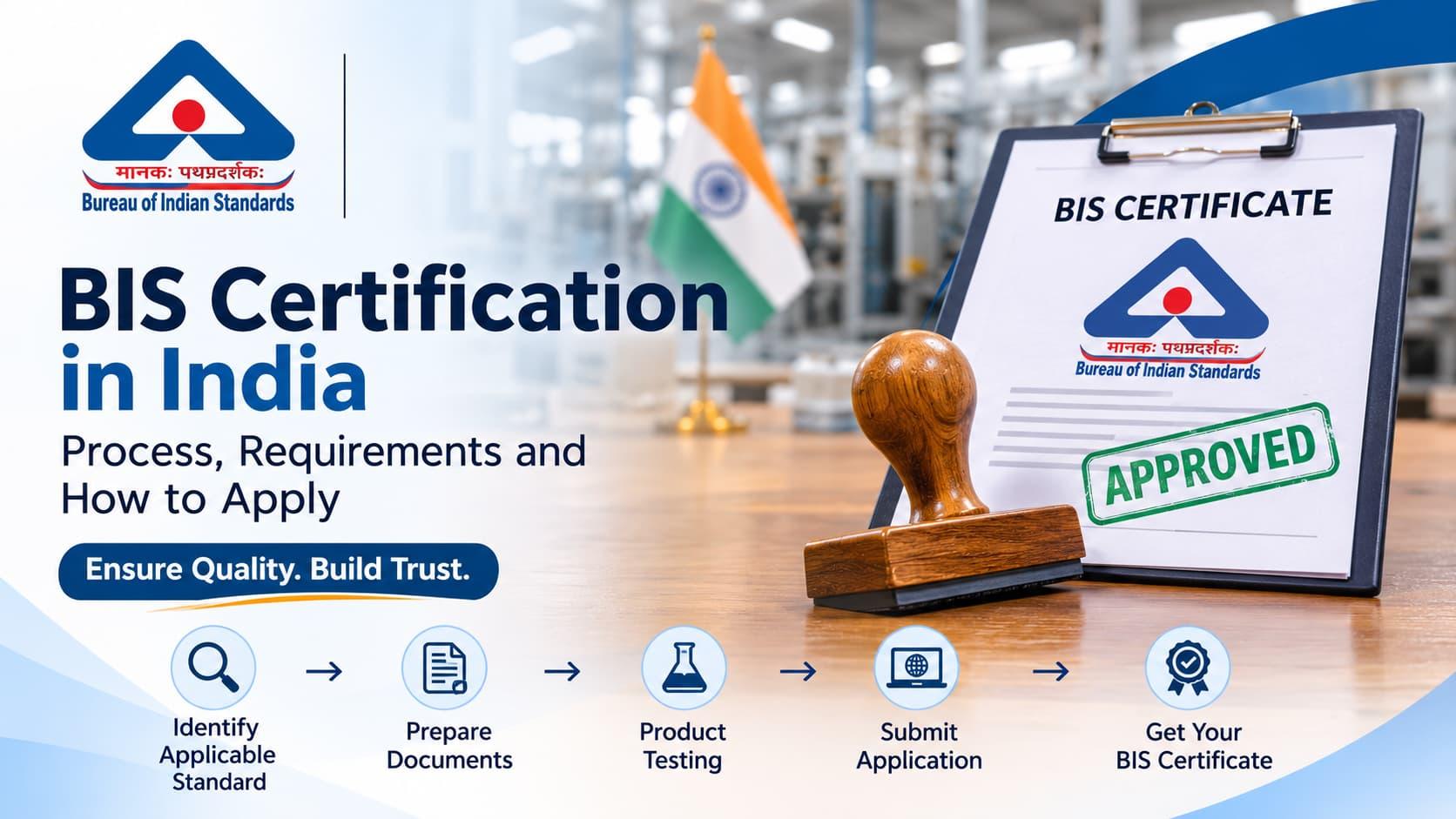
Why Is a BIS Registration Certificate Important for Businesses?
Getting a product ready for the Indian market involves more than manufacturing, packaging and distribution. Businesses must also understand the applicable product quality and safety regulations. Depending on the product category, obtaining a BIS Registration Certificate may be a necessary step before commercial sale.
The Bureau of Indian Standards (BIS) operates different conformity assessment schemes to establish whether products meet the relevant Indian Standards. The applicable approval route depends on the product, its intended use and the government notification covering it.
One important distinction is that a BIS registration certificate under the Compulsory Registration Scheme (CRS) is different from a BIS licence under the ISI Mark scheme. Both fall under the broader BIS conformity assessment framework but follow different procedures.
For manufacturers and businesses planning product launches, understanding this difference can help avoid applying under the wrong category.
What Is a BIS Registration Certificate?
A BIS Registration Certificate is an approval granted by BIS under the applicable registration scheme after the prescribed requirements are fulfilled.
Under Scheme II, which includes the Compulsory Registration Scheme, manufacturers of notified products must demonstrate conformity with the applicable Indian Standard.
The registration process generally involves:
-
Identifying the applicable Indian Standard.
-
Testing the product at a BIS-recognised laboratory.
-
Preparing the required manufacturer and product documents.
-
Filing the registration application.
-
Completing BIS scrutiny and addressing queries.
-
Obtaining registration and following marking requirements.
For products covered under Scheme I, the manufacturer follows a different licensing process that includes assessment of manufacturing infrastructure, quality control and product conformity.
Who Should Apply for BIS Registration?
The requirement depends on the product and the applicable conformity assessment scheme.
Generally, manufacturers dealing with products covered under mandatory BIS requirements need to obtain the relevant approval before placing those products on the Indian market.
The following businesses should examine their compliance obligations:
Domestic manufacturers: Companies manufacturing regulated products in India should check whether their product requires BIS registration or a licence.
Foreign manufacturers: Overseas manufacturers exporting notified products to India must comply with the applicable BIS requirements. Depending on the scheme, they may also need to appoint an Authorised Indian Representative.
Importers and distributors: Businesses sourcing products from overseas manufacturers should verify that the relevant BIS approval exists before importing or distributing regulated products.
An important point is that the registration or licence requirement is linked to the manufacturer and applicable product details, not simply to the business importing or selling the product.
Documents Required for BIS Certificate Registration
The document checklist varies according to the product category and the applicable scheme. However, businesses may need to arrange the following information:
-
Company registration documents.
-
Manufacturing unit address and contact details.
-
Product technical specifications.
-
Brand and trademark information.
-
Product model or series details.
-
Applicable Indian Standard information.
-
Test reports from recognised laboratories, where required.
-
Manufacturing and quality control information, where applicable.
-
Authorisation documents.
-
Affidavits and undertakings as prescribed under the relevant scheme.
For foreign applicants, additional documents relating to the Authorised Indian Representative may be necessary.
Document accuracy is important. Product descriptions, model numbers, manufacturing addresses and brand details should remain consistent across the application and supporting records.
How to Obtain a BIS Registration Certificate in India
The BIS certification process depends on the relevant scheme. For products covered under CRS, businesses generally follow these steps.
1. Verify Product Applicability
Check whether the product is covered by a compulsory government notification and identify the applicable Indian Standard.
This should be done before making a testing or registration decision.
2. Arrange Product Testing
Submit the product sample to a BIS-recognised laboratory for testing against the applicable standard.
The test report should establish whether the product meets the prescribed technical requirements.
3. Prepare the Application Documents
Collect the manufacturer details, product specifications, brand information, test reports and other documents required under the applicable scheme.
Review the information carefully before filing.
4. File the BIS Registration Application
Submit the application through the relevant online BIS portal along with the required documents and applicable fees.
5. Respond to BIS Queries
BIS may examine the application and request clarification or additional supporting information.
Responding with accurate information helps keep the application process organised.
6. Obtain Registration
After the applicable requirements are fulfilled and the application is accepted, BIS may grant the registration certificate with the relevant registration details.
The manufacturer must follow the prescribed marking and ongoing compliance requirements.
Common Mistakes to Avoid During BIS Registration
Many businesses focus on submitting an application quickly without checking the technical requirements first. This can result in additional work.
Here are some issues worth checking before starting the process:
-
Selecting the wrong Indian Standard.
-
Applying under an incorrect certification scheme.
-
Submitting incomplete manufacturer information.
-
Using inconsistent product model numbers.
-
Providing an unsuitable or outdated test report.
-
Overlooking foreign manufacturer authorisation requirements.
-
Ignoring product marking conditions after approval.
A proper review before application submission can help businesses avoid several preventable issues.
How Agile Regulatory Helps with BIS Certificate Registration
Understanding BIS requirements can be challenging when a business is dealing with multiple products, manufacturing locations or different product standards.
Agile Regulatory provides assistance to businesses looking for support with BIS compliance and registration.
Our services include:
-
Understanding product-specific BIS requirements.
-
Identifying the applicable certification or registration route.
-
Reviewing application documents.
-
Supporting product testing coordination.
-
Assisting with online application filing.
-
Coordinating responses to regulatory queries.
-
Providing application follow-up support.
We work with manufacturers and businesses to organise the compliance process based on their product requirements.
Frequently Asked Questions
1. Is a BIS Registration Certificate the same as an ISI licence?
No. A CRS registration under Scheme II and an ISI Mark licence under Scheme I are different conformity assessment routes. Their application procedures and requirements are not the same.
2. Can one BIS Registration Certificate cover multiple products?
This depends on the applicable standard, product category, model details and BIS guidelines. Businesses should verify the permitted scope before applying.
3. Is BIS registration required for imported products?
If an imported product falls under a mandatory BIS requirement, the applicable manufacturer must obtain the required approval before the product is placed on the Indian market.
4. Can a BIS Registration Certificate be renewed?
Registration validity and renewal requirements depend on the applicable scheme and current BIS rules. Applicants should check the relevant portal instructions and renewal conditions.
Start Your BIS Registration Process with Agile Regulatory
Whether you are launching a new product, expanding manufacturing or planning to enter the Indian market, checking BIS requirements before commercial operations is a practical business decision.
Agile Regulatory assists manufacturers and businesses with BIS certification assessment, documentation, product testing coordination and registration support.

 English
 French
 Spanish
 Portuguese
 Deutsch
 Turkish
 Dutch
 Italiano
 Russian
 Romaian
 Portuguese (Brazil)
 Greek
