
Edge Controllers for Subsea Pipeline Monitoring Market to Reach USD 1,124.3 Million by 2036; China Leads at 12.3% CAGR, UK at 11.7%, Germany at 11.6%
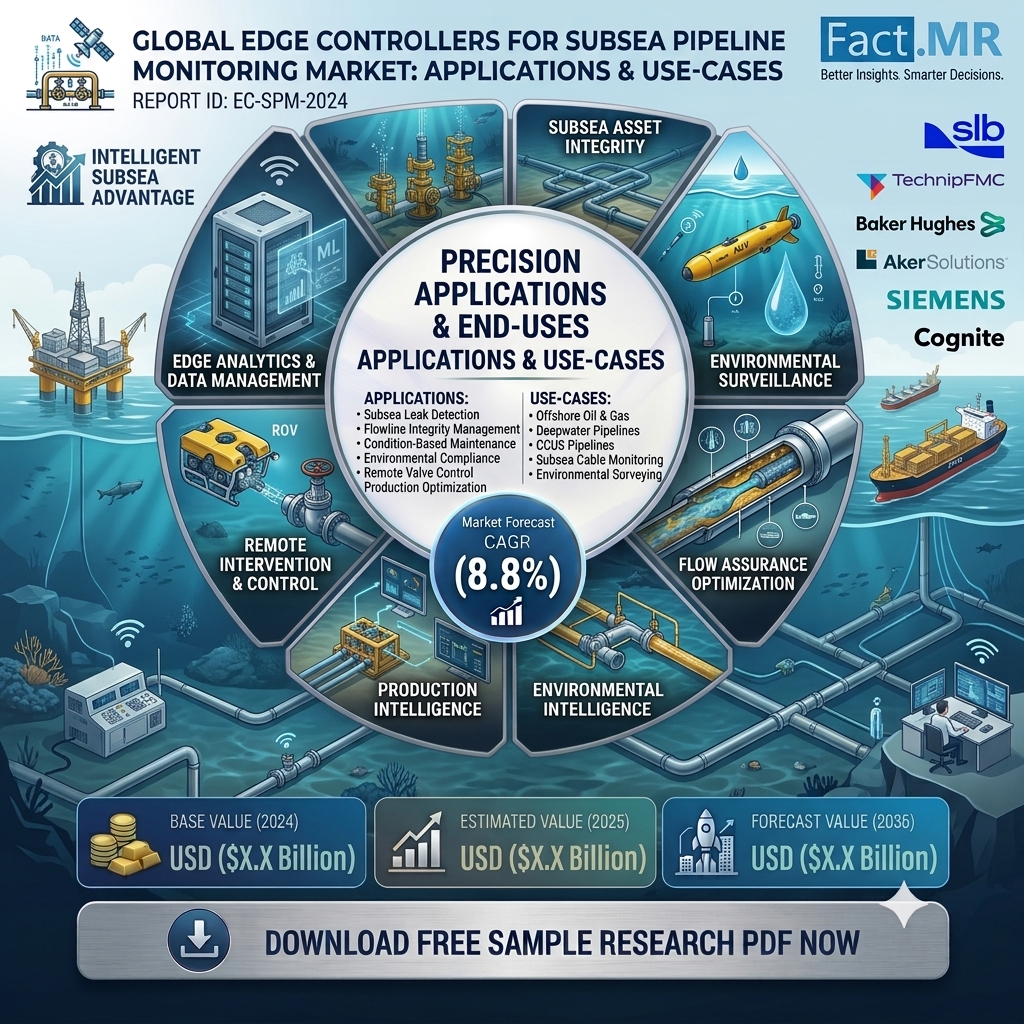
The global edge controllers for subsea pipeline monitoring market is forecast to expand from USD 381.6 million in 2026 to USD 1,124.3 million by 2036, registering an 11.4% CAGR over the forecast period. According to Fact.MR, the market was valued at USD 342.8 million in 2025. Growth is being supported by increasing demand for real-time pipeline integrity monitoring, localized data processing, and predictive maintenance technologies across offshore oil and gas transportation infrastructure.
Offshore energy operators are increasingly adopting distributed computing systems to improve monitoring reliability across subsea pipeline networks. Conventional centralized monitoring architectures can experience communication delays and bandwidth limitations, particularly in remote underwater environments. Edge controllers address these challenges by processing sensor information near pipeline assets, enabling faster detection of pressure fluctuations, corrosion indicators, and flow irregularities. The growing emphasis on reducing unplanned maintenance and extending infrastructure lifecycles is strengthening demand for these systems.
Get detailed market forecasts, competitive benchmarking, and pricing trends:
https://www.factmr.com/connectus/sample?flag=S&rep_id=14721
Offshore Oil Pipelines Retain Dominant Position
By end use, offshore oil pipelines are expected to account for 46% of the edge controllers for subsea pipeline monitoring market in 2026. Their leading position reflects the need for continuous integrity assessment across underwater hydrocarbon transportation networks. These pipelines require dependable monitoring systems capable of identifying pressure deviations, vibration changes, corrosion patterns, and operational abnormalities before they develop into costly failures.
Edge controllers support localized sensor-data processing, allowing operators to identify potential problems without relying entirely on continuous communication with centralized offshore control systems. Their integration with subsea instrumentation networks also improves operational visibility across long-distance pipelines, where conventional inspection methods can involve considerable logistical expenses.
Ethernet connectivity represents another leading segment, projected to capture 36% of the market in 2026. Industrial Ethernet systems support high-bandwidth communication between subsea sensors, control modules, and topside monitoring infrastructure. Their compatibility with industrial control and supervisory control and data acquisition (SCADA) protocols makes them suitable for applications requiring consistent transmission of operational data.
Other connectivity technologies, including industrial wireless, fiber optic, and satellite communication, remain relevant across different offshore operating environments. Technology selection depends on infrastructure requirements, communication reliability, and integration with existing monitoring architectures.
China, United Kingdom, and Germany Show Strong Growth Potential
China is expected to record the fastest growth among the countries assessed, with demand for edge controllers for subsea pipeline monitoring increasing at a 12.3% CAGR from 2026 to 2036. Expansion of offshore oil and gas infrastructure and investment in digital monitoring systems are supporting adoption. Fact.MR highlights China's March 2024 offshore digital oilfield development guideline update as an important development encouraging real-time monitoring capabilities. Industrial edge computing platforms are also gaining relevance as operators modernize offshore infrastructure.
The United Kingdom follows with a projected 11.7% CAGR through 2036. Its established North Sea energy infrastructure creates continuing requirements for pipeline integrity assessment, predictive maintenance, and asset lifecycle extension. Offshore safety requirements and the increasing adoption of distributed monitoring technologies are encouraging operators to strengthen subsea condition-monitoring capabilities. Fact.MR also identifies offshore safety compliance developments reported in February 2024 as a supporting factor.
Germany is projected to advance at an 11.6% CAGR during the same period. Its industrial automation expertise and established engineering capabilities support the integration of edge computing technologies into offshore instrumentation networks. The October 2023 Industrie 4.0 interoperability framework update is among the developments identified by Fact.MR as supporting distributed industrial computing adoption.
India is another important growth market, with demand expected to increase at an 11.9% CAGR through 2036. Offshore hydrocarbon infrastructure development and investment in digital surveillance technologies are creating opportunities for localized pipeline monitoring. The United States is forecast to register an 11.4% CAGR, supported by modernization of existing offshore monitoring systems and continued investment in asset integrity management.
Competitive Landscape
Competition in the edge controllers for subsea pipeline monitoring market includes established industrial automation companies with expertise in distributed control systems, rugged computing hardware, and offshore monitoring technologies. Key companies profiled by Fact.MR include Siemens AG, ABB Ltd., Schneider Electric SE, Emerson Electric Co., Honeywell International Inc., Rockwell Automation Inc., Advantech Co. Ltd., Beckhoff Automation GmbH, Moxa Inc., and Yokogawa Electric Corporation.
Manufacturers compete on processing performance, operational reliability, environmental durability, and compatibility with existing SCADA and industrial communication systems. Offshore operators also evaluate equipment certification, long-term maintenance support, and integration capabilities when selecting technology providers.
Companies offering integrated automation platforms and ruggedized edge computing equipment are positioned to address demand from pipeline operators seeking dependable monitoring solutions. Multivendor procurement strategies remain important as energy companies work to maintain operational continuity and reduce dependence on individual suppliers.
Technology and Regulatory Developments Shape the Market
The subsea monitoring industry is undergoing a transition from centralized data-processing architectures toward distributed industrial computing systems. Edge controllers enable real-time analysis of pipeline operating conditions, helping identify abnormalities without continuous dependence on topside computing infrastructure.
Predictive maintenance is becoming an important application as offshore operators seek to reduce inspection frequency and unplanned intervention costs. Localized analytics can support earlier identification of corrosion, pressure instability, and flow irregularities, potentially reducing the need for expensive inspection vessel deployments.
Regulatory and technical requirements also influence equipment development. Fact.MR identifies IEC 61508 functional safety standards and ISO 13628 subsea production system standards as relevant to reliability requirements for offshore monitoring equipment. Manufacturers must also address subsea environmental durability, communication latency, cybersecurity exposure, and integration with legacy control infrastructure.
Higher initial costs for ruggedized edge computing equipment and complex certification requirements remain market considerations. Nevertheless, the potential to improve monitoring reliability and extend pipeline operating life continues to support investment.
As offshore operators place greater emphasis on continuous pipeline surveillance and predictive asset management, edge controllers are expected to become increasingly important within subsea monitoring architectures. The full Fact.MR report provides detailed market forecasts, country-level analysis, technology trends, and competitive assessments through 2036.
Top Reports:
https://adamaamresearch.blogspot.com/2026/10/acetoacetanilide-market-to-cross-usd-89.html
https://net-pals.com/blogs/61804/Global-Acetoacetanilide-Market-Forecast-to-Hit-USD-8-9-Billion
https://acmingle.com/blogs/33952/Global-Acetoacetanilide-Market-Outlook-USD-8-9-Billion-by-2036
https://ikofficial.com/blogs/62120/Global-Acetoacetanilide-Market-Set-to-Reach-USD-8-9-Billion
About Fact.MR
Fact.MR is a market research and consulting company providing market intelligence, competitive analysis, and forecasting across global industries. Its research supports businesses with data-driven insights into emerging markets, technology trends, competitive dynamics, regional opportunities, and changing demand patterns.

 English
 Arabic
 French
 Spanish
 Portuguese
 Deutsch
 Turkish
 Italiano
 Russian
 Romaian
 Portuguese (Brazil)
 Greek
