
Bio-Based PMMA Market Expansion: Leading Companies and Revenue Outlook
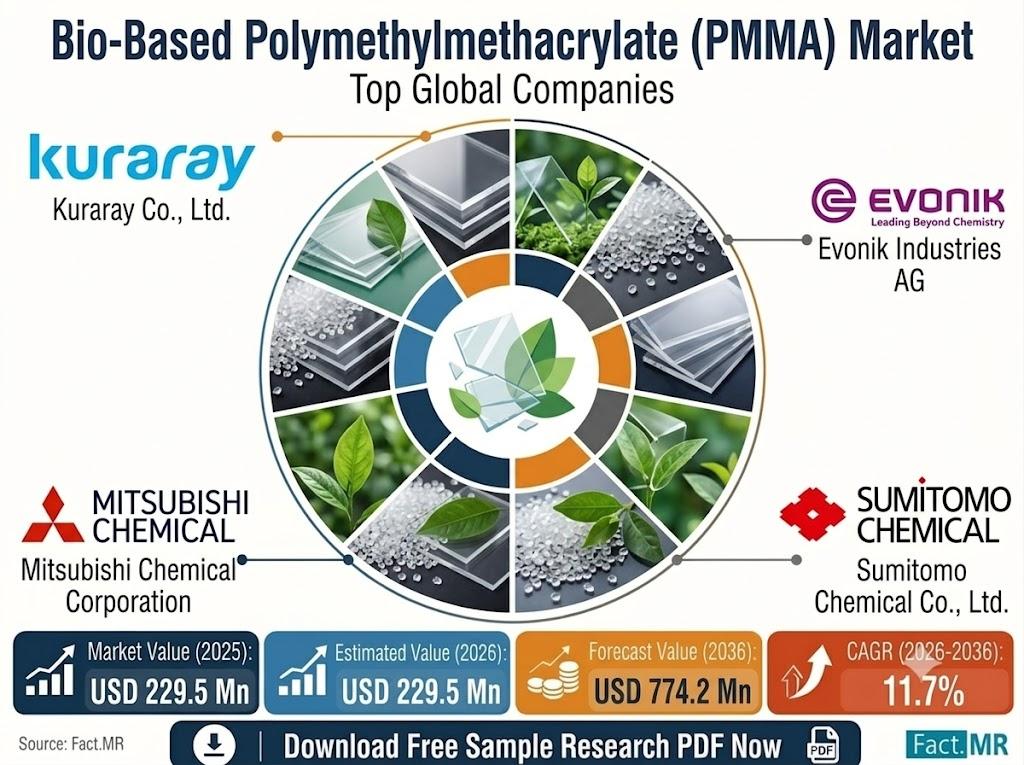
The global bio-based polymethyl methacrylate (PMMA) market is projected to increase from USD 256.3 million in 2026 to USD 774.2 million by 2036, expanding at a compound annual growth rate (CAGR) of 11.7% during the forecast period, according to Fact.MR analysis. The market was valued at USD 229.4 million in 2025, indicating growing commercial interest in renewable feedstocks for acrylic materials.
The market is expected to generate an absolute opportunity of USD 517.9 million between 2026 and 2036. Manufacturers developing plant-derived methyl methacrylate (MMA), automotive suppliers seeking alternative material inputs, and procurement teams evaluating traceable renewable content are among the stakeholders positioned to assess this opportunity.
Get detailed market forecasts, competitive benchmarking, and pricing trends: https://www.factmr.com/connectus/sample?flag=S&rep_id=16942
What Is Driving the Bio-Based PMMA Market?
The development of renewable MMA feedstocks is an important factor supporting market growth. Mitsubishi Chemical Corporation is advancing technology for producing MMA monomer from plant-derived materials. Its pilot plant began operating in 2023, with commercial-scale applications identified as a development objective for 2026.
Growing interest in resource-efficient plastics is another demand driver. Manufacturers are evaluating alternative feedstocks as businesses address plastic pollution, fossil-resource dependence, and material traceability requirements. However, commercial adoption depends on more than renewable feedstock availability. Producers must demonstrate consistent material quality, processing compatibility, and reliable supply at competitive costs.
Automotive manufacturing also presents opportunities for bio-based PMMA. Acrylic materials are used in selected transparent, decorative, and interior components where optical clarity, weather resistance, and durability are important. Suppliers seeking to enter automotive supply chains must demonstrate that renewable-content materials meet the technical specifications required for each application.
Which Market Segments Offer the Strongest Opportunities?
Fact.MR identifies three leading segments in its 2026 market analysis.
-
Product type: Extruded sheets are projected to account for 38.5% of the market in 2026. Their relevance stems from applications requiring transparency, surface quality, consistent thickness, and dimensional stability.
-
Application: Automotive is expected to represent 36.8% of the market in 2026, reflecting demand for acrylic materials in selected vehicle components.
-
End-user: Automotive is projected to hold a 35.2% share in 2026, highlighting the importance of automotive manufacturers and their suppliers in market development.
These categories measure different aspects of the market and should not be combined. Product type describes the material form, application identifies its use, and end-user classifies the purchasing or consuming industry.
For manufacturers, extruded sheets and automotive applications offer identifiable areas for product qualification and commercial development. Nevertheless, renewable feedstock content alone does not establish suitability. Suppliers must validate optical properties, mechanical performance, weathering resistance, and processing requirements for the intended use.
Which Countries Are Expected to Drive Market Growth?
Fact.MR projects different growth rates across five selected national markets between 2026 and 2036.
-
Germany: 13.6% CAGR, supported by automotive manufacturing and demand for advanced acrylic materials.
-
Brazil: 11.9% CAGR, with opportunities linked to automotive manufacturing and renewable feedstock availability.
-
Japan: 11.6% CAGR, supported by chemical industry capabilities and renewable MMA technology development.
-
United Kingdom: 10.0% CAGR, reflecting interest in advanced manufacturing and traceable material attributes.
-
United States: 9.6% CAGR, with potential applications across automotive components, electronics, and specialty acrylic products.
Germany has the highest projected CAGR among these five countries. For suppliers evaluating market entry, regional investment decisions should also consider local customer qualification requirements, renewable raw material availability, production economics, and distribution capabilities.
Japan's established chemical and materials technology base offers opportunities for renewable MMA development. Meanwhile, manufacturers targeting Brazil, the UK, and the United States will need to demonstrate dependable supply and application-specific performance to support adoption.
Who Are the Top Companies in the Bio-Based PMMA Market?
Companies identified in the supplied Fact.MR material include:
-
Kuraray Co., Ltd.
-
Mitsubishi Chemical Corporation
-
Asahi Kasei Corporation
-
CHIMEI Corporation
-
Evonik
-
Sumitomo Chemical
These companies have relevant activities across the PMMA and renewable methacrylate value chain, as described in the source material. Their inclusion should not be interpreted as a verified market-share ranking or confirmation that every company currently supplies certified bio-based PMMA.
Mitsubishi Chemical is developing plant-derived MMA production technology for acrylic resin applications. Kuraray has announced ISCC PLUS certification for selected thermoplastic elastomers and liquid rubber products under a mass-balance approach; the cited announcement does not confirm PMMA-specific certified supply.
For purchasing teams, the distinction between renewable monomers, finished bio-based PMMA, and mass-balance-attributed materials is commercially important. Recycled PMMA represents a separate circular-material pathway and does not, by itself, establish bio-based content.
What Challenges Could Limit Market Expansion?
Despite its growth outlook, the market faces several constraints. Premium pricing compared with conventional PMMA can limit purchasing decisions, particularly where customers cannot justify the additional cost through product specifications or sustainability requirements.
Limited renewable feedstock availability and challenges associated with scaling production may also affect commercial supply. In automotive and electronics applications, qualification and testing requirements can extend adoption timelines. Manufacturers must demonstrate consistent processing characteristics and finished-product performance before customers can approve new grades.
Verified bio-based content is another important consideration. Suppliers should provide transparent documentation distinguishing renewable feedstocks from recycled inputs and mass-balance attribution. Procurement teams should compare total material costs, supply reliability, technical specifications, and verification standards before selecting alternative grades.
What Is the Strategic Outlook for Manufacturers and Buyers?
The projected USD 517.9 million increase in market value between 2026 and 2036 creates opportunities for companies developing renewable MMA, bio-based acrylic sheets, and traceable material supply chains.
Material producers should prioritize feedstock verification, scalable production processes, and performance consistency. Automotive suppliers should evaluate optical quality, durability, dimensional stability, and qualification requirements alongside sustainability criteria. Purchasing teams should assess commercial availability and price premiums against conventional PMMA alternatives.
Shambhu Nath Jha, Principal Consultant at Fact.MR, states, “Bio-based PMMA adoption will depend on more than renewable feedstock availability. Material suppliers must demonstrate that bio-based content can be verified while maintaining the optical quality, durability and processing performance expected by automotive and electronics customers.”
The market's long-term development will depend on the ability of suppliers to combine credible renewable-content claims with dependable manufacturing and application-specific performance.
Access the Full Fact.MR Market Analysis
For detailed market forecasts, segment analysis, regional growth estimates, competitive coverage, and strategic insights, visit the original Fact.MR report:
Top Trending Reports:
Global Local Anesthesia Drugs Market Grows in North America | Pfizer, Aspen, Fresenius Kabi Lead Demand https://www.openpr.com/news/4506344/global-local-anesthesia-drugs-market-grows-in-north-america
Global Gout Therapeutics Market Grows in North America | Takeda, Novartis, AstraZeneca Drive Innovation https://www.openpr.com/news/4506347/global-gout-therapeutics-market-grows-in-north-america-takeda
Global Elder Care Product Market Grows in Asia Pacific | Invacare, Drive DeVilbiss, Etac AB Lead Innovation https://www.openpr.com/news/4506350/global-elder-care-product-market-grows-in-asia-pacific

 English
 Arabic
 Spanish
 Portuguese
 Deutsch
 Turkish
 Dutch
 Italiano
 Russian
 Romaian
 Portuguese (Brazil)
 Greek
