
Greenhouse Market Analysis of Hardware Segment Leadership
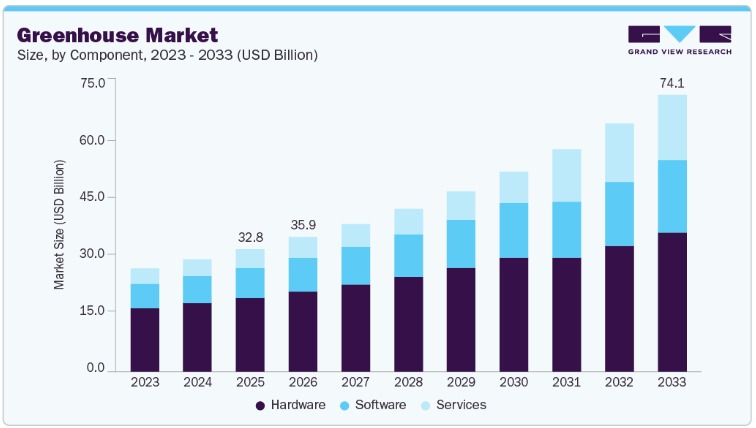
The global Greenhouse Market is entering a significant growth phase as agriculture increasingly shifts toward sustainable, controlled-environment cultivation. The global Greenhouse Market size was valued at USD 32.8 billion in 2025 and is projected to grow from USD 35.9 billion in 2026 to USD 74.1 billion by 2033, registering a CAGR of 10.9% from 2026 to 2033. Growing demand for fresh produce, limited agricultural land, urbanization, and technological advancements are strengthening the adoption of greenhouse farming. Europe accounted for the largest regional market share of 31.0% in 2025, while Asia Pacific is expected to experience the fastest growth during the forecast period.
What Is Driving the Growth of the Greenhouse Market?
Increasing pressure on agricultural land and the need to improve food production efficiency are important factors supporting greenhouse market growth. Urbanization, climate change, and soil degradation are reducing the availability of suitable farmland, encouraging growers to explore cultivation methods that maximize output within limited spaces. Greenhouses provide controlled growing conditions that help maintain temperature, humidity, and light while protecting crops from adverse weather.
The rising global urban population is further strengthening this demand. As cities expand, agricultural land is increasingly converted into residential, commercial, and industrial areas. Greenhouse cultivation allows growers to produce more crops per square meter while improving water and fertilizer utilization. These advantages make controlled-environment agriculture an increasingly relevant approach to supporting long-term food security.
Demand for locally grown, fresh, and high-quality produce is another major growth factor. Consumers are paying greater attention to food freshness, origin, and safety. Greenhouses located near urban centers can supply fruits, vegetables, and herbs with shorter transportation distances, supporting local food systems and reducing transportation-related costs.
Want to Understand What’s Driving Market Growth? Ask Prism AI for research-backed insights into market size, evolving opportunitie
How Are Greenhouses Supporting Sustainable and Year-Round Farming?
Greenhouses enable cultivation beyond traditional seasonal limitations by creating a more predictable growing environment. Growers can adjust environmental conditions to meet crop-specific requirements, improving consistency and supporting production throughout the year. This capability is particularly valuable for specialty crops, including herbs, flowers, and high-value fruits and vegetables that require specific growing conditions.
The expansion of urban agriculture and vertical farming is also creating opportunities. Greenhouses integrated with hydroponics, aeroponics, and advanced lighting systems can support cultivation where conventional farmland is limited. Rooftops, community spaces, and urban developments are becoming potential locations for localized food production.
Export-oriented agriculture is another important application. Countries investing in greenhouse infrastructure can produce vegetables, flowers, and fruits that meet international quality requirements. Controlled growing conditions help improve product consistency and reduce weather-related and contamination risks, supporting growers targeting demanding export markets.
Greenhouse production flowchart
Land and Infrastructure Constraints → Controlled Growing Environment → Efficient Water and Nutrient Management → Consistent Crop Production → Local and Export Market Supply
Which Greenhouse Components Are Leading Market Development?
Hardware accounted for more than 60.0% of the greenhouse market in 2025, making it the leading component segment. Greenhouse structures, irrigation equipment, fertigation systems, and other physical technologies are essential for maintaining suitable growing conditions. Automated drip and mist irrigation systems are particularly valuable in water-scarce areas because they support precise water delivery while reducing resource wastage.
Software is anticipated to register the fastest CAGR during the forecast period. Cloud-based greenhouse management platforms enable growers to monitor operations, analyze historical and real-time data, and receive alerts and recommendations through connected devices. These systems can integrate with greenhouse hardware and support centralized management across multiple facilities.
The integration of Internet of Things sensors, artificial intelligence, automated climate controls, precision irrigation, and energy-efficient LED grow lights is increasing the importance of digital management. Monitoring temperature, humidity, carbon dioxide levels, nutrient delivery, and pest activity can help growers make timely decisions and improve operational efficiency.
Download a free sample report or claim your copy of this full market intelligence report
Which Crop Categories and End Users Are Creating Opportunities?
Fruits, vegetables, and herbs represented more than 57.0% of greenhouse market revenue in 2025. Rising demand for fresh produce and the expansion of urban farming initiatives are supporting this segment. Leafy greens, herbs, and fruiting vegetables are particularly suited to greenhouse environments where growing conditions can be managed more precisely.
Flowers and ornamentals are expected to record significant growth from 2026 to 2033. E-commerce and online floral delivery services are increasing the need for reliable supplies of uniform, high-quality flowers and ornamental plants. Greenhouse cultivation helps growers maintain consistent production and respond to seasonal demand fluctuations.
Commercial growers accounted for more than 37.0% of the market in 2025. Restaurants, hotels, catering businesses, and institutional kitchens require dependable supplies of fresh produce, including specialty crops and out-of-season vegetables. Greenhouses help commercial producers manage crop quality and delivery schedules according to customer requirements.
Research and educational institutes are anticipated to record a CAGR of around 10.0% during the forecast period. Their adoption of sensor-equipped greenhouses, automated controls, and data analytics supports research into plant health, crop quality, and resource optimization.
Where Are the Strongest Greenhouse Market Opportunities Emerging?
Europe held the largest regional share at 31.0% in 2025. Demand for locally produced and seasonal food is encouraging investment in greenhouse infrastructure near urban markets. The UK greenhouse industry is expected to grow at a CAGR of 8.0% during the forecast period, supported by growing emphasis on food traceability, biosecurity, and controlled cultivation.
Asia Pacific is expected to grow at a CAGR of 12.3% from 2026 to 2033. Export-oriented horticulture in countries such as China and Thailand is encouraging growers to adopt greenhouse systems that support consistent quality, freshness, and year-round production. In India, agritech startups and private investment in precision farming are improving access to climate-control systems, connected monitoring, and AI-driven analytics.
North America is also expected to experience significant growth. Greenhouse investments are supported by demand for controlled cultivation, agricultural policy initiatives, and the expansion of cannabis cultivation in several U.S. states and Canada. Government funding, research grants, tax credits, and technical assistance are further supporting greenhouse adoption in the United States.
What Challenges Could Limit Greenhouse Market Expansion?
Dependence on reliable electricity and water infrastructure remains a significant restraint. Climate control, lighting, irrigation, and automated equipment require dependable utilities, which can increase operating complexity where infrastructure is limited. Growers must also manage the resource requirements of greenhouse operations while maintaining productivity and cost efficiency.
The market remains fragmented, with participants operating across greenhouse structures, coverings, LED lighting, irrigation, and automation systems. Customization, technological differentiation, and after-sales support are important competitive factors. Continued innovation in smart monitoring, precision irrigation, hydroponics, vertical farming, and renewable energy integration is creating opportunities to improve productivity and sustainability.

 English
 Arabic
 French
 Spanish
 Portuguese
 Deutsch
 Turkish
 Dutch
 Italiano
 Russian
 Portuguese (Brazil)
 Greek
