
Bioceramics Market Expected to Reach USD 41.3 Billion by 2036, with Top Players CeramTec, KYOCERA and CoorsTek
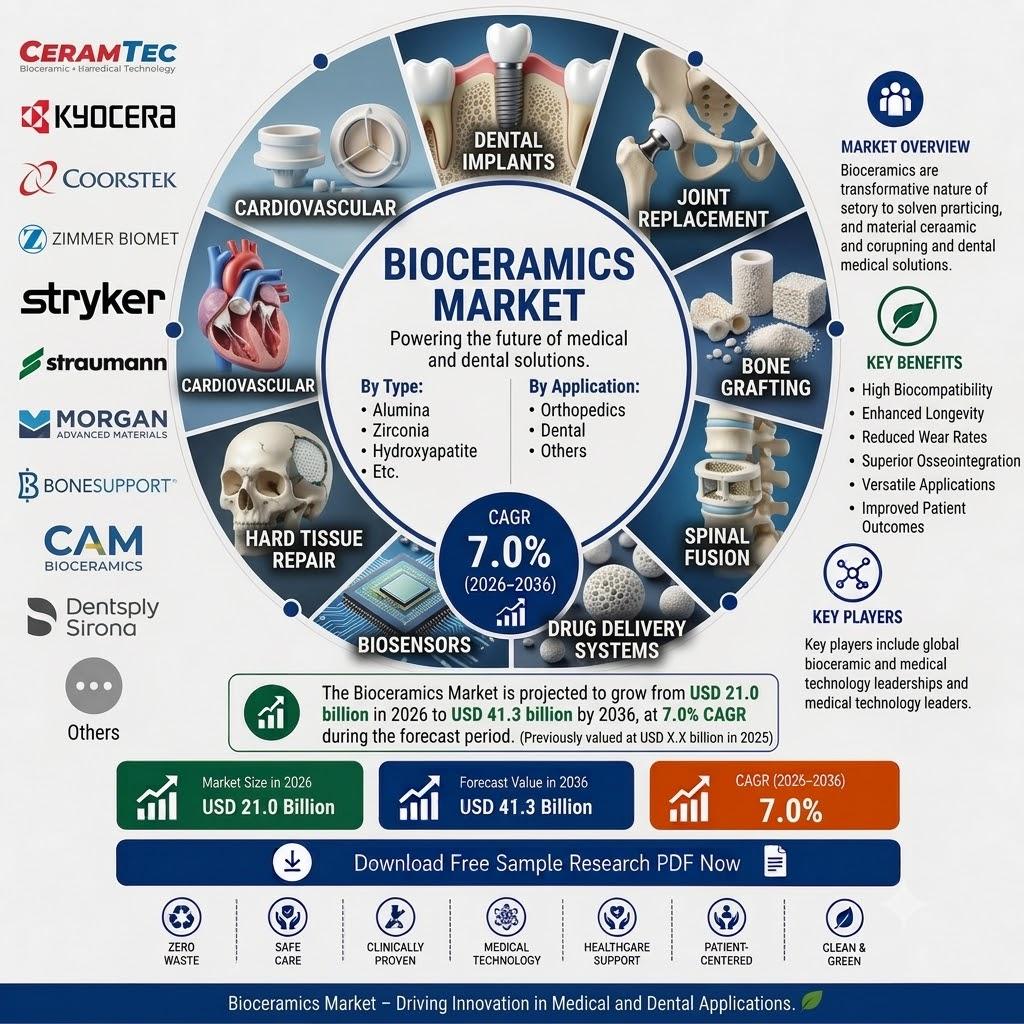
The global bioceramics market is projected to increase from USD 21.0 billion in 2026 to USD 41.3 billion by 2036, expanding at a compound annual growth rate (CAGR) of 7.0%, according to Fact.MR. The market was valued at USD 19.6 billion in 2025. Growth is supported by rising orthopedic and dental implant procedures, wider adoption of 3D-printed ceramic implants, and increasing use of bioceramic scaffolds in regenerative medicine.
Bioceramics are used in medical applications that require biocompatibility, chemical stability, wear resistance, and integration with bone tissue. Materials such as alumina, zirconia, hydroxyapatite, and calcium phosphate support applications ranging from joint reconstruction to dental restoration and bone repair. Their role in producing durable implant components is becoming increasingly relevant as healthcare providers address growing demand for long-term implant performance.
Get detailed market forecasts, competitive benchmarking, and pricing trends: https://www.factmr.com/connectus/sample?flag=S&rep_id=6393
Bioinert Bioceramics Lead Product Demand
Bioinert bioceramics are projected to account for 58.7% of the market in 2026, making them the leading product category. Alumina- and zirconia-based materials are widely used in orthopedic and dental applications because of their chemical stability and wear resistance. Their established role in load-bearing components supports continued demand.
By application, orthopedic uses are expected to represent 41.6% of the market in 2026. Hip and knee reconstruction procedures, fracture repair, and bone-regeneration requirements contribute to this segment's leading position. Dental applications are also important, particularly as zirconia gains adoption in metal-free crowns, bridges, and implant components.
Manufacturing developments are creating additional opportunities. Additive manufacturing enables patient-matched geometries and complex porous structures, while surface modification can improve material integration with surrounding bone. These technologies are expanding the potential use of bioceramics beyond conventional structural implants.
Regional Outlook: China and India Drive Growth
China is projected to record the fastest growth among the countries analyzed, with a CAGR of 9.4% through 2036. Expanding domestic ceramic production and rising orthopedic and dental device manufacturing are supporting market development.
India is expected to grow at a CAGR of 8.8%, driven by increasing implant procedures and investment in private healthcare facilities. Germany follows with a projected CAGR of 8.1%, supported by its medical-device manufacturing base and stringent material qualification requirements. Brazil is forecast to expand at 7.4%, while the United States is expected to register 6.7% growth. The United Kingdom and Japan are projected to record CAGRs of 6.0% and 5.3%, respectively.
Analyst Perspective
Shambhu Nath Jha, Principal Consultant at Fact.MR, states, “Bioceramics is increasingly a materials story driven by aging-population implant demand and the move to additive manufacturing. Bioinert grades still dominate, but patient-matched 3D-printed implants are where differentiation is emerging, and device makers reward suppliers who pair validated materials with regulatory documentation.”
The market also faces challenges, including high manufacturing costs, lengthy medical-device validation requirements, and the brittle nature of some ceramic materials compared with metals. Suppliers that improve processing efficiency while maintaining material quality and regulatory documentation can strengthen their position in this evolving market.
Competitive Landscape
The bioceramics market includes specialist advanced-material manufacturers and medical-device companies supplying orthopedic and dental implant systems. Key companies profiled by Fact.MR include CeramTec GmbH, KYOCERA Corporation, CoorsTek, Inc., Zimmer Biomet Holdings, Inc., Stryker Corporation, Straumann Holding AG, Morgan Advanced Materials, BONESUPPORT AB, CAM Bioceramics B.V., and Dentsply Sirona Inc.
Material suppliers compete through product breadth, precision manufacturing, and the ability to meet demanding implant specifications. Medical-device companies differentiate through clinical evidence, implant performance, and established relationships with hospitals and dental professionals. Additive manufacturing capabilities and digital dental ecosystems are emerging as important areas of competition.
Market Snapshot
- Market size (2025): USD 19.6 billion
- Estimated market size (2026): USD 21.0 billion
- Forecast market size (2036): USD 41.3 billion
- CAGR (2026–2036): 7.0%
- Leading product: Bioinert bioceramics (58.7% share in 2026)
- Leading application: Orthopedic applications (41.6% share in 2026)
- Fastest-growing country: China (9.4% CAGR)
- India growth outlook: 8.8% CAGR
- Key growth technologies: Additive manufacturing and surface modification
To View Related Reports
https://www.blogger.com/blog/post/preview/8852343521825395046/4842794053405646031
https://social.art-inpa.com/blogs/42962/Growth-Factor-Market-Growth-Trajectory-Points-to-USD-4-7
About Fact.MR
Fact.MR is a market research and competitive intelligence provider delivering market intelligence, competitive analysis, and forecasting across global industries. Its research helps businesses evaluate market demand, understand competitive developments, and identify growth opportunities.

 English
 Arabic
 French
 Spanish
 Portuguese
 Turkish
 Dutch
 Italiano
 Russian
 Romaian
 Portuguese (Brazil)
 Greek
