
Froth Flotation Equipment Market Expected to Reach USD 547.9 Million by 2036 as Mining Technology Advances
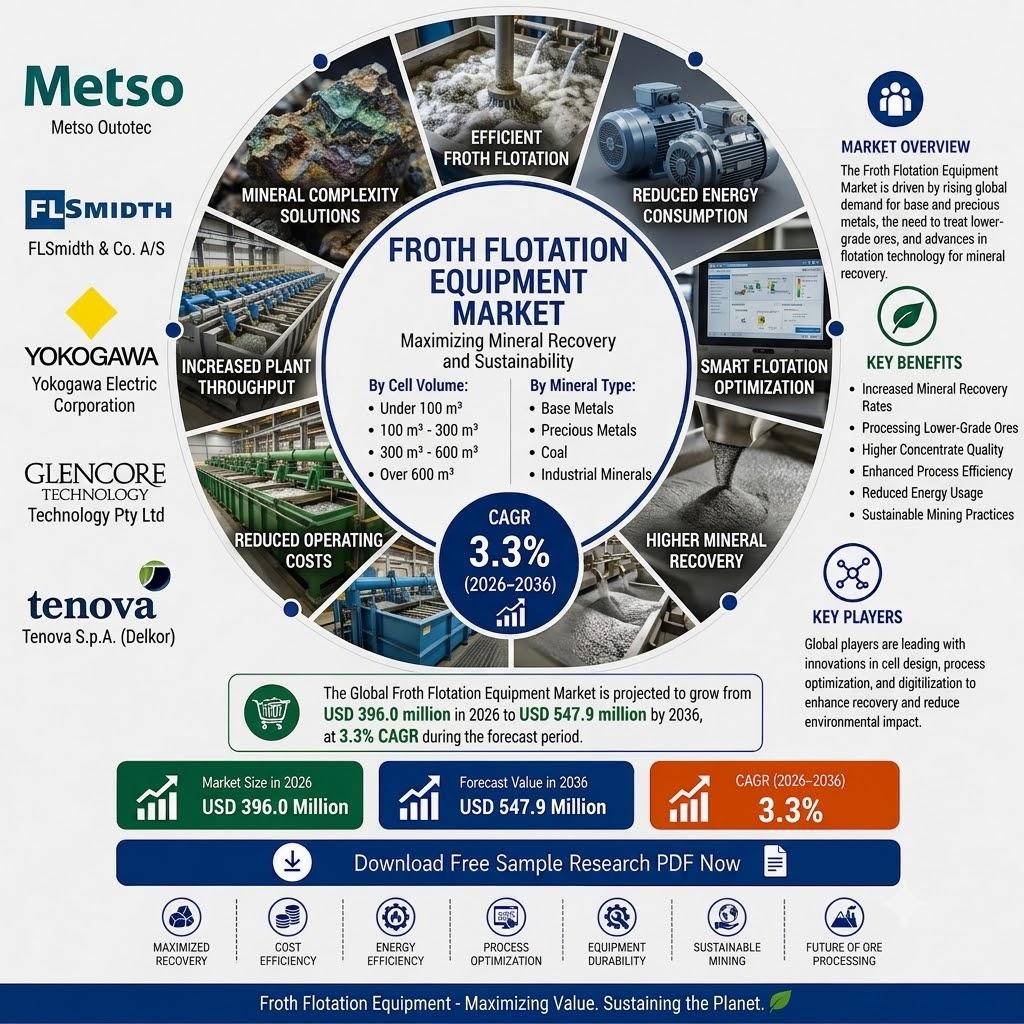
The global froth flotation equipment market is projected to increase from USD 396.0 million in 2026 to USD 547.9 million by 2036, registering a compound annual growth rate (CAGR) of 3.3%, according to Fact.MR. Expanding mineral processing capacity, modernization of mining facilities, and demand for improved mineral recovery are supporting investments in flotation equipment across established and emerging mining markets.
Froth flotation is widely used to separate valuable minerals from ore through differences in surface properties. Mining operators rely on flotation systems to recover minerals used in base metals and precious metals production. Equipment selection increasingly considers recovery efficiency, energy consumption, operating costs, and compatibility with automated plant operations.
Get detailed market forecasts, competitive benchmarking, and pricing trends: https://www.factmr.com/connectus/sample?flag=S&rep_id=12534
Free Flow Flotation Leads Machine Type Demand
Free flow flotation is projected to account for 56% of the machine type segment in 2026. Its established position across mineral processing operations and suitability for standard and high-volume requirements support continued demand. Mechanical free flow cells and column free flow cells serve more specialized processing needs, including applications requiring improved separation performance.
Mineral and ore processing is expected to represent 52% of the application segment in 2026. Demand is supported by mining operations seeking reliable equipment for mineral separation and concentrate recovery. Base metal and precious metal processing also contribute to procurement as mining companies upgrade existing facilities and develop new processing capacity.
Collectors Account for a Major Share of Reagent-Type Demand
Collectors are projected to hold 48% of the reagent type segment in 2026. These reagents help improve the selective attachment of target minerals to air bubbles during flotation, supporting the separation and recovery process.
Xanthates and dithiophosphates are among the collector types used in mineral processing. Frothers, modifiers, pH regulators, depressants, and activators also contribute to flotation performance by influencing bubble formation and mineral selectivity. The choice of reagent depends on ore characteristics, processing conditions, and recovery objectives.
India and China Support Regional Market Growth
India is projected to record the fastest growth in the froth flotation equipment market, with a CAGR of 5.1% through 2036. Government and private-sector investment in mineral processing capacity, infrastructure development, and domestic manufacturing are supporting equipment demand.
China follows with a projected CAGR of 4.8%, driven by its established mineral processing industry and investment in industrial modernization. Australia is expected to grow at 4.5%, supported by mining-sector demand and requirements for durable equipment suited to demanding operating environments. The United States and Germany are projected to register CAGRs of 3.7% and 3.4%, respectively.
Analyst Perspective
Shambhu Nath Jha, Principal Consultant at Fact.MR, stated, "The froth flotation equipment market is moving beyond volume-driven growth toward value-led expansion. Buyers are increasingly specifying products based on lifecycle cost, energy efficiency, and integration capability rather than upfront price alone. This shift is favoring suppliers with stronger technical portfolios and aftermarket service networks. Demand in India and China reflects structural capacity additions rather than one-time procurement cycles, which supports sustained growth through the forecast period."
Competitive Landscape
The global froth flotation equipment market includes established mining technology providers, industrial equipment manufacturers, and specialized flotation system suppliers. Key companies profiled by Fact.MR include Metso Outotec Corporation, FLSmidth & Co. A/S, Yokogawa Electric Corporation, Endress+Hauser Group, Foxboro (a Schneider Electric Systems company), Eriez Manufacturing Co., JXSC Mine Machinery Factory, Yantian Jingpeng Mining Technology Co., Ltd., GEA Group AG, and Sandvik AB.
Competition is shaped by equipment performance, technical expertise, lifecycle costs, and aftermarket service capabilities. Leading suppliers are strengthening their portfolios through higher-specification flotation systems, process monitoring, and automation integration. Service networks and access to replacement components are also important factors influencing purchasing decisions among mining operators.
Market Snapshot
- Market size (2026): USD 396.0 million
- Forecast value (2036): USD 547.9 million
- CAGR (2026–2036): 3.3%
- Leading machine type: Free flow flotation, with 56% share in 2026
- Leading application: Mineral and ore processing, with 52% share in 2026
- Leading reagent type: Collectors, with 48% share in 2026
- Fastest-growing country: India, at a CAGR of 5.1%
To View Related Reports
https://sportgalax.com/read-blog/26422
https://afgbfh.blogspot.com/2026/10/pool-and-spa-market-forecast-indicates.html
About Fact.MR
Fact.MR is a market research and competitive intelligence provider delivering market intelligence, competitive analysis, and forecasting across global industries. Its research helps businesses evaluate market demand, understand competitive developments, and identify growth opportunities.

 English
 Arabic
 French
 Spanish
 Portuguese
 Deutsch
 Turkish
 Dutch
 Italiano
 Russian
 Portuguese (Brazil)
 Greek
