
Solid Oxide Fuel Cell Market Analysis of Stationary Power Systems
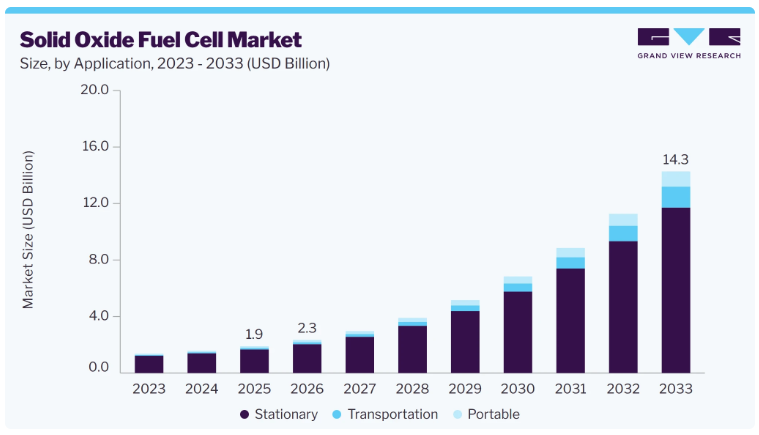
The Solid Oxide Fuel Cell Market is expanding as industries seek efficient, reliable, and lower-emission alternatives to conventional power generation. The Solid Oxide Fuel Cell Market was valued at USD 1.9 billion in 2025 and is projected to grow from USD 2.3 billion in 2026 to USD 14.3 billion by 2033, registering a CAGR of 29.4% from 2026 to 2033. Asia Pacific accounted for 42.0% of global revenue in 2025, supported by established fuel-cell programs, hydrogen investments, and growing demand for distributed energy systems.
Key Highlights of the Solid Oxide Fuel Cell Market
The stationary application segment dominated the Solid Oxide Fuel Cell Market with an 87.9% revenue share in 2025, while transportation is projected to record the fastest growth at a CAGR of 40.2% through 2033. Asia Pacific remained the leading regional market with a 42.0% share, whereas Latin America is expected to experience the fastest regional growth. Increasing interest in hydrogen-based energy, microgrids, combined heat and power systems, and reliable onsite electricity generation is creating new opportunities for SOFC technology. However, high installation costs, durability requirements, and fuel infrastructure limitations continue to influence commercialization.
Stationary Applications Remain the Market's Primary Growth Foundation
Stationary power generation represents the core of the Solid Oxide Fuel Cell Market because businesses increasingly require dependable electricity that can operate independently of conventional grid infrastructure. In 2025, this segment captured 87.9% of market revenue, reflecting demand from commercial buildings, industrial facilities, hospitals, data centers, and other energy-intensive operations.
The appeal of stationary SOFC systems lies in their ability to deliver electricity at high efficiency while supporting fuel flexibility. Depending on system design, they can use hydrogen, natural gas, biogas, and other suitable fuels. Their compatibility with combined heat and power (CHP) applications can also improve overall energy utilization by making use of the heat produced during electricity generation.
Demand is particularly relevant for facilities where power interruptions can disrupt operations. Data centers, manufacturing plants, and healthcare institutions are evaluating onsite generation to strengthen energy resilience and manage increasing electricity requirements. As grid capacity constraints and decarbonization objectives become more prominent, stationary systems are positioned to remain central to market expansion.
Want to Understand What’s Driving Market Growth? Ask Prism AI for research-backed insights into market size, evolving opportunities
Transportation Is Emerging as a High-Growth Application
Although transportation currently represents a smaller application than stationary power generation, it is projected to grow at a CAGR of 40.2% from 2026 to 2033. This growth outlook reflects interest in fuel-cell technologies that can support demanding mobility applications while reducing emissions.
Heavy-duty vehicles, marine systems, auxiliary power units, and hybrid-electric platforms are potential areas of opportunity. SOFC technology offers high electrical efficiency and the ability to operate on different fuels, making it relevant to applications where energy requirements and operating conditions differ from those of passenger vehicles.
Commercialization will depend on improvements in system durability, thermal management, start-up performance, and overall cost. The technology's high operating temperatures can create engineering challenges for mobile applications, particularly where rapid start-up and frequent operating cycles are important. Continued research and development will therefore be essential to translate transportation interest into broader commercial deployment.
Fuel Flexibility Connects SOFC Technology With the Hydrogen Economy
The transition toward lower-carbon energy systems is strengthening the relevance of solid oxide fuel cells. Their ability to work with different fuels provides flexibility as energy markets gradually develop hydrogen production, distribution, and storage infrastructure.
Government-backed research is helping advance this transition. In September 2024, the U.S. Department of Energy announced up to USD 4 million in funding for research and development of reversible solid oxide fuel cell systems. The targeted applications included hydrogen production, energy storage, microgrids, CHP, and distributed power generation. Such initiatives can support technical improvements and help address commercialization barriers.
Japan also provides an important example of sustained fuel-cell deployment. Its ENE-FARM residential fuel-cell program had surpassed 560,000 cumulative installations by the second quarter of fiscal year 2025, according to the supplied market information. Continued policy attention to hydrogen and energy efficiency reinforces the role of fuel-cell technology in distributed energy planning.
Download a free sample report or claim your copy of this full market intelligence report
High Costs and Durability Remain Important Commercial Barriers
Despite its growth potential, the Solid Oxide Fuel Cell Market faces challenges associated with capital expenditure, material performance, and system complexity. High operating temperatures place demanding requirements on cell materials and system components. Long-term performance depends on managing degradation and maintaining efficiency across extended operating periods.
Initial investment can also limit adoption among smaller businesses and projects with constrained budgets. Additional infrastructure may be required for fuel supply, thermal management, electrical integration, and maintenance. In markets where hydrogen remains expensive or difficult to obtain, the economics of particular SOFC configurations may be less attractive.
These challenges create opportunities for innovation in ceramic materials, manufacturing processes, system design, and monitoring technologies. Lower production costs and longer operating lifetimes could improve the business case for commercial and industrial installations.
Key Solid Oxide Fuel Cell Companies
The companies identified in the supplied market information include Bloom Energy, Mitsubishi Heavy Industries, Ltd., Ceres Power Holdings plc, and General Electric through GE Vernova. Their activities span solid oxide fuel-cell systems, advanced energy technologies, and power infrastructure relevant to the development and integration of fuel-cell-based generation.
Regional Expansion Reflects Different Energy Priorities
Asia Pacific led the Solid Oxide Fuel Cell Market in 2025 with a 42.0% revenue share. Japan's established residential fuel-cell deployment, South Korea's interest in fuel-cell technologies, and China's manufacturing capabilities contribute to the region's importance. Government initiatives, industrial energy demand, and investment in hydrogen infrastructure further support market development.
North America benefits from research funding, distributed power requirements, and growing demand for reliable electricity among commercial and industrial users. The U.S. is an important market as data centers, microgrids, and critical facilities explore onsite power solutions. Europe is also advancing fuel-cell adoption through decarbonization policies, hydrogen development, and energy diversification initiatives.
Latin America is projected to register the fastest regional CAGR of 35.9% from 2026 to 2033. Interest in energy diversification, renewable energy integration, and reliable electricity for remote or industrial locations may create opportunities as supporting infrastructure develops.
The Next Phase of Growth Will Depend on Commercial Readiness
The outlook for the Solid Oxide Fuel Cell Market will depend on whether technological progress can translate into economically competitive systems. Stationary installations are likely to remain the principal source of demand, while transportation offers a faster-growing opportunity. Hydrogen infrastructure, government-supported research, and demand for resilient electricity systems will continue to influence adoption.
Progress in durability, fuel flexibility, manufacturing scale, and operating costs will be critical. As these factors improve, SOFC technology could play a larger role in distributed power generation and the transition toward lower-emission energy systems.

 English
 Arabic
 French
 Spanish
 Portuguese
 Deutsch
 Turkish
 Dutch
 Russian
 Romaian
 Portuguese (Brazil)
 Greek
