
How can IVF Lab Design improve staff movement and material handling?
INTRODUCTION
Efficient IVF Lab Design plays a crucial role in improving staff movement, material handling, contamination control, and overall laboratory productivity. In vitro fertilization laboratories require carefully coordinated workflows because embryologists, technicians, and healthcare professionals routinely handle sensitive reproductive cells, culture media, laboratory instruments, and specialized equipment. Poorly planned layouts can create unnecessary movement, workflow interruptions, material handling delays, and contamination risks. A well-designed IVF laboratory integrates functional zoning, ergonomic workstations, dedicated storage areas, controlled access, and efficient transfer routes. These elements help laboratory personnel perform their responsibilities safely while supporting consistent laboratory conditions and reliable reproductive healthcare services.
Understanding Staff Movement and Material Handling in IVF Laboratories
An IVF laboratory contains several interconnected work areas, including embryology, andrology, cryopreservation, preparation, storage, and supporting utility spaces.
Each area has specific operational requirements.
Staff members may need to move between workstations to prepare culture media, handle gametes, operate incubators, perform micromanipulation procedures, and manage laboratory documentation.
Materials may include:
- Culture media and laboratory reagents
- Sterile consumables
- Oocyte collection supplies
- Sperm preparation materials
- Embryo culture dishes
- Cryopreservation containers
- Laboratory instruments
- Cleaning and disinfection supplies
- Waste collection materials
Effective laboratory planning aims to reduce unnecessary movement while ensuring that materials reach the appropriate workstations without compromising identification, quality, or environmental control.
1. Establish Functional Laboratory Zoning
Functional zoning is one of the most important principles of laboratory workflow planning.
Different activities should be organized into designated areas according to their operational requirements and contamination risks.
Common functional zones include:
- Embryology laboratory
- Andrology laboratory
- Oocyte handling area
- Micromanipulation workstation
- Embryo culture area
- Cryopreservation area
- Media preparation area
- Consumable storage
- Cleaning and utility spaces
The relationship between these zones should reflect the actual sequence of laboratory procedures.
For example, oocyte handling and embryo culture activities should be positioned to support safe, efficient transfers between relevant workstations.
Functional zoning also helps reduce unnecessary movement of personnel and materials through sensitive laboratory areas.
2. Create Logical Staff Movement Pathways
A well-planned laboratory layout should support predictable staff movement.
Embryologists frequently move between microscopes, incubators, micromanipulation equipment, and preparation stations.
If these workstations are positioned too far apart, staff may spend unnecessary time transporting samples or moving around equipment.
Effective IVF Lab Design can improve movement by providing:
- Direct access between related workstations
- Adequate circulation space
- Clear routes around equipment
- Conveniently positioned storage
- Minimal unnecessary room transitions
- Unobstructed emergency access
Movement pathways should be reviewed using actual laboratory procedures rather than relying only on architectural drawings.
Workflow simulations can help identify congestion points and improve workstation positioning before installation.
3. Minimize Unnecessary Handling of Gametes and Embryos
Oocytes, sperm, and embryos require carefully controlled handling conditions.
Unnecessary movement between workstations may increase the risk of temperature changes, identification errors, delays, or accidental disturbance.
Laboratory layouts should therefore support short, controlled transfer routes between relevant equipment.
Important considerations include:
- Positioning incubators near embryo handling workstations
- Providing suitable heated work surfaces where required
- Keeping essential supplies within easy reach
- Avoiding congested transfer routes
- Establishing clear sample identification procedures
- Using validated transport arrangements when necessary
The goal is not simply to reduce walking distance but to maintain appropriate handling conditions throughout each procedure.
Sample identification and witnessing protocols remain essential regardless of the physical layout.
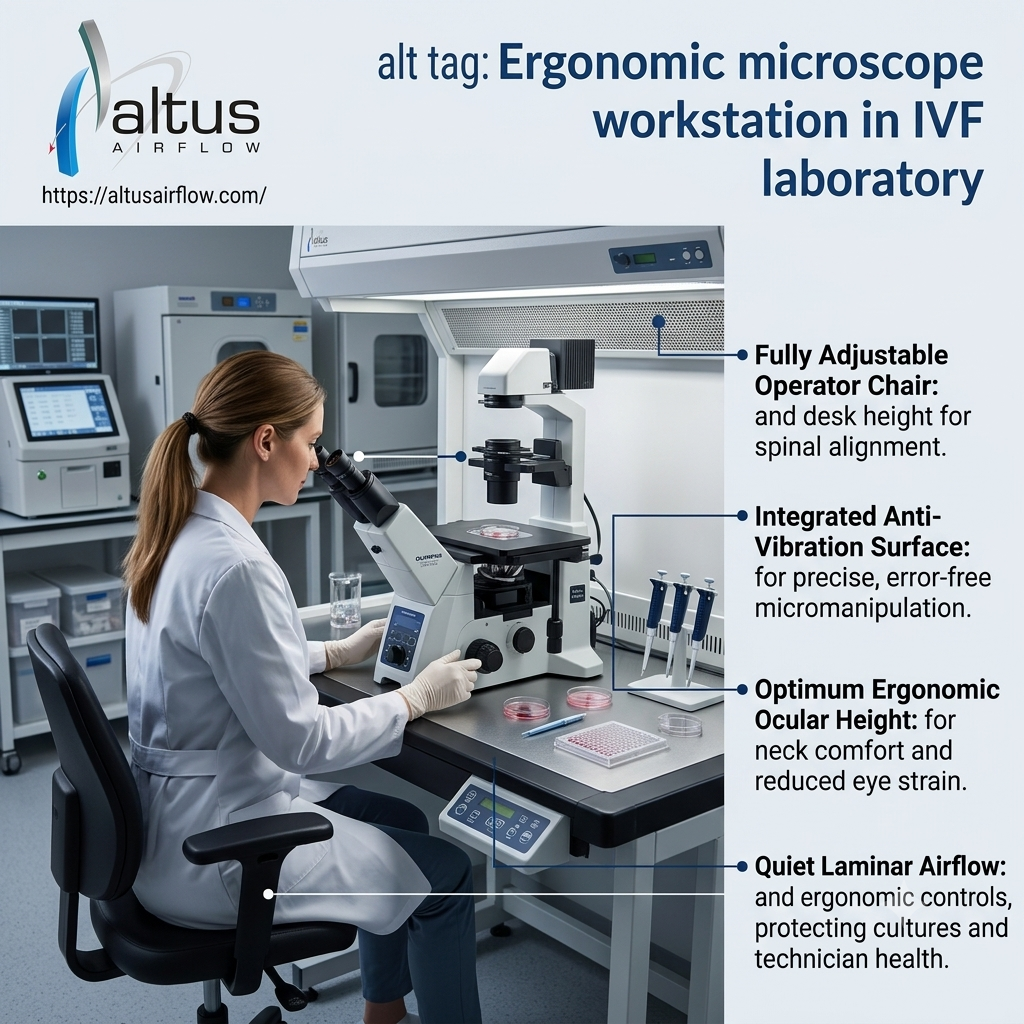
4. Design Ergonomic Workstations
Embryologists perform tasks that require sustained concentration, fine motor control, and precise visual observation.
Poor workstation ergonomics may contribute to fatigue, discomfort, and reduced efficiency.
An ergonomic laboratory design should consider:
- Adjustable seating
- Appropriate microscope height
- Comfortable arm support
- Suitable bench dimensions
- Adequate legroom
- Accessible equipment controls
- Convenient monitor positioning
- Proper task lighting
Micromanipulation stations should also account for vibration control and the physical arrangement of microscopes, manipulators, and associated equipment.
Ergonomic planning helps staff work comfortably while reducing unnecessary reaching, twisting, and repeated movement.
5. Improve Material Storage and Accessibility
Efficient material handling depends on proper storage organization.
Frequently used consumables should be accessible without requiring staff to leave critical work areas repeatedly.
Storage planning should distinguish between:
- Sterile consumables
- Non-sterile supplies
- Culture media
- Temperature-sensitive reagents
- Cleaning materials
- Cryogenic supplies
- Equipment accessories
- Waste materials
Storage conditions must follow manufacturer instructions and applicable laboratory quality requirements.
A well-organized system can use labelled shelves, designated cabinets, controlled-temperature storage, and inventory tracking.
Materials should be arranged to support stock rotation, expiry-date checks, and traceability.
6. Separate Clean and Used Material Pathways
Laboratory workflow planning should reduce unnecessary interaction between clean supplies and used or contaminated materials.
Clean consumables should be transferred through appropriate routes and handled according to laboratory procedures.
Used materials and waste should be collected and removed without unnecessarily passing through sensitive workstations.
Design considerations include:
- Designated clean supply storage
- Suitable waste collection points
- Controlled transfer procedures
- Separate handling of hazardous materials
- Accessible cleaning and utility areas
- Clear staff responsibilities
Complete physical separation of every route may not be practical in smaller laboratories.
Where separate pathways are not feasible, procedural controls, scheduled transfers, and appropriate containment can help manage risks.
7. Position Incubators Strategically
Incubators are essential equipment in embryology laboratories.
Their placement affects staff movement, sample handling, maintenance access, and operational efficiency.
Incubators should be located according to manufacturer requirements and laboratory workflow needs.
Important considerations include:
- Proximity to embryo handling stations
- Suitable electrical connections
- Appropriate environmental conditions
- Adequate ventilation clearance
- Access for servicing
- Stable support surfaces
- Convenient monitoring access
Incubator placement should also minimize unnecessary door openings and sample transfers.
The internal conditions of embryo incubators are distinct from general room conditions and must be maintained according to the validated culture system.
8. Improve Micromanipulation Workflow
Micromanipulation procedures, including intracytoplasmic sperm injection, require precise equipment positioning and controlled handling conditions.
The workstation may include an inverted microscope, micromanipulators, heated stage, microinjection equipment, and associated accessories.
An effective layout should provide:
- Stable work surfaces
- Suitable vibration control
- Adequate working clearance
- Convenient access to prepared materials
- Appropriate lighting
- Organized cable connections
- Nearby incubator access
Equipment positioning should support the embryologist's normal working posture and procedural sequence.
A properly arranged micromanipulation station helps reduce avoidable interruptions during delicate laboratory tasks.
9. Integrate Air Quality and Contamination Control
Air quality is an important consideration in IVF laboratories because laboratory processes may be sensitive to airborne particles and chemical contaminants.
The HVAC system should be designed according to the laboratory's risk assessment and environmental specifications.
Potential design measures include:
- Appropriate air filtration
- Suitable ventilation rates
- Control of relevant chemical contaminants
- Temperature and humidity management
- Defined pressure relationships
- Careful placement of air outlets
- Environmental monitoring
HEPA filtration can reduce airborne particles, but it does not remove most gaseous volatile organic compounds.
Where chemical contamination is a concern, suitable gas-phase filtration and source-control measures may be required.
Airflow should be coordinated with workstation placement so that personnel movement and equipment arrangements do not unnecessarily interfere with controlled laboratory activities.
10. Provide Dedicated Material Preparation Areas
Material preparation activities should be organized to reduce unnecessary handling within sensitive work zones.
Depending on the laboratory's size and procedures, dedicated preparation areas may be used for culture media, consumables, and other materials.
Planning should consider:
- Appropriate work surfaces
- Storage requirements
- Material identification
- Temperature-sensitive handling
- Cleaning procedures
- Equipment access
- Transfer routes
Preparation activities should follow validated laboratory protocols.
Dedicated preparation arrangements can improve organization and help reduce avoidable interruptions in active embryology areas.
11. Incorporate Controlled Access and Entry Procedures
Unnecessary movement into sensitive laboratory areas can disrupt workflows and introduce contamination risks.
Access control helps ensure that only authorized personnel enter designated spaces.
An IVF laboratory may incorporate:
- Controlled entry points
- Staff changing areas
- Hand hygiene facilities
- Appropriate gowning provisions
- Visitor restrictions
- Clearly identified laboratory zones
The level of access control should reflect the laboratory's risk assessment and operating procedures.
Entry arrangements should allow authorized personnel to move efficiently without compromising required hygiene and security measures.
12. Improve Cryopreservation Material Handling
Cryopreservation requires careful management of samples, storage equipment, identification systems, and safety procedures.
The cryopreservation area should be planned to support controlled movement of samples and safe access to storage vessels.
Important considerations include:
- Appropriate cryogenic storage locations
- Safe handling space
- Suitable ventilation
- Oxygen-deficiency monitoring where required
- Secure sample identification
- Access-controlled storage
- Emergency response procedures
- Appropriate personal protective equipment
Liquid nitrogen presents serious cold-burn and oxygen-displacement hazards.
Cryogenic storage systems must therefore be designed according to the quantity stored, room conditions, and applicable safety requirements.
Material movement procedures should preserve sample identity and traceability.
13. Use Digital Systems to Improve Workflow Coordination
Digital laboratory management systems can support staff coordination and material tracking.
Depending on the laboratory's operations, these systems may help manage:
- Sample identification
- Electronic witnessing
- Consumable inventory
- Equipment maintenance
- Incubator monitoring
- Procedure documentation
- Quality control records
- Staff task scheduling
Digital records can reduce reliance on fragmented paperwork and improve information accessibility.
However, digital systems require appropriate validation, access controls, cybersecurity measures, and backup arrangements.
Electronic tools should complement established laboratory identification and witnessing procedures rather than replace essential verification steps without validation.
14. Plan Efficient Waste Management
Waste handling should be incorporated into the laboratory layout from the beginning.
IVF laboratories may generate general waste, biological waste, sharps, packaging materials, and chemical waste.
Each category requires appropriate handling according to its hazards and applicable regulations.
Effective waste management planning includes:
- Clearly labelled waste containers
- Convenient collection points
- Appropriate segregation
- Safe sharps disposal
- Defined waste removal procedures
- Suitable temporary storage
- Staff training
In India, biomedical waste must be managed according to applicable biomedical waste management regulations.
Waste movement should be planned to avoid unnecessary contact with clean supplies and sensitive laboratory processes.
15. Allow Flexibility for Future Laboratory Expansion
IVF laboratories may introduce new incubators, imaging systems, micromanipulation technologies, or additional workstations as clinical demand changes.
A flexible layout can help accommodate these developments.
Future planning may include:
- Spare electrical capacity
- Accessible service connections
- Adaptable workstations
- Additional storage provisions
- Expandable monitoring systems
- Space for new equipment
- Maintenance access
- Updated workflow routes
Any future modifications should be evaluated for their effects on environmental conditions, sample handling, safety, and laboratory validation.
Planning for expansion can reduce disruption and improve long-term operational efficiency.
16. Validate Staff Movement and Material Handling Procedures
The effectiveness of laboratory design should be verified before routine operation.
Workflow validation may involve observing simulated procedures, reviewing transfer routes, and confirming that equipment locations support intended activities.
Useful evaluation methods include:
- Staff movement observations
- Workflow mapping
- Equipment accessibility checks
- Material transfer simulations
- Sample identification exercises
- Emergency access assessments
- Environmental performance testing
- Staff feedback
The laboratory should document identified problems and implement corrective actions before beginning or expanding clinical operations.
Periodic reviews can also identify opportunities for improvement as workloads and technologies change.
Conclusion
Effective IVF Lab Design improves staff movement and material handling by creating logical workflows, organized workstations, controlled transfer routes, appropriate storage, and reliable environmental conditions. Functional zoning helps reduce unnecessary movement, while ergonomic planning supports comfortable and efficient laboratory operations. Strategic equipment placement, contamination-control measures, digital tracking, and safe waste management further strengthen laboratory organization. Successful implementation requires collaboration between embryologists, laboratory managers, equipment suppliers, and engineering professionals. By integrating these requirements into a coordinated laboratory environment, fertility clinics can support efficient operations and consistent quality practices. Altus Airflow provides specialized laboratory engineering solutions focused on workflow planning, controlled environments, and functional infrastructure for modern fertility facilities.
Frequently Asked Questions (FAQs)
1. How does IVF Lab Design improve staff movement?
IVF Lab Design improves staff movement by organizing related workstations, reducing unnecessary walking distances, providing clear circulation routes, and positioning essential equipment according to laboratory workflows.
2. Why is functional zoning important in IVF Lab Design?
Functional zoning in IVF Lab Design helps organize embryology, andrology, cryopreservation, preparation, and storage activities while reducing unnecessary movement between sensitive work areas.
3. How can IVF Lab Design reduce material handling errors?
IVF Lab Design can help reduce material handling errors through organized storage, controlled transfer routes, clear identification points, and convenient access to laboratory supplies. Reliable witnessing and traceability procedures remain essential.
4. What role does workstation ergonomics play in IVF Lab Design?
Ergonomic IVF Lab Design supports comfortable seating, suitable microscope positioning, accessible controls, and efficient equipment arrangements that help reduce physical strain during precision laboratory work.
5. How does IVF Lab Design support contamination control?
IVF Lab Design supports contamination control through appropriate zoning, air quality management, controlled access, clean material handling procedures, and suitable cleaning and waste management arrangements.
Read Our Previous Blog------>What fire safety measures are required for Ophthalmic Modular Operation Theatre?

 English
 Arabic
 French
 Spanish
 Portuguese
 Turkish
 Dutch
 Italiano
 Russian
 Romaian
 Portuguese (Brazil)
 Greek
