
Can Simulation-Based Training Prepare Japan’s Workforce for Complex Industrial Jobs?
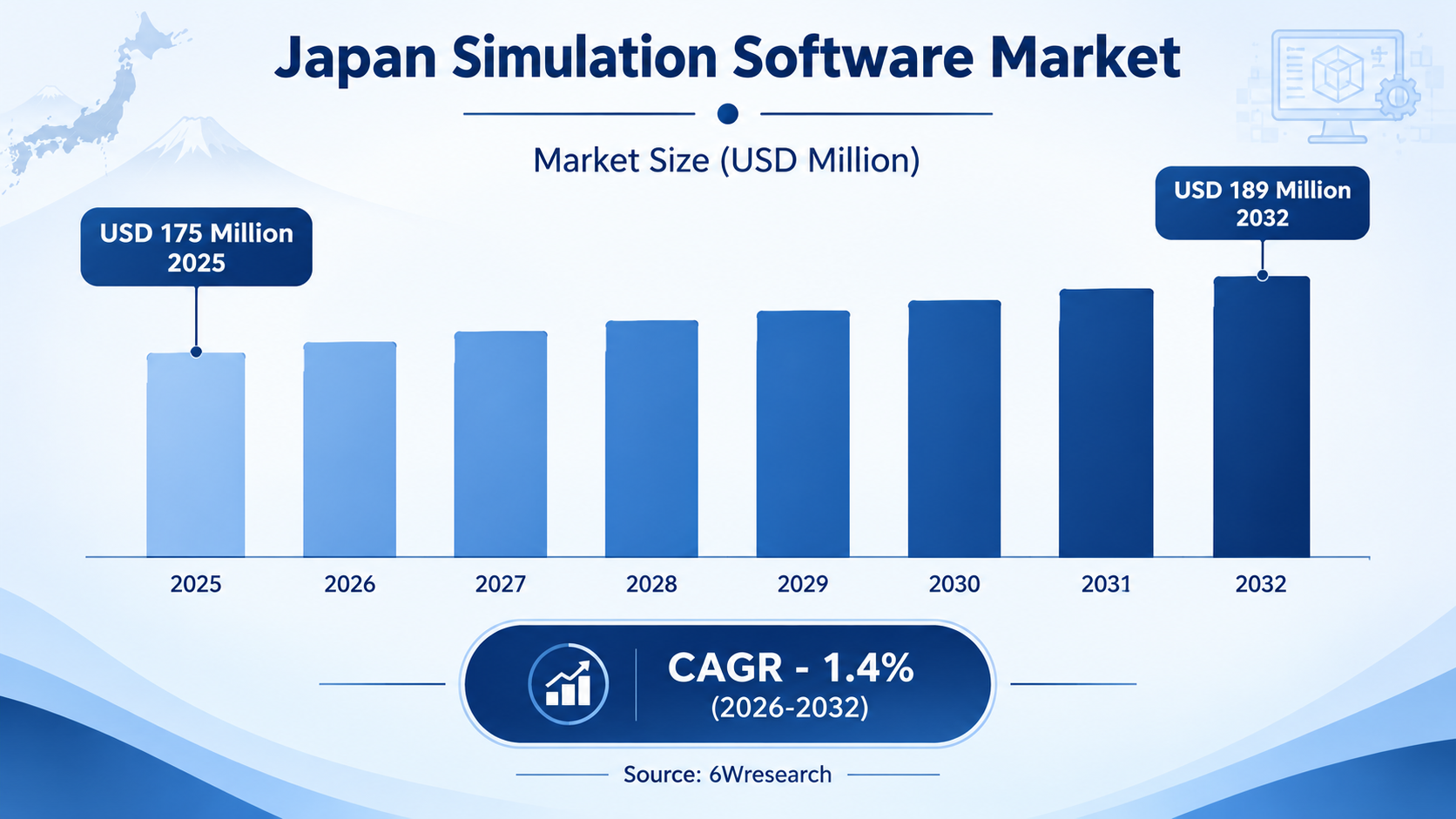
Japan's industrial sector depends on skilled professionals who can operate sophisticated machinery, follow safety procedures, and respond effectively to unexpected situations. However, traditional training can involve production interruptions, equipment costs, and potential safety risks when employees practice unfamiliar tasks. Simulation software offers an alternative by creating virtual environments where workers can develop practical skills and explore challenging scenarios. These needs create opportunities within the Japan Simulation Software Market, particularly in industrial training, professional development, and operational preparedness.
Why Is Virtual Training Gaining Attention?
Many industrial jobs require more than theoretical knowledge. Workers must understand equipment behavior, recognize hazards, and make appropriate decisions under changing conditions.
Simulation-based training allows employees to practice tasks in controlled environments without directly affecting production equipment. Depending on the application, these environments can represent manufacturing lines, machinery controls, industrial processes, or emergency situations.
Trainees can repeat exercises, receive feedback, and learn from mistakes before performing the same tasks in real workplaces. This can make simulation a useful complement to classroom instruction, demonstrations, and supervised practical training.
Major Applications Across Japanese Industries
Simulation-based learning can serve a broad range of professional requirements.
-
Manufacturing: Workers can practice operating machinery, adjusting production parameters, and responding to equipment abnormalities.
-
Automotive production: Training environments can demonstrate assembly procedures, quality checks, and maintenance activities.
-
Healthcare: Selected simulations can help medical professionals practice procedures and decision-making in controlled environments.
-
Construction: Workers can learn equipment operation, site coordination, and hazard recognition.
-
Aerospace: Specialized training systems can support procedural learning and the practice of complex operational scenarios.
-
Industrial safety: Employees can rehearse responses to emergencies without being exposed to the actual hazards.
Training requirements vary considerably by profession, so software must reflect the tasks employees are expected to perform.
Virtual Reality Makes Training More Immersive
Virtual reality can place trainees inside computer-generated environments that reproduce aspects of real workplaces. Users may interact with simulated equipment, follow procedures, and observe the consequences of their decisions.
Augmented reality offers a different approach by placing digital instructions or visual information over a view of the physical environment. Depending on the application, it can help workers understand equipment layouts or follow maintenance procedures.
Both technologies can enhance particular learning experiences, but they require suitable hardware, software integration, and content development. Not every training activity needs an immersive environment; conventional desktop simulations may be sufficient for many tasks.
How Simulation Can Support Workforce Productivity
Well-designed training programs can help organizations standardize instruction across teams and locations. Employees can practice the same procedures and be assessed against consistent performance criteria.
Simulation may also help companies evaluate training needs by recording task completion, errors, and responses to different scenarios. Trainers can use these observations to identify areas where additional instruction is needed.
For businesses operating expensive production equipment, virtual practice may reduce the need to reserve machinery solely for basic training. However, the actual operational benefits depend on the quality of the training design and how effectively virtual learning transfers to real tasks.
Overcoming Barriers to Adoption
Organizations considering simulation-based training must address several challenges.
-
Initial investment: Software, hardware, content development, and implementation services can be costly.
-
Training relevance: Virtual scenarios must reflect actual workplace procedures and equipment.
-
Employee acceptance: Some workers may need support adapting to unfamiliar digital learning methods.
-
Content maintenance: Simulations require updates when equipment, procedures, or safety standards change.
-
Performance measurement: Organizations need reliable ways to determine whether virtual training improves real-world competence.
Successful adoption requires cooperation among training managers, technical specialists, equipment manufacturers, and employees.
Opportunities for Simulation Software Providers
Providers can expand their reach by offering modular training solutions that address specific industrial tasks. Instead of requiring a large initial deployment, modular products allow companies to begin with high-priority training requirements and add further scenarios as needed.
Industry partnerships can help vendors develop realistic training content. Local-language interfaces, accessible technical support, and compatibility with existing learning-management systems may further improve adoption.
Providers should also demonstrate training effectiveness through appropriate assessments rather than relying solely on claims about immersion or realism.
What Is the Future of Simulation-Based Training in Japan?
The future of simulation-based training will depend on the need for specialized skills, industrial digitalization, training budgets, and the practical benefits organizations achieve. As workplaces adopt more sophisticated equipment, companies may increasingly explore virtual methods for teaching complex procedures and evaluating readiness.
The strongest opportunities are likely to come from solutions that address clearly defined training needs, deliver measurable learning outcomes, and integrate smoothly into existing workforce-development programs.
For Japan's simulation software providers, combining realistic scenarios with practical implementation support can help turn virtual training into a valuable industrial capability.
About 6Wresearch
About 6Wresearch: 6Wresearch is a commercial strategy and growth advisory firm founded in 2011 and headquartered in New Delhi, India, with partners across Southeast Asia and the Middle East & Africa. The firm has delivered over 20,000 commercial engagements for over 2,000 organizations, including Fortune 500 companies, government agencies, and multilateral institutions such as the World Bank and the Asian Development Bank. Backed by proprietary market research and advanced analytics, 6Wresearch combines sector expertise with data-driven intelligence to help organizations navigate market complexity and drive sustainable growth. These capabilities explain why organizations trust 6Wresearch Global Market Research & Consulting Firm for reliable commercial insights and confident decision-making.
Our Proprietary Platform: 6W Export GTM
6W Export GTM is 6Wresearch's proprietary trade intelligence and go-to-market platform, built on UN Comtrade data and enhanced with 6Wresearch's in-house analytical and simulation models, including system dynamics-based forecasting. Unlike broad, sector-level market sizing tools, 6W Export GTM operates at the individual product level down to specific HS codes and micro-segments to identify precise, actionable export opportunities by country and product pair, including markets where trade currently does not exist. This granular, simulation-driven approach allows 6W Export GTM to surface opportunities that sector-wide analysis typically misses, positioning it among a small number of platforms globally offering this depth of product-and-country-specific export intelligence.

 English
 French
 Spanish
 Portuguese
 Deutsch
 Turkish
 Dutch
 Italiano
 Russian
 Romaian
 Portuguese (Brazil)
 Greek
