
Global Heart Pump Devices Market Set for Rapid Expansion to USD 23.2 Billion by 2036
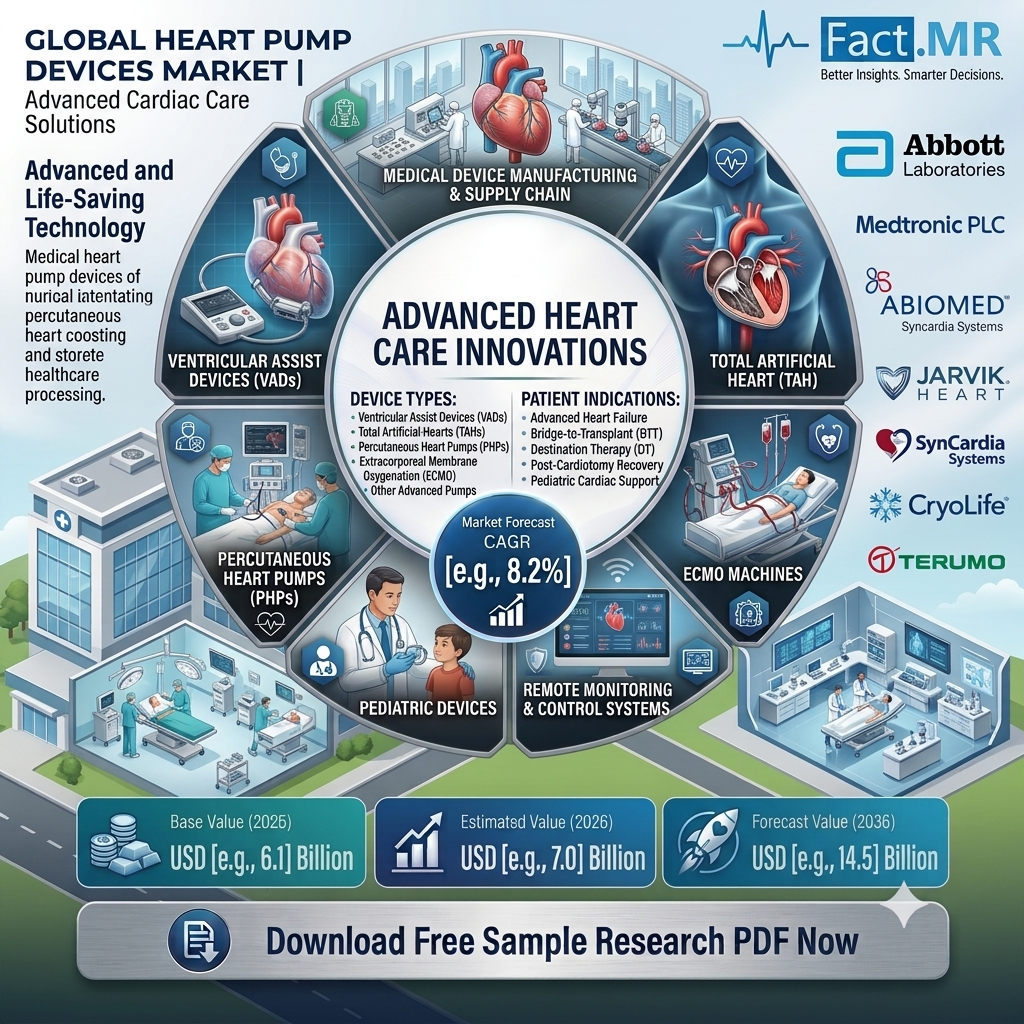
Demand for heart pump devices is expected to increase as the global market expands from USD 5.5 billion in 2026 to USD 23.2 billion by 2036, registering a 15.4% CAGR over the forecast period. Fact.MR attributes this expansion to the rising burden of advanced heart failure, aging populations, and increasing adoption of mechanical circulatory support systems. Improvements in device durability and wider access to destination therapy are also influencing treatment decisions across cardiovascular care.
Heart pump devices are increasingly used to support patients whose hearts cannot maintain adequate blood circulation. Ventricular assist devices, total artificial hearts, and extracorporeal support systems serve patients awaiting transplantation or requiring longer-term treatment. Advances in continuous-flow technology and magnetic levitation have improved clinical outcomes, encouraging cardiac specialists to consider mechanical support for a broader range of patients. Organ donor shortages are adding further pressure on healthcare systems to expand access to these technologies.
Get detailed market forecasts, competitive benchmarking, and pricing trends:
https://www.factmr.com/connectus/sample?flag=S&rep_id=14331
Implanted Heart Pump Devices Retain Dominant Position
By type, implanted heart pump devices are expected to account for 69.3% of the market in 2026. Their leading position reflects increasing demand for durable mechanical circulatory support that allows patients to receive treatment outside intensive care settings. These systems can support longer-term management of advanced heart failure, helping eligible patients return to everyday activities following implantation and recovery.
Left ventricular assist devices represent another major segment, projected to capture 70.1% of the market by product in 2026. Their dominance is associated with the high prevalence of left ventricular dysfunction among advanced heart failure patients. Continuous-flow LVADs have gained clinical acceptance because of improvements in durability and survival outcomes. Fact.MR reports that five-year survival among HeartMate 3 patients reached 59.1% in the MOMENTUM 3 destination therapy cohort.
Hospitals are projected to account for 84.2% of market demand in 2026. Implantation procedures require specialized surgical infrastructure, trained cardiovascular teams, and postoperative monitoring capabilities. Although dedicated cardiac centers are expanding their role, hospitals remain central to device implantation and complex patient management.
China, United States, and United Kingdom Show Strong Growth Potential
China is expected to record a 21.7% CAGR from 2026 to 2036, representing the highest growth rate in the report's country-CAGR table. Expansion of specialized cardiac treatment facilities and broader reimbursement coverage are supporting device adoption. National reimbursement initiatives introduced in 2024 have improved access to destination therapy in major provinces. Domestic manufacturers are also developing ventricular assist devices that could reduce dependence on imported systems.
The United States is projected to advance at a 20.4% CAGR during the same period. Its established cardiovascular treatment infrastructure, regulatory framework, and growing destination therapy programs support market development. Medicare coverage changes have expanded treatment opportunities for selected advanced heart failure patients. The report also highlights Abbott's USD 150 million investment in California production capacity during 2024 to address demand for mechanical circulatory support technologies.
The United Kingdom is forecast to grow at a 20.0% CAGR through 2036. Centralized cardiovascular treatment programs and evolving reimbursement policies are supporting adoption. According to Fact.MR, NHS England concentrated ventricular assist device implantation into 12 designated centers in 2024. Clinical research programs and greater recognition of destination therapy are contributing to wider use of mechanical circulatory support.
Japan and South Korea also represent important Asia-Pacific markets. Aging populations, reimbursement developments, and investment in specialized cardiac treatment infrastructure are creating additional opportunities for advanced heart pump technologies.
Competitive Landscape
Competition in the heart pump devices market includes established cardiovascular technology manufacturers and emerging developers of mechanical circulatory support systems. Key companies profiled by Fact.MR include Abbott Laboratories, ABIOMED, Inc. (Johnson & Johnson), CorWave SA, LivaNova PLC, Berlin Heart GmbH, SynCardia Systems LLC, Jarvik Heart, Inc., BiVACOR Inc., and Medtronic plc.
Abbott maintains a prominent position in durable left ventricular assist devices through its HeartMate 3 platform. Other manufacturers are pursuing opportunities involving device miniaturization, improved blood-flow management, and artificial heart technologies.
Purchasing decisions are strongly influenced by clinical outcomes, device reliability, regulatory approvals, and institutional experience. Hospitals also evaluate long-term patient management requirements, surgical training, maintenance support, and reimbursement arrangements when selecting mechanical circulatory support systems.
Technology and Regulatory Developments Shape the Market
The heart pump devices market is experiencing changes in clinical technology and treatment eligibility. Fully magnetically levitated pumps are gaining attention because they can reduce mechanical wear and support improved long-term performance. Research into smaller devices is also intended to expand treatment access for patients previously excluded because of anatomical limitations.
Regulatory developments are influencing adoption. Fact.MR highlights the October 2022 revision of Medicare National Coverage Determination 20.9.1, which expanded destination therapy coverage to eligible INTERMACS Profile 3 patients. Such changes are encouraging treatment programs to evaluate mechanical support beyond traditional transplant waiting lists.
Clinical evidence remains important. The MOMENTUM 3 trial demonstrated improvements in outcomes with magnetically levitated cardiac pumps compared with earlier technologies. Continued evaluation of survival, device complications, and patient quality of life is expected to influence future approvals and hospital procurement strategies.
As cardiovascular treatment programs expand and device technologies advance, mechanical circulatory support is expected to become increasingly important in managing advanced heart failure. Fact.MR's report provides detailed market forecasts, segment analysis, country-level growth assessments, and competitive intelligence through 2036.
Top Reports:
https://adamaamresearch.blogspot.com/2026/10/machine-safety-market-to-achieve-usd.html
https://net-pals.com/blogs/55639/Global-Machine-Safety-Industry-to-Reach-USD-11-9-Billion
https://acmingle.com/blogs/31183/Global-Machine-Safety-Market-Outlook-USD-11-9-Billion-by
https://ikofficial.com/blogs/59867/Global-Machine-Safety-Market-Set-to-Hit-USD-11-9
About Fact.MR
Fact.MR is a market research and consulting company providing market intelligence, competitive analysis, and forecasting across global industries. Its research supports businesses with data-driven insights into emerging markets, technology trends, competitive dynamics, regional opportunities, and changing demand patterns.

 English
 Arabic
 French
 Portuguese
 Deutsch
 Turkish
 Dutch
 Italiano
 Russian
 Romaian
 Portuguese (Brazil)
 Greek
