
Metal Chelates Market Value to Reach USD 1,139.8 Million by 2036, with Four Key Markets Expanding
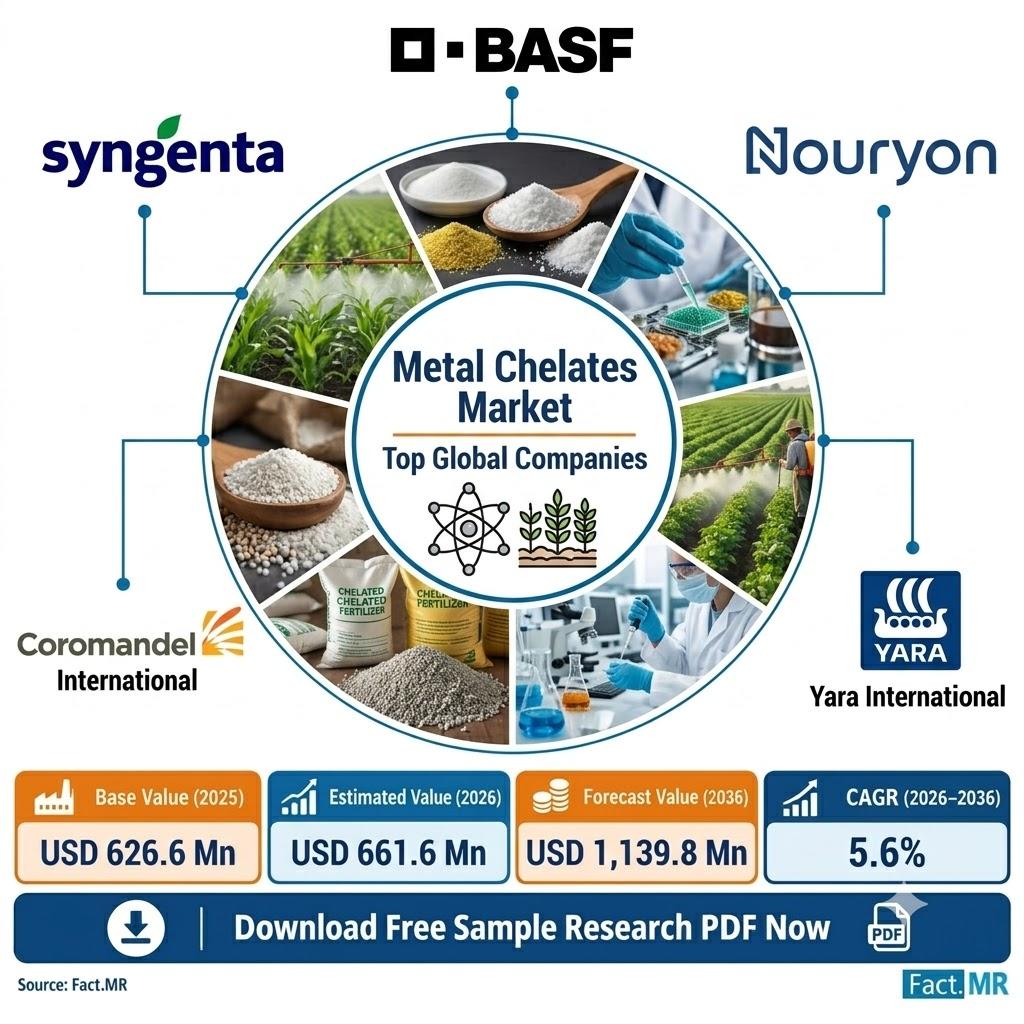
The global metal chelates market is projected to increase from USD 661.6 million in 2026 to USD 1,139.8 million by 2036, expanding at a compound annual growth rate (CAGR) of 5.6%, according to Fact.MR analysis. The market was valued at USD 626.6 million in 2025. The forecast represents an incremental opportunity of USD 478.2 million between 2026 and 2036.
Demand is linked to the need for more targeted mineral nutrition in agricultural production. Metal chelates are used in crop nutrient formulations where the availability of a specific mineral can influence nutrient management decisions. Adoption depends on crop requirements, soil conditions, application methods and the economic case for additional treatment.
Get detailed market forecasts, competitive benchmarking, and pricing trends:https://www.factmr.com/connectus/sample?flag=S&rep_id=16695
Agricultural nutrient management creates a demand opportunity
Farmers and crop advisers face competing requirements: maintaining crop nutrition while managing fertilizer expenditure and environmental pressures. Soil testing, crop-specific recommendations and appropriate nutrient placement can help determine where chelated formulations fit within existing fertilizer programs.
Official agricultural statistics provide context for these decisions. On June 26, 2026, Eurostat reported that European Union farms used 9.8 million tonnes of nitrogen and phosphorus mineral fertilizers in 2024. In Brazil, the Companhia Nacional de Abastecimento (Conab) projected grain production of 361.7 million tonnes for the 2025/26 season in a release dated September 15, 2026.
These figures describe the broader agricultural environment rather than direct demand for metal chelates. For suppliers, the commercial opportunity depends on demonstrating where a particular formulation addresses a documented nutrient requirement and how its cost compares with the expected benefit.
Where growth is fastest
Fact.MR identifies Germany and Brazil as the fastest-growing national markets among the countries listed in its forecast, followed by the United States, the United Kingdom and Japan.
- Germany – 7.0% CAGR: Large cereal production and structured nutrient planning support opportunities for targeted mineral treatments. Germany recorded a grain harvest of 45 million tonnes in 2025, according to the supplied Destatis reference.
- Brazil – 6.4% CAGR: Large-scale grain production and successive crop seasons create demand for timely nutrient planning. Conab projected 361.7 million tonnes of grain output for the 2025/26 season.
- United States – 5.8% CAGR: Extensive field-crop production creates opportunities for nutrient management tailored to crop and soil conditions. USDA's National Agricultural Statistics Service estimated that 95.3 million acres of corn were planted in 2026.
- United Kingdom – 5.2% CAGR: Arable crop nutrition and seasonal application schedules influence the potential adoption of chelated nutrient products. The supplied Defra reference reports on UK cereal and oilseed production in 2025.
- Japan – 4.6% CAGR: Rice cultivation and field-specific nutrient management provide a distinct route to adoption, with application timing and local growing conditions shaping product selection.
The country growth rates are Fact.MR forecasts for 2026–2036. The agricultural statistics provide background on the markets; they should not be interpreted as direct measurements of metal chelate consumption.
What leads the market
Cereals and grains, secondary nutrients and soil application are the leading segments in Fact.MR's 2026 estimates.
- By crop type – Cereals & Grains: 44.6% share. The segment's leading position reflects the importance of nutrient management across extensive field-crop acreage and recurring growing seasons.
- By product type – Secondary Nutrients: 40.7% share. This is the leading product category within the report's defined segmentation. The share applies to the classification used in the analysis.
- By application method – Soil Application: 41.7% share. Soil application leads because it can be incorporated into planned nutrient management before or during crop growth.
The remaining shares are distributed across other categories in each segment. These percentages represent separate classifications of the market and should not be added together.
Application decisions still depend on the specific nutrient requirement. Foliar spraying targets plant tissue more directly, while fertigation delivers dissolved nutrients through irrigation systems. Each method has its own crop-stage, equipment and compatibility considerations.
The hurdle: Treatment costs and uncertain field response
The cost per treated hectare is a key restraint on market adoption, according to Fact.MR. Farmers must weigh the expense of a chelated formulation against the likelihood of correcting a confirmed nutrient deficiency and achieving a commercially meaningful crop response.
Uncertain results without soil testing create another barrier. Symptoms associated with nutrient deficiencies can overlap with those caused by water stress or poor root health. Applying a product without establishing the underlying problem can increase input costs without delivering the intended result.
Tank-mix compatibility and uneven access to distributor agronomy support also affect purchasing decisions. Clear nutrient concentration labels, practical mixing instructions and field evidence relevant to local crop conditions can help manufacturers and distributors address these concerns.
Industry investment and competitive positioning
Fact.MR profiles five companies across the metal chelates and agricultural input value chain:
- BASF
- Nouryon
- Syngenta
- Yara International
- Coromandel International
These companies participate in different parts of the broader chemical, chelating-agent, crop nutrition and agricultural input markets. Their inclusion in the report does not mean that all five compete directly across identical product categories. Buyers should compare the specific chelated ingredient, nutrient concentration, formulation and intended crop use when assessing suppliers.
The supplied report material does not identify specific dated product launches, acquisitions or partnerships by these companies. The following dated agricultural developments provide context for the market rather than evidence of company investment:
- June 26, 2026 – European Union: Eurostat reported mineral fertilizer use of 9.8 million tonnes of nitrogen and phosphorus fertilizers in 2024.
- September 15, 2026 – Brazil: Conab projected grain production of 361.7 million tonnes for the 2025/26 season.
- October 8, 2026 – United Kingdom: The Department for Environment, Food & Rural Affairs published its reference on cereal and oilseed production in the United Kingdom in 2025, as listed in the supplied bibliography.
These developments establish agricultural production and nutrient-management context. They do not independently establish an increase in demand for metal chelates.
Analyst opinion
Shambhu Nath Jha, Principal Consultant at Fact.MR, states, “Chelated formulations are likely to attract interest where soil types limit the availability of a needed mineral. Growers still need crop-specific advice and a practical use plan before choosing an extra treatment.”
The analysis highlights a distinction between market growth and product-level adoption. Manufacturers may benefit from interest in targeted nutrient correction, but commercial uptake depends on demonstrating a clear use case and helping buyers make informed application decisions.
What this means for agricultural input buyers
- Match the formulation to a confirmed crop requirement.
Farm operators and agronomists should use soil or leaf test results, where appropriate, to identify the nutrient deficiency before selecting a chelated treatment. Product choice should reflect the crop, soil conditions and intended application method.
- Evaluate cost at the field level.
Procurement teams and growers should compare the cost per treated hectare with the expected agronomic benefit under local conditions. Field trials and crop-specific evidence can help distinguish products with a relevant use case from those that add cost without a demonstrated advantage.
- Make technical support part of supplier evaluation.
Distributors and manufacturers should provide clear nutrient concentration information, mixing guidance and application recommendations. Buyers using foliar sprays or fertigation should also verify compatibility with their planned application systems and other inputs.
For suppliers, these requirements create opportunities to differentiate products through formulation suitability, documented field performance and practical agronomic support rather than price or nutrient claims alone.
Report coverage
The Fact.MR Metal Chelates Market report examines market size and forecasts from 2026 to 2036, including crop type, product type, application method, regional coverage, country-level growth and key companies.
Top Trending Reports:
Air Ambulance Services Market https://www.openpr.com/news/4529849/air-ambulance-services-market-to-reach-usd-84-9-billion-by-2036-as
Industrial Air Table Market https://www.openpr.com/news/4531075/industrial-air-table-market-to-reach-usd-328-5-million-by-2036
Acoustic Mixer Market https://www.openpr.com/news/4531083/acoustic-mixer-market-to-reach-usd-323-8-million-by-2036-as-ev
Densimetric Table Market https://www.openpr.com/news/4531117/densimetric-table-market-to-reach-usd-2-86-billion-by-2036-as
About Fact.MR
Fact.MR is a market research and consulting firm that provides market intelligence, industry analysis and forecasts to support business and strategic decisions across multiple sectors.

 English
 Arabic
 French
 Spanish
 Portuguese
 Deutsch
 Turkish
 Dutch
 Italiano
 Romaian
 Portuguese (Brazil)
 Greek
