
Extended Detection and Response Market Growth Across Security Operations
A single cyberattack can leave traces across an employee's device, a cloud application, an email account, and an organization's internal network. When security teams investigate each signal through separate tools, connecting the evidence can take valuable time. Extended detection and response (XDR) addresses this problem by bringing security information from multiple environments into a more unified detection and response process.
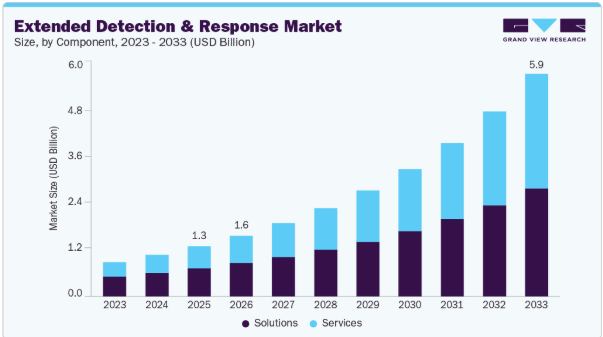
The global Extended Detection And Response Market was valued at USD 1.3 billion in 2025. It is forecast to rise from USD 1.6 billion in 2026 to USD 6.0 billion by 2033, expanding at a CAGR of 20.5% during the forecast period. This outlook reflects the growing importance of coordinated cybersecurity as businesses manage increasingly connected digital infrastructures.
The Security Problem XDR Is Designed to Solve
Consider a hypothetical attack in which a malicious email leads to stolen employee credentials, followed by unauthorized access to cloud resources. An endpoint security tool might flag suspicious activity on the device, while a separate network monitoring system identifies unusual traffic. Without effective coordination, analysts may have to investigate these alerts independently before recognizing that they are connected.
XDR is designed to correlate signals across security layers, helping teams identify attack patterns and prioritize incidents according to their potential impact. Machine learning, behavioral analytics, telemetry analysis, and automation can support threat investigation and response.
The technology is particularly relevant as organizations expand their use of cloud computing, connected devices, remote access, and hybrid IT environments. Each additional connection can create new security considerations, while a growing number of alerts can overwhelm teams working with fragmented systems.
Five Market Signals Worth Watching
Rather than viewing market growth as a single trend, the available figures reveal five distinct aspects of demand.
- Solutions remain the largest component. The solutions segment accounted for 55.6% of revenue in 2025. Organizations need integrated capabilities that bring together information from endpoints, networks, servers, email systems, and cloud environments.
- On-premise deployment continues to matter. On-premise solutions represented 52.1% of market revenue in 2025. Organizations managing sensitive information or operating under strict infrastructure requirements may prefer greater control over deployment, data access, and system upgrades.
- Large enterprises lead adoption. Large enterprises accounted for the largest application share in 2025. Their extensive IT environments, numerous users, and large volumes of sensitive information can make fragmented security operations difficult to manage.
- Services offer another growth avenue. The services segment is expected to record the fastest CAGR among component categories from 2026 to 2033. Implementation, training, managed monitoring, and incident response support are increasingly important as organizations seek to deploy and operate complex security systems.
- Smaller businesses represent emerging demand. Small and medium-sized enterprises are expected to grow at the fastest rate among application segments. Their expanding use of mobile applications, web platforms, and digital business processes creates a need for more coordinated protection, including solutions that reduce the burden on limited security teams.
Download a free sample report or claim your copy of this full market intelligence report
Why Deployment Preferences Are Changing
The balance between on-premise and cloud-based XDR reflects two different operational priorities.
Organizations choosing on-premise deployment may value infrastructure control, physical access management, and the ability to manage upgrades within their own environments. This approach can be particularly relevant where sensitive data, internal policies, or operational requirements influence security architecture.
Cloud-based XDR, meanwhile, offers flexibility and can support organizations operating across multiple cloud environments. Cloud-native capabilities can help businesses coordinate security monitoring without relying entirely on locally installed infrastructure. The cloud-based segment is expected to grow at the fastest rate among deployment categories during the forecast period.
Neither model automatically guarantees better protection. The appropriate deployment depends on an organization's existing systems, data governance requirements, integration needs, and available expertise. As businesses modernize their infrastructure, the ability to connect security information across different environments will remain an important consideration.
The Forces Accelerating Adoption
Three connected pressures are shaping demand for XDR.
The first is the sophistication of cyberattacks. Ransomware, advanced persistent threats, credential theft, and multi-vector attacks can involve several systems and stages. Security teams need ways to connect these activities rather than assess every alert in isolation.
The second is the growing complexity of enterprise technology. Hybrid workplaces, cloud services, connected applications, and distributed networks create a broader environment to monitor. Unified detection can help security analysts investigate activity across these different layers.
The third is the operational pressure on security teams. Excessive alerts, disconnected tools, and limited investigative context can delay decisions. XDR platforms aim to reduce this fragmentation by correlating security signals, prioritizing potential threats, and supporting faster incident handling.
Regulatory expectations also contribute to adoption. Organizations in sectors such as banking, healthcare, government, and critical infrastructure face substantial responsibilities for protecting sensitive information and maintaining operational resilience.
What Could Slow the Market?
Strong growth prospects do not eliminate implementation challenges. Integrating XDR into an existing security environment can require technical expertise, changes to established workflows, and coordination across multiple systems. Organizations may also face substantial implementation and operating costs.
Compatibility is another consideration. A platform's effectiveness depends partly on its ability to collect useful information from the organization's existing security tools and infrastructure. Poor integration can limit visibility and weaken the benefits of consolidation.
Companies must also determine how much automation to enable and which decisions require human review. Automated responses can help contain threats quickly, but response policies need to account for business context and the consequences of disrupting legitimate activity.
These challenges create an opportunity for services that assist with implementation, monitoring, staff training, and ongoing threat investigation. However, buyers will need to assess whether a proposed platform addresses their actual security gaps rather than simply adding another layer of complexity.
Regional Demand: Where the Momentum Lies
North America held 47.5% of global revenue in 2025, making it the largest regional market. The region's cybersecurity ecosystem, enterprise cloud adoption, regulatory pressures, and exposure to sophisticated threats support demand for integrated security platforms.
Asia Pacific is expected to record the fastest regional growth from 2026 to 2033. Rapid digital transformation, expanding cloud use, and increasing cybersecurity requirements are creating opportunities across industries. India is projected to experience particularly fast growth within the Asia Pacific market, while China accounted for a dominant share of the regional market in 2025.
Europe is also advancing as organizations respond to cybersecurity requirements and seek stronger coordination across endpoint, network, and cloud security. Regulations such as the General Data Protection Regulation and the Network and Information Security Directive 2 reinforce the importance of effective risk management and incident preparedness.
Across these regions, adoption will depend on the maturity of security infrastructure, regulatory requirements, organizational budgets, and the availability of qualified cybersecurity professionals.
The Outlook Through 2033
The extended detection and response market is projected to approach USD 6.0 billion by 2033, reflecting a shift toward more integrated cybersecurity operations. Solutions that connect security telemetry, improve threat visibility, and support timely response are likely to remain central to this development.
Future adoption will depend on practical results: better detection, clearer incident prioritization, manageable implementation, and effective integration with existing systems. As organizations continue to expand their digital environments, XDR is positioned to play a growing role in helping security teams understand threats as connected events rather than isolated alerts.
Explore Our Research & Intelligence Solutions
Prism AI: Ask. Analyze. Get Cited Market Insights. – Explore Now
Grand View Signal: Understand the Factors Shaping Commodity Prices – Explore the Platform

 English
 Arabic
 French
 Spanish
 Portuguese
 Turkish
 Dutch
 Italiano
 Russian
 Romaian
 Portuguese (Brazil)
 Greek
