
Wetting and Dispersing Agents Market Forecast at USD 5.8 Billion by 2036 as USA Leads Regional Expansion
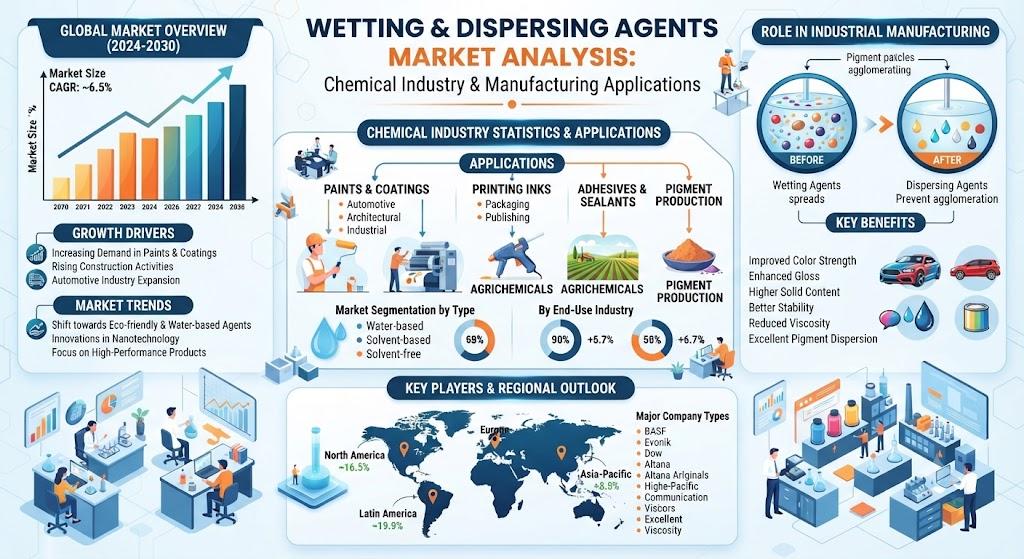
The global wetting and dispersing agents market is projected to increase from USD 3.2 billion in 2026 to USD 5.8 billion by 2036, expanding at a compound annual growth rate (CAGR) of 6.2%, according to the supplied Fact.MR market analysis. The market was valued at USD 3.0 billion in 2025, with an additional USD 2.6 billion in market opportunity expected between 2026 and 2036.
Demand is being shaped by changes in coating formulations, printing ink requirements and industrial pigment processing. Manufacturers need additives that improve pigment wetting, control mill-base viscosity and maintain color strength during storage and application. Waterborne and lower-solvent formulations are increasing the importance of compatibility between dispersants, pigments and binder systems.
Get detailed market forecasts, competitive benchmarking, and pricing trends: https://www.factmr.com/connectus/sample?flag=S&rep_id=10837
Regulatory and formulation changes shape demand
Environmental criteria and manufacturing requirements are influencing additive selection across coatings and paints. The U.S. Environmental Protection Agency maintains national volatile organic compound emission standards for architectural coatings. In 2026, the European Commission updated EU Ecolabel criteria for paints and varnishes, including lower VOC and semi-volatile organic compound thresholds, according to the supplied source material.
These developments increase the importance of formulation testing. An additive must support pigment dispersion without undermining viscosity, storage stability or finished-film performance. Manufacturers are also evaluating higher pigment loading and milling efficiency to control processing costs.
Printing applications provide another source of demand. Packaging and digital printing require consistent color development, stable pigment concentrates and controlled ink-substrate interaction. Evonik introduced waterborne inkjet-receptive particle dispersions in 2025, illustrating continued product development in water-based printing systems.
Where growth is fastest
The supplied Fact.MR analysis identifies the following country-level growth rates for 2026–2036:
- USA: 5.1% CAGR. A substantial coatings manufacturing base and continuing lower-VOC reformulation support demand for dispersion-control additives.
- UK: 4.8% CAGR. Domestic paint production, exports and printing ink manufacturing provide recurring demand across industrial formulations.
- France: 4.2% CAGR. Paints, inks, adhesives and resins create opportunities across several applications.
- Germany: 3.9% CAGR. Established coatings and printing ink production supports demand for higher-performance dispersants.
- Italy: 3.6% CAGR. Architectural coatings, industrial finishes and related manufacturing activity support additive consumption.
These growth rates indicate differing national market trajectories, with the USA leading the five profiled countries.
What leads the market
The 2026 segment estimates identify polymeric additives, coatings applications and waterborne formulations as the largest categories.
- Product: Polymeric wetting and dispersing agents account for 68.4% of the market segment. Their molecular architecture supports pigment-surface attachment and steric stabilization.
- Application: Coatings and paints represent 72.1%. Pigment wetting and dispersion influence grind efficiency, gloss, color strength and storage stability.
- End use: The paints and coatings industry holds 64.9%, reflecting recurring additive requirements across architectural paints, industrial finishes and pigment concentrates.
- Technology: Polymer dispersion technology accounts for 55.6%, supported by the ability to tailor polymer structures to pigment and binder combinations.
- Formulation: Waterborne formulations represent 61.8%, reflecting demand for dispersion control in systems designed to reduce reliance on volatile solvents.
- Distribution: Direct industrial sales account for 47.2%, as customers often require application testing, dosage optimization and scale-up support.
The hurdle: Cost and formulation compatibility
Specialty-polymer and surfactant costs remain constraints for additive suppliers and industrial buyers. Compatibility problems can also emerge when dispersants interact with different pigments, resins, pH conditions or formulation media.
Overdosing may create additional formulation problems, while qualification and reformulation can take time. Regulatory scrutiny of surfactant chemistry adds another consideration, particularly for manufacturers serving markets with stricter environmental requirements.
Suppliers must therefore demonstrate measurable formulation benefits rather than compete on additive price alone. Buyers need to assess viscosity reduction, color development, pigment stability and finished-product performance together.
Industry investment and recent developments
Three developments and technical trends illustrate the direction of the market:
- 2024 — Waterborne polymer dispersions: A review published in RSC Sustainability examined commercialized waterborne polymer dispersion systems and emerging trends in coating applications.
- 2025 — Waterborne printing technology: Evonik introduced waterborne inkjet-receptive particle dispersions, reflecting continued development in printing-related dispersion technologies.
- 2026 — Environmental criteria: The European Commission updated EU Ecolabel criteria for paints and varnishes, including tighter VOC and SVOC thresholds, according to the supplied material. The exact publication date and formal criteria reference require confirmation before publication.
Companies profiled in the supplied market assessment include BASF, Clariant, Evonik, Dow, Arkema SA (Rhodoline®), ALTANA AG, Solvay S.A., Elementis plc, Croda International Plc, Air Products & Chemicals, Inc., and Huntsman Corporation.
Competition centers on pigment affinity, viscosity management, color development, compatibility across formulation types and technical support during customer qualification.
Analyst perspective
Shambhu Nath Jha, Senior Consultant at Fact.MR, states:
“Wetting and dispersing agents are becoming more formulation-specific as coatings, inks and polymer systems move toward lower-VOC, higher-solids and waterborne designs. Buyers are looking beyond simple surface-tension reduction. They need additives that can hold pigment stability, lower process viscosity, improve color development and remain compatible with the binder system. That requirement favors polymeric technologies, waterborne formulations and technically supported direct sales.”
What this means for coatings manufacturers and industrial buyers
- Evaluate performance across the production cycle. Compare additives using mill-base viscosity, color strength, gloss, storage stability and resistance to re-agglomeration. A lower dosage cost may not translate into lower overall production costs.
- Match dispersant chemistry to the formulation. Test pigment type, binder chemistry, pH and pigment loading before scaling up. Waterborne products also require attention to foam control, water resistance and compatibility with the finished coating.
- Build technical support into supplier selection. Direct-sales relationships can help with laboratory screening, application testing and production-scale qualification. Buyers transitioning from solventborne to waterborne systems should assess both performance and reformulation time.
Report coverage
The supplied market assessment examines wetting and dispersing agents across product categories, applications, end uses, technologies, formulations and distribution channels, with country-level forecasts through 2036.
Report source: Fact.MR market analysis supplied for this draft. The original report URL must be inserted before publication.
Top Trending Reports:
"Elastomeric Sealants Market Forecast 2025-2035: Market to Reach 10.7 Billion by 2035 at 6.7 % CAGR
https://www.openpr.com/news/4401670/elastomeric-sealants-market-forecast-2025-2035-market
"Low Migration Inks Market Forecast 2025-2035: Market to Reach USD 630.0 Million by 2035 at 4.4 % CAGR
https://www.openpr.com/news/4401683/low-migration-inks-market-forecast-2025-2035-market-to-reach
"Thermoplastic Vulcanizates (TPV) Market Forecast 2026-2036: Market to Reach USD 4.52 Billion by 2035 at 8.9% CAGR
https://www.openpr.com/news/4402991/thermoplastic-vulcanizates-tpv-market-forecast-2026-2036
About Fact MR
Fact MR is an ESOMAR-certified market research and consulting firm headquartered in Delaware, USA, with offices in the United Kingdom, the United Arab Emirates and India. FMI delivers syndicated and custom research across food and beverage, healthcare, chemicals, technology, packaging, consumer goods and industrial sectors.

 English
 Arabic
 French
 Portuguese
 Deutsch
 Turkish
 Dutch
 Italiano
 Russian
 Romaian
 Portuguese (Brazil)
 Greek
