
Green Methanol Market to See Strong Country-Level Growth Through 2036, Germany Leads at 19.3% CAGR
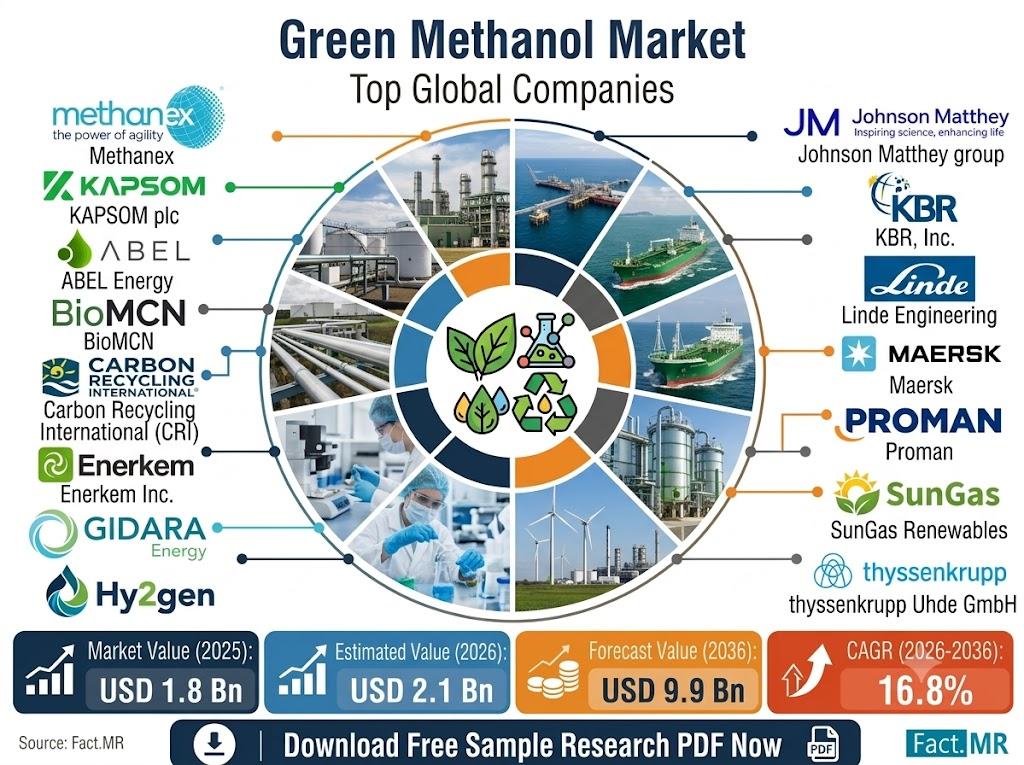
The global green methanol market is valued at USD 2.1 billion in 2026 and is projected to reach USD 9.9 billion by 2036, expanding at a compound annual growth rate (CAGR) of 16.8%, according to Fact.MR. The market is expected to generate an additional USD 7.8 billion in opportunity over the forecast period.
Shipping decarbonization is creating a more defined commercial pathway for renewable methanol. The International Maritime Organization's 2023 GHG Strategy calls for zero or near-zero greenhouse gas fuels and energy sources to represent at least 5%, striving for 10%, of international shipping energy by 2030. The European Union's Regulation (EU) 2023/1805, known as FuelEU Maritime, also establishes requirements to reduce the greenhouse gas intensity of energy used by ships calling at EU ports.
Get detailed market forecasts, competitive benchmarking, and pricing trends: https://www.factmr.com/connectus/sample?flag=S&rep_id=10838
These measures increase the importance of fuel suppliers' ability to demonstrate lifecycle emissions performance, maintain consistent fuel specifications and deliver contracted volumes. However, project economics remain sensitive to renewable electricity prices, feedstock availability, capital requirements and the pace at which shipping operators adopt alternative fuels.
Where growth is fastest
Germany is projected to record the fastest growth among the five profiled countries, followed by Brazil, the United States, the United Kingdom and Japan.
- Germany — 19.3% CAGR: The country's hydrogen import strategy anticipates demand for 95 to 130 TWh of hydrogen and hydrogen derivatives by 2030, with 50% to 70% expected to come from imports. This creates a potential route for renewable methanol through industrial and maritime supply chains.
- Brazil — 17.6% CAGR: Federal Law No. 14.948 of 2024 established a legal framework for low-emission hydrogen. Port-linked renewable projects, including a planned green methanol facility at Suape, provide a pathway for production and marine-fuel supply.
- United States — 16.0% CAGR: Regional Clean Hydrogen Hubs are intended to connect hydrogen producers, consumers and supporting infrastructure. These networks could support renewable-hydrogen supply for methanol production, although financing and offtake execution remain important constraints.
- United Kingdom — 14.3% CAGR: The 2025 Maritime Decarbonisation Strategy establishes lifecycle greenhouse gas reduction milestones for domestic maritime activity. Renewable Transport Fuel Obligation guidance also recognizes bio-methanol and non-biological renewable methanol as renewable fuel categories.
- Japan — 12.6% CAGR: A ship-to-ship methanol bunkering operation at anchor in Yokohama in February 2026 demonstrated progress in marine-fuel handling. The operation included domestically produced biomethanol.
What leads the market
Fact.MR's 2026 segment estimates show that biomass-derived production, fuel consumption and transportation applications account for substantial shares of green methanol demand.
- Product: Biomass Derived Green Methanol accounts for 74.6% of the market. Agricultural residues, forestry by-products and other renewable carbon sources provide feedstock options for production.
- Application: Fuel Applications represent 61.3%. Marine and other transport users can consume methanol in compatible or dual-fuel engines, creating recurring demand.
- End use: The Transportation Sector accounts for 69.8%, reflecting the role of shipping and other transport applications in fuel procurement.
- Technology: Electrolysis Based Methanol Technology represents 58.2%. This route combines electrolytic hydrogen with renewable electricity and a suitable carbon source.
- Formulation: Liquid Methanol Formulations account for 46.9%. Storage, handling, purity and contamination control remain important requirements for commercial supply.
- Distribution channel: Direct Industrial Sales represent 63.7%. Large buyers often require contracted volumes, traceable lifecycle data and predictable delivery schedules.
The hurdle: production costs and reliable supply
The main restraint is the green premium over conventional methanol, compounded by capital-intensive projects and the cost of renewable electricity and electrolytic hydrogen. Biomass producers also need reliable access to sustainable feedstocks, while carbon-capture-based projects depend on suitable CO2 supplies and supporting infrastructure.
Certification adds another layer of complexity. Buyers need evidence that fuel meets applicable sustainability and lifecycle-emissions requirements, particularly when production and consumption take place in different countries.
Project execution provides a further warning. SunGas Renewables ended development of its proposed Beaver Lake low-carbon methanol project in June 2026, with the supplied market analysis identifying fuel-adoption pace, carbon-storage uncertainty and financing conditions among the challenges. The development highlights the importance of securing buyers and resolving project risks before committing substantial capital.
Recent developments and competitive activity
Commercial activity across production technology, vessel deployment and port infrastructure is shaping the market's next phase.
- June 27, 2025 — Methanex completes acquisition: Methanex completed its acquisition of OCI Global's international methanol business. The transaction included a low-carbon methanol production and marketing business and an idled methanol facility in the Netherlands. The acquired asset package included BioMCN plants.
- 2025 — Maersk deploys Berlin Maersk: The vessel entered service as part of Maersk's wider methanol-capable dual-fuel fleet program, providing a demand-side signal for alternative marine fuels.
- February 2026 — Yokohama demonstrates methanol bunkering: Japan completed an at-anchor ship-to-ship methanol bunkering operation, including domestically produced biomethanol, advancing practical experience with marine methanol handling.
Key companies profiled in the market include Methanex, KAPSOM plc, ABEL Energy, BioMCN, Carbon Recycling International (CRI), Enerkem Inc., GIDARA Energy, Hy2gen, Johnson Matthey, KBR, Inc., Linde Engineering, Maersk, Proman, SunGas Renewables and thyssenkrupp Uhde GmbH.
Their activities span methanol production, biomass conversion, CO2-to-methanol technology, engineering and marine-fuel demand. The competitive environment therefore involves not only production capacity but also feedstock access, project integration, logistics and the ability to meet buyers' contractual requirements.
Analyst opinion
Shambhu Nath Jha, Principal Consultant, Fact.MR, states, “Green methanol growth is becoming an infrastructure and contracting question rather than only a production-technology question. Shipping buyers need verified lifecycle carbon intensity, dependable fuel supply and bunkering access, while producers need renewable power, sustainable carbon feedstock and bankable offtake. Projects that integrate those requirements are more likely to move from announced capacity to delivered volume.”
What this means for shipping buyers, producers and project developers
- Contract for verified emissions performance. Marine-fuel buyers should specify lifecycle greenhouse gas intensity, fuel quality, delivery location and minimum volumes in procurement agreements. A broad green-methanol designation alone may not establish compliance or supply reliability.
- Build feedstock resilience into project plans. Producers should assess sustainable biomass availability, captured-CO2 supply and renewable electricity requirements before finalizing production routes. Where practical, multiple suitable feedstock sources can reduce exposure to supply interruptions.
- Align investment with infrastructure and demand. Developers should coordinate electrolysis, carbon supply, synthesis capacity, storage, port access and long-term offtake. Phasing capital commitments against permitting, financing and buyer commitments can help limit exposure to execution risks.
Report details
Fact.MR's Green Methanol Market analysis examines market size and growth through 2036, product and application segments, end-use industries, production technologies, formulations, distribution channels, country-level growth and competitive developments.
Top Trending Reports:
Structural Insulated Panels Market to Reach USD 8.2 Billion by 2035 at 5.1 % CAGR
https://www.openpr.com/news/4401643/structural-insulated-panels-market-to-reach-usd-8-2-billion
"Magnetorheological Fluids Market Forecast 2025-2035: Market to Reach USD 372.7 Million by 2035 at 18.2 % CAGR https://www.openpr.com/news/4401652/magnetorheological-fluids-market-forecast-2025-2035-market
sodium benzoate market Forecast 2025-2035: Market to Reach USD 2.7 Billion by 2035 at 5.4% CAGR
https://www.openpr.com/news/4401656/sodium-benzoate-market-forecast-2025-2035-market-to-reach-usd
About Fact MR
Fact MR is an ESOMAR-certified market research and consulting firm headquartered in Delaware, USA, with offices in the United Kingdom, the United Arab Emirates and India. FMI delivers syndicated and custom research across food and beverage, healthcare, chemicals, technology, packaging, consumer goods and industrial sectors.

 English
 French
 Spanish
 Portuguese
 Deutsch
 Turkish
 Dutch
 Italiano
 Russian
 Romaian
 Portuguese (Brazil)
 Greek
