
Global Superfoods Market Projected to Reach USD 385.5 Billion by 2036, India Leads at 6.5% CAGR
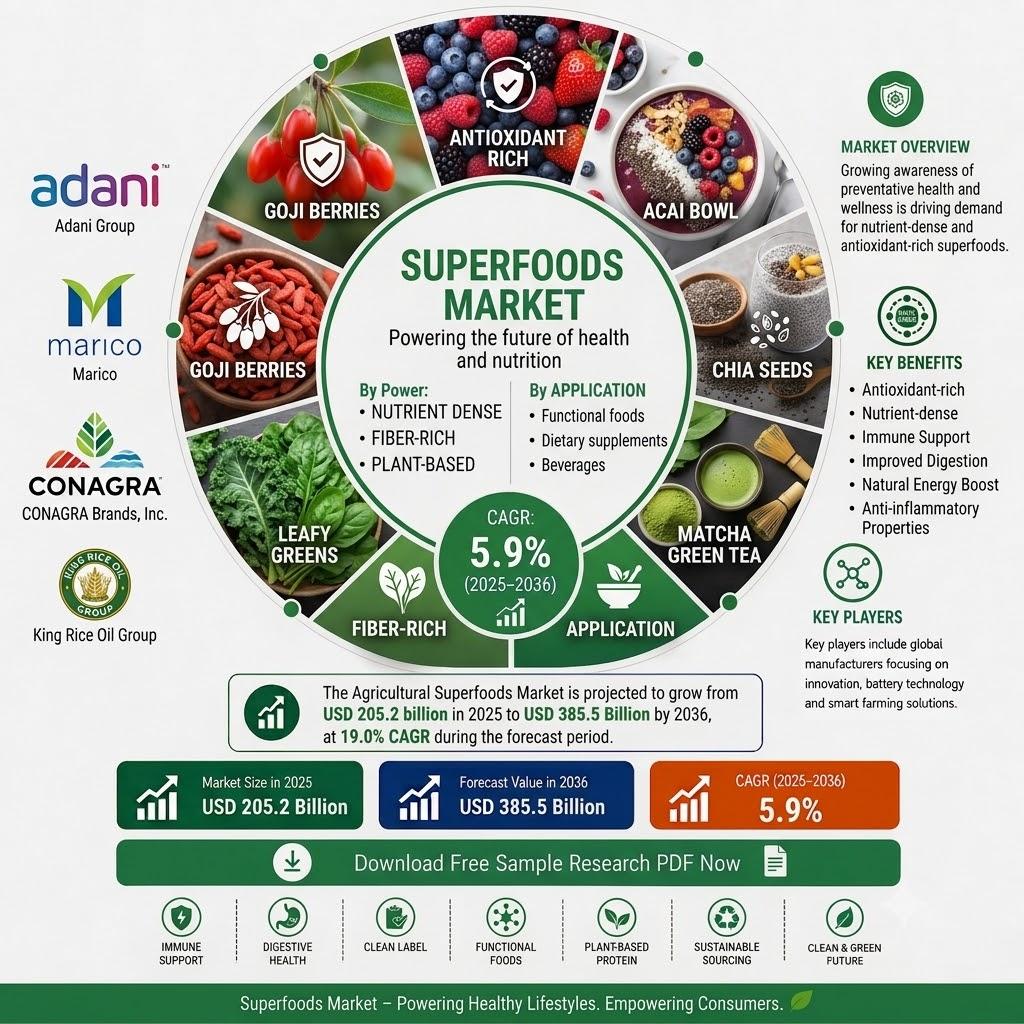
The global superfoods market is estimated at USD 217.3 billion in 2026 and is projected to reach USD 385.5 billion by 2036, registering a compound annual growth rate (CAGR) of 5.9% during the forecast period, according to Fact.MR. The market was valued at USD 205.2 billion in 2025 and is expected to create an incremental opportunity of approximately USD 168.2 billion between 2026 and 2036.
Superfoods include nutrient-dense ingredients such as berries, chia seeds, quinoa, turmeric, spirulina, moringa, and other fruits, vegetables, grains, and herbs. Their growing use reflects consumer interest in foods that combine everyday nutrition with specific functional attributes. Food manufacturers are incorporating these ingredients into snacks, bakery products, beverages, and supplement formulations, moving superfoods beyond specialist health food outlets into mainstream retail.
Get detailed market forecasts, competitive benchmarking, and pricing trends: https://www.factmr.com/connectus/sample?flag=S&rep_id=11735
Fruit-Based Superfoods Hold a Leading Position
Fruits account for 28.6% of the product segment in 2026, supported by consumer familiarity with berries and tropical fruits and their association with antioxidant-rich diets. Ingredients such as blueberries, acai, and other fruit varieties are used in smoothies, breakfast foods, snack bars, juices, and powdered blends.
Fruit-based ingredients offer manufacturers several formulation options. They can be incorporated into whole-food products, dried preparations, purees, and powders, allowing brands to serve different price points and consumption occasions. Demand also benefits from the versatility of fruit ingredients across conventional food products and premium wellness offerings.
Powder formats account for 57.2% of form-based demand in 2026. Powders are convenient to transport, store, and incorporate into packaged foods, beverages, and dietary supplements. They also allow manufacturers to combine several ingredients in a single formulation, including fruit powders, seeds, herbs, and plant-based extracts.
However, maintaining ingredient quality remains important. Processing methods can influence nutritional composition, flavor, color, and shelf life. Producers must manage sourcing, drying, storage, and testing to ensure that products meet formulation requirements and deliver consistent quality.
Functional Food Innovation Expands Commercial Applications
Bakery and confectionery accounts for 30.0% of application demand in 2026. Manufacturers are incorporating superfood ingredients into energy bars, breakfast cereals, baked snacks, and other packaged foods to respond to demand for products positioned around nutrition and convenience.
Superfood ingredients can help companies differentiate products in competitive grocery categories. Chia seeds, quinoa, berries, and selected plant ingredients can add texture, flavor, color, or nutritional characteristics. Their commercial value depends on the formulation, ingredient cost, and the extent to which consumers recognize and value the product attributes.
The beverages category also presents opportunities through smoothies, juices, powdered drink mixes, and functional beverages. Superfood ingredients can be blended into ready-to-drink products or sold in concentrated formats for home preparation. Meanwhile, dietary supplement manufacturers use selected ingredients in powders, capsules, and other formulations targeting consumers interested in specific nutritional goals.
Supermarkets and hypermarkets account for 63.4% of distribution channel share in 2026. Mainstream grocery placement increases product visibility and makes superfood ingredients accessible to shoppers who may not regularly visit specialty health stores. Online channels provide another route to market, especially for specialist powders, ingredient blends, and products aimed at consumers with particular dietary preferences.
Health Awareness and Clean-Label Reformulation Support Demand
Rising awareness of nutrition and preventive wellness is encouraging consumers to pay closer attention to food ingredients. Superfoods benefit from this shift because many products can be positioned around recognizable plant-based ingredients and their role within a balanced diet.
Food manufacturers are also reviewing formulations as demand for clean-label products expands. Superfood-derived ingredients can contribute natural color, flavor, texture, or nutritional attributes in selected applications. Their suitability depends on technical performance, cost, and regulatory requirements rather than consumer positioning alone.
The market nevertheless faces challenges. Premium ingredients can carry higher prices, while supply availability and quality may vary by crop, harvest, origin, and processing method. Manufacturers also need to substantiate nutrition and health claims and avoid implying that an individual ingredient can independently prevent or treat disease.
India Leads Country-Level Growth
India is projected to record the fastest growth among the countries covered by Fact.MR, with a CAGR of 6.5% through 2036. Demand is supported by rising interest in packaged health foods and the growing availability of products featuring ingredients such as turmeric, moringa, amla, and other plant-based ingredients. Traditional familiarity with several of these ingredients gives brands opportunities to develop products that connect established food practices with modern retail formats.
China is forecast to grow at a CAGR of 6.2%. Expanding e-commerce access and interest in health-oriented food products are supporting opportunities for both domestic producers and imported brands. Online platforms can help specialist products reach consumers beyond conventional health food distribution channels.
Brazil is projected to expand at a CAGR of 5.8%, supported by its role as both a source of superfood ingredients and a growing consumption market. The United States is expected to register a CAGR of 5.5%, while Canada is forecast to grow at 5.2%. The United Kingdom and Germany are projected to record CAGRs of 5.0% and 4.8%, respectively.
These markets present different opportunities. In established economies, product differentiation, organic positioning, and premium formulations can support category development. In emerging markets, consumer education, affordable formats, and improved access to modern retail can help broaden demand.
Analyst Perspective
Fact.MR's analysis indicates that superfoods are transitioning from a specialist health food category into a broader ingredient platform for food and beverage manufacturers. Their use in everyday products creates opportunities for suppliers that can deliver consistent quality, reliable sourcing, and formats suited to industrial production.
The commercial outlook also places greater emphasis on traceability and ingredient standardization. Companies sourcing acai, chia, quinoa, turmeric, and other specialty ingredients need to manage variations in agricultural output and processing quality. Suppliers that establish dependable sourcing relationships and verification procedures may be better positioned to serve manufacturers seeking consistent formulations at scale.
Competitive Landscape
The superfoods market includes ingredient suppliers, branded food businesses, and specialist wellness companies competing on sourcing quality, product variety, formulation expertise, and distribution. Del Monte Foods Corporation II Inc., Sunfood, Nature Superfoods, OMG Superfoods, Suncore Foods Inc., Raw Nutritional, Barlean's Organic Oils LLC, Aduna Limited, The Green Labs LLC, and GQ Superfoods are among the companies identified by Fact.MR.
Del Monte Foods Corporation II Inc. holds approximately 7.0% of the global market, according to the report. The broader competitive field includes businesses targeting different parts of the value chain, from packaged fruit products to specialist powders and nutritional blends.
Product development remains a key competitive lever. Companies can expand their reach through convenient formats, combinations of familiar and emerging ingredients, and distribution partnerships with mainstream retailers. At the same time, transparent ingredient sourcing and quality assurance are important for maintaining credibility in a category where consumers increasingly scrutinize product composition and health-related claims.
Superfoods Market Snapshot
- Market size in 2025: USD 205.2 billion
- Estimated market size in 2026: USD 217.3 billion
- Forecast market size in 2036: USD 385.5 billion
- Forecast CAGR (2026–2036): 5.9%
- Incremental dollar opportunity: USD 168.2 billion
- Leading product segment: Fruits, with 28.6% share
- Leading form: Powder, with 57.2% share
- Leading application: Bakery and confectionery, with 30.0% share
- Leading distribution channel: Supermarkets and hypermarkets, with 63.4% share
- Fastest-growing country: India, at 6.5% CAGR
To View Top Reports
https://net-pals.com/blogs/52301/Aerial-Firefighting-Market-to-Reach-USD-2-28-Billion-by
https://uddokta64.com/blogs/12450/Global-Aerial-Firefighting-Market-Set-to-Hit-USD-2-28
https://acmingle.com/blogs/29709/Aerial-Firefighting-Market-Forecast-to-Reach-USD-2-28-Billion
https://gulfsena.com/blogs/105832/Aerial-Firefighting-Market-Poised-to-Reach-USD-2-28-Billion
About Fact.MR
Fact.MR is a market research and competitive intelligence provider delivering market intelligence, competitive analysis, and forecasting across global industries. Its research helps businesses evaluate market demand, understand competitive developments, and identify growth opportunities across established and emerging markets.

 English
 Arabic
 French
 Spanish
 Portuguese
 Deutsch
 Turkish
 Dutch
Dutch
 Italiano
 Russian
 Romaian
 Portuguese (Brazil)
