
Neurology Devices Market Strategies for Competitive Differentiation
The future of neurological care is increasingly being shaped by devices that help clinicians intervene earlier, treat complex conditions more precisely, and monitor patients beyond traditional hospital settings. From electrical stimulation systems used in chronic pain management to specialized instruments for neurovascular procedures, innovation is expanding the role of medical technology in neurological treatment.
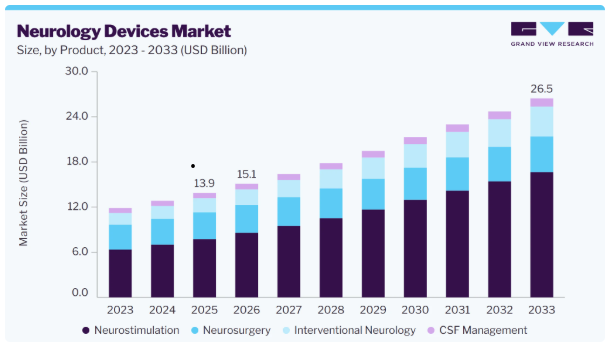
The global Neurology Devices Market was valued at USD 13.9 billion in 2025 and is projected to reach USD 15.1 billion in 2026 and USD 26.5 billion by 2033, registering a CAGR of 8.4% from 2026 to 2033. North America held the largest revenue share at 39.7% in 2025, while Asia Pacific is expected to record the fastest growth.
Rather than relying on a single technology, market expansion is emerging from several connected changes: rising neurological disease prevalence, growing demand for less invasive procedures, improvements in stimulation systems, and increased interest in connected monitoring solutions.
The Patient Journey Is Creating New Device Opportunities
Neurological conditions often require more than one intervention. Patients may need diagnostic evaluation, continuous monitoring, surgical treatment, rehabilitation support, or long-term symptom management. This broad range of clinical needs creates opportunities for manufacturers across the neurology devices market.
For people experiencing chronic pain, neurostimulation devices offer an alternative treatment approach in selected cases. Spinal cord stimulation is used for certain persistent pain conditions, including failed back surgery syndrome. Deep brain stimulation supports the management of selected movement disorders, while vagus nerve stimulation and transcranial magnetic stimulation provide other therapeutic options.
For patients with neurovascular conditions, specialized devices can support minimally invasive procedures. Aneurysm coils, flow-diversion devices, cerebral stents, and balloon angioplasty technologies help clinicians treat selected conditions affecting blood vessels in the brain.
Meanwhile, neurosurgical equipment and intraoperative neuromonitoring systems support clinicians during complex procedures by helping them monitor neurological function and improve procedural precision.
This variety of applications gives the market multiple sources of demand, with different technologies addressing distinct clinical challenges.
Download a free sample report or claim your copy of this full market intelligence report
Where Innovation Is Making a Difference
Responsive stimulation systems
Neurostimulation accounted for 55.7% of neurology devices market revenue in 2025, making it the leading segment. Manufacturers are developing smaller implants, rechargeable systems, wireless connectivity, and technologies that can adjust stimulation according to patient-specific signals.
Medtronic's Inceptiv closed-loop spinal cord stimulator received FDA approval in April 2024. Its ability to sense biological signals and adjust stimulation in real time illustrates the industry's movement toward more responsive treatment systems.
Less invasive neurological intervention
Interventional neurology is gaining momentum as clinicians seek effective approaches that can reduce reliance on more invasive procedures in appropriate cases. Improvements in stent design, imaging technologies, and embolization devices are supporting treatment for selected aneurysms and other neurovascular conditions.
The interventional neurology segment is projected to grow at a CAGR of 10.51% from 2025 to 2030, according to the supplied market information. This growth outlook reflects the importance of specialized devices in treating complex cerebrovascular conditions.
Monitoring beyond clinical facilities
Portable EEG systems and connected neurotechnology are creating opportunities for selected forms of neurological monitoring outside conventional hospital environments.
In April 2024, Soterix Medical introduced its MxN-GO EEG system, a wire-free wearable platform designed for at-home use that combines high-definition transcranial electrical stimulation with EEG monitoring. In September 2024, Neurable introduced MW75 Neuro headphones in partnership with Master & Dynamic, incorporating EEG sensors designed to provide insights into focus and cognitive activity.
These products demonstrate the range of applications being explored. Their wider adoption will depend on clinical usefulness, reliability, usability, and the ability to integrate device-generated information into appropriate care.
What Is Keeping Demand in Motion?
The growing burden of neurological disease remains a central market driver. Alzheimer's disease, Parkinson's disease, epilepsy, stroke, and other disorders create demand for technologies that support diagnosis, intervention, and ongoing management.
According to Alzheimer's Disease Facts and Figures 2024, approximately 6.9 million Americans aged 65 and older were living with Alzheimer's disease. The Parkinson's Foundation estimated that around 1.1 million people in the United States were living with Parkinson's in 2024, with the figure projected to reach 1.2 million by 2030.
Research investment is also supporting product development. The World Health Organization's Intersectoral Global Action Plan on Epilepsy and Other Neurological Disorders 2022–2031 emphasizes improving neurological services, research, and access to quality care.
However, advanced technology alone cannot guarantee widespread adoption. High device and procedure costs, regulatory requirements, reimbursement limitations, and the need for specialized clinical training can restrict access. Manufacturers must demonstrate clinical value while making their products practical for healthcare providers and patients.
Regional Demand: Where the Market Is Heading
North America held the leading position in 2025, accounting for 39.7% of global revenue. Established healthcare infrastructure, research investment, specialist facilities, and access to advanced treatment technologies support the region's market position. The United States was the largest country market in North America.
Europe remains important because of its established medical technology industry and growing need for neurological services. Meanwhile, Asia Pacific is expected to record the fastest market growth as healthcare infrastructure expands and demand for specialized treatment increases. China and India offer opportunities as access to advanced neurological care develops.
Latin America and the Middle East & Africa may also benefit from improvements in healthcare infrastructure and awareness, although affordability and access to specialist services remain challenges in some markets.
The Road Ahead
The neurology devices market is projected to reach USD 26.5 billion by 2033. Neurostimulation is expected to remain a major contributor, while interventional procedures and wearable monitoring technologies provide additional avenues for development.
Long-term success will depend on connecting technological progress with real clinical requirements. Companies that combine effective treatment capabilities with patient usability, strong clinical evidence, and broader accessibility will be better positioned to participate in the market's next phase of growth.
Explore Our Research & Intelligence Solutions
Prism AI: Ask. Analyze. Get Cited Market Insights. – Explore Now
U.S. Healthcare Facility Intelligence: Make Better Decisions with Comprehensive Data – Explore the Platform

 English
 Arabic
 French
 Spanish
 Portuguese
 Deutsch
 Turkish
 Dutch
Dutch
 Italiano
 Russian
 Portuguese (Brazil)
 Greek
Greek
