
Pancreatic Cancer Diagnostic Market Analysis of Imaging and Blood Tests
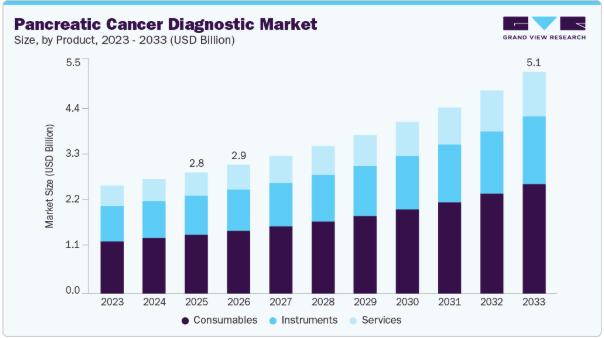
The pancreatic cancer diagnostic market is entering a period of technological transformation as healthcare providers seek more reliable ways to identify one of the deadliest forms of cancer. With many patients diagnosed only after the disease has advanced, the need for earlier detection, improved diagnostic accuracy, and accessible testing solutions is becoming increasingly important.
The global Pancreatic Cancer Diagnostic Market was valued at USD 2.8 billion in 2025 and is projected to increase from USD 2.9 billion in 2026 to USD 5.1 billion by 2033, registering a CAGR of 6.8% from 2026 to 2033. North America held the largest regional revenue share at 39.5% in 2025, while Asia Pacific is expected to record the fastest growth during the forecast period.
The Diagnostic Challenge Behind Market Expansion
Pancreatic cancer presents a significant diagnostic challenge because symptoms may remain difficult to identify during the early stages. According to the supplied source, the five-year relative survival rate is approximately 13%, reflecting the poor prognosis associated with late-stage detection.
In the United States, an estimated 67,530 new cases and 52,740 deaths are projected for 2026. Pancreatic cancer is expected to remain the third-leading cause of cancer-related mortality despite representing approximately 3% of cancer diagnoses.
Only around 17% of patients are diagnosed when the cancer remains localized, a stage associated with a five-year survival rate of approximately 44%. This gap between early and advanced diagnosis is encouraging investment in technologies that can identify suspicious lesions and disease-associated biomarkers sooner.
Four Developments Changing the Diagnostic Landscape
- Imaging remains the clinical foundation.
Imaging tests accounted for 57.03% of market revenue in 2025. Computed tomography (CT), magnetic resonance imaging (MRI), endoscopic ultrasound (EUS), and positron emission tomography (PET) remain important tools for detecting abnormalities and assessing disease progression.
The integration of artificial intelligence (AI), radiomics, contrast agents, and three-dimensional imaging is expanding the capabilities of these technologies. AI-assisted systems can help identify and segment pancreatic lesions, potentially improving interpretation efficiency and supporting more consistent assessments.
- Blood-based testing is gaining momentum.
Blood tests are expected to register the fastest growth among test types during the forecast period. Conventional biomarkers such as CA 19-9 and carcinoembryonic antigen (CEA) are used in pancreatic cancer diagnosis and monitoring, while research into circulating tumor DNA, liquid biopsy, and multi-omics approaches is expanding the potential of non-invasive testing.
In March 2026, researchers supported by the National Institutes of Health developed a blood-based test combining multiple protein biomarkers that reportedly demonstrated more than 90% accuracy in detecting pancreatic cancer, including early-stage cases. Such developments illustrate the growing interest in diagnostic approaches that could complement existing procedures.
Download a free sample report or claim your copy of this full market intelligence report
- Molecular diagnostics is widening testing possibilities.
Molecular diagnostics can identify genetic mutations and biomarkers associated with pancreatic malignancies. These capabilities are relevant to precision medicine, inherited-risk assessment, and the development of more targeted diagnostic pathways.
Research into next-generation sequencing, biomarker discovery, and circulating tumor DNA is creating opportunities for diagnostic companies to expand their portfolios. However, clinical validation remains essential before emerging technologies can become widely adopted in routine practice.
- Specialized diagnostic services are expanding.
The services segment is projected to grow at the fastest CAGR among product categories. Research programs, multidisciplinary cancer centers, and integrated diagnostic services are increasing the focus on high-risk patient surveillance and coordinated care.
For example, the Duke Cancer Institute launched a multidisciplinary pancreatic cancer center in March 2026, focusing on early detection, surveillance of high-risk patients, clinical trials, and integrated care delivery. Such models demonstrate how diagnostic services can extend beyond individual tests to coordinated clinical pathways.
Where Revenue Is Concentrated
The market's segment structure reveals how established diagnostic procedures and recurring testing requirements support revenue generation.
- Consumables: The largest product segment, accounting for 48.65% of revenue in 2025. Diagnostic kits, reagents, and other frequently used materials benefit from ongoing testing demand and research investment.
- Imaging tests: The leading test type, with a 57.03% revenue share in 2025. Established clinical use and continuing technological improvements support its position.
- Exocrine cancer: The dominant cancer-type segment in 2025. Exocrine malignancies account for the overwhelming majority of pancreatic cancer cases, with pancreatic ductal adenocarcinoma representing a particularly important source of diagnostic demand.
- Hospitals: The largest end-use segment, representing 56.06% of revenue in 2025. Hospitals combine imaging, laboratory testing, oncology expertise, and patient management within integrated care environments.
- Laboratories: Expected to record the fastest growth among end-use segments, supported by increasing demand for molecular, genetic, and biomarker-based testing.
The endocrine segment is also anticipated to grow at a faster rate than other cancer-type categories, although endocrine malignancies remain less common than exocrine cancers.
Regional Competition: Established Infrastructure Meets Emerging Demand
North America accounted for 39.5% of global market revenue in 2025. Its position is supported by advanced healthcare infrastructure, oncology research investment, established diagnostic laboratories, and the adoption of molecular testing and AI-assisted imaging. The United States remains a major contributor because of its diagnostic technology ecosystem, research funding, and strong presence of biotechnology and diagnostics companies.
Europe represents another significant market, supported by established healthcare systems, molecular diagnostic capabilities, and regulatory oversight. Requirements under the European Union's In Vitro Diagnostic Regulation are influencing the development and commercialization of diagnostic products, particularly those requiring extensive performance validation.
Asia Pacific is expected to register the fastest CAGR from 2026 to 2033. Rising cancer incidence, expanding healthcare infrastructure, greater diagnostic laboratory capacity, and increased investment in cancer care are supporting regional demand. Japan's established medical technology infrastructure and China's healthcare development initiatives contribute to the region's evolving diagnostic landscape.
Latin America and the Middle East & Africa offer additional opportunities as healthcare systems invest in cancer services and diagnostic accessibility. Nevertheless, uneven access to specialized facilities, affordability constraints, and limited diagnostic resources in some areas may restrict adoption.
What Will Determine the Market's Next Phase?
The pancreatic cancer diagnostic market is projected to reach USD 5.1 billion by 2033, but its longer-term development will depend on how effectively innovation addresses the limitations of existing diagnostic pathways.
Imaging is likely to remain central to clinical evaluation, while blood-based assays and molecular diagnostics could broaden the available options for identifying disease-associated signals. AI may further support imaging interpretation and diagnostic workflows, whereas specialized laboratories and integrated cancer centers can help expand access to advanced testing.
At the same time, high development costs, regulatory requirements, clinical validation needs, and unequal access to healthcare infrastructure remain important constraints.
The market's strongest opportunities will emerge from diagnostic solutions that combine dependable clinical performance with practical implementation. As research advances and healthcare systems strengthen early-detection pathways, pancreatic cancer diagnostics is positioned for continued growth through 2033.
Explore Our Research & Intelligence Solutions
Prism AI: Ask. Analyze. Get Cited Market Insights. – Explore Now
U.S. Healthcare Facility Intelligence: Make Better Decisions with Comprehensive Data – Explore the Platform

 English
 Arabic
 French
 Spanish
 Portuguese
 Deutsch
 Turkish
 Italiano
 Russian
 Romaian
 Portuguese (Brazil)
 Greek
Greek
