
AI Automation Market Opportunities in Intelligent Process Automation
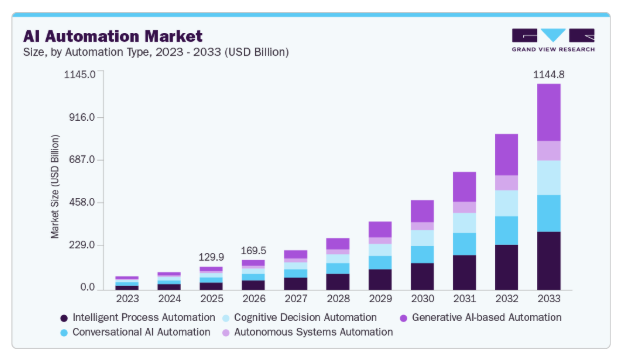
AI automation is changing how organizations execute work, manage information, and make operational decisions. Instead of relying exclusively on predefined rules and manual intervention, businesses are adopting intelligent systems capable of interpreting data, coordinating workflows, identifying exceptions, and supporting decisions across departments. This transition is expanding AI automation from a productivity tool into a broader enterprise transformation strategy.
The global AI Automation Market was valued at USD 129.9 billion in 2025 and is projected to increase from USD 169.5 billion in 2026 to USD 1,144.8 billion by 2033, representing a CAGR of 31.4% from 2026 to 2033. North America accounted for 32.7% of global revenue in 2025, while Asia Pacific is expected to register the fastest growth during the forecast period.
The Shift From Automating Tasks to Automating Decisions
Traditional automation typically follows predefined instructions. AI-powered automation introduces capabilities such as language understanding, pattern recognition, predictive analysis, and contextual decision-making. This allows organizations to automate more complex activities, including document processing, customer interactions, operational monitoring, and exception handling.
Businesses are increasingly pursuing these capabilities to improve resource utilization, reduce operating expenses, and respond to skilled labor shortages. AI systems can also monitor energy consumption and operational footprints in real time, helping organizations identify inefficiencies while supporting environmental compliance objectives.
Integration with enterprise resource planning (ERP) and customer relationship management (CRM) platforms further extends automation across departments. Rather than operating as isolated applications, connected automation systems can coordinate information between finance, procurement, human resources, customer service, and supply chain operations.
The combination of enterprise data, cloud infrastructure, and machine learning is therefore creating demand for automation platforms that can manage entire workflows rather than individual repetitive tasks.
Five Market Shifts Defining Competitive Advantage
- Intelligent process automation becomes a core enterprise capability.
Intelligent process automation (IPA) held 33.8% of market revenue in 2025, making it the leading automation type. By combining robotic process automation with AI capabilities, IPA supports more sophisticated workflows involving unstructured information, exception handling, and contextual decisions.
Finance, procurement, human resources, and supply chain departments are important application areas. Organizations increasingly value systems that provide process visibility, maintain audit trails, and support continuous improvement in regulated or operationally complex environments.
Download a free sample report or claim your copy of this full market intelligence report
- Generative AI expands automation into knowledge work.
Generative AI-based automation is expected to experience significant growth as businesses adopt tools for document creation, code generation, personalized communications, customer support, and knowledge management.
These applications extend automation beyond repetitive administrative tasks. Employees can use AI-enabled systems to prepare content, summarize information, and accelerate software development. For businesses managing high volumes of digital information, the opportunity lies in reducing turnaround times while improving productivity.
- Cloud deployment lowers implementation barriers.
Cloud-based solutions held the largest deployment share in 2025. Flexible pricing, scalable infrastructure, centralized data access, and regular software updates make cloud platforms attractive to organizations seeking faster implementation without substantial upfront infrastructure investment.
Hybrid deployment is also gaining importance. Companies managing sensitive information or legacy systems can combine cloud-based capabilities with greater control over selected workloads and data. This approach supports gradual modernization while maintaining operational continuity.
- Modular integration supports practical adoption.
API-based and modular integration models held the largest share of integration-mode revenue in 2025. Organizations often prefer connecting automation tools to existing applications rather than replacing entire technology environments.
Modular architecture allows businesses to introduce capabilities incrementally, customize workflows, and upgrade individual components. Embedded AI automation is also expected to expand as intelligence becomes integrated directly into enterprise software, industrial equipment, and digital platforms.
- Smaller businesses are entering the automation market.
Large enterprises represented 67.5% of market revenue in 2025, reflecting their complex operations, substantial transaction volumes, and greater capacity to invest in enterprise-wide systems.
However, small and medium-sized enterprises are expected to record significant growth as subscription-based tools and cloud platforms make automation more accessible. These businesses can use AI to improve responsiveness, streamline administrative work, and compete more effectively without building extensive in-house technology infrastructure.
Industry Adoption: Where AI Automation Creates Value
AI automation adoption varies by industry because each sector faces different operational challenges.
In banking, financial services, and insurance (BFSI), automation supports transaction processing, customer onboarding, fraud detection, credit assessment, and compliance verification. The segment accounted for the largest vertical revenue share in 2025, supported by digital banking adoption and the need for faster, more consistent processing.
Healthcare is projected to grow at the fastest CAGR among verticals, reaching 36.0% from 2026 to 2033. Increasing patient volumes and administrative complexity are encouraging providers to automate scheduling, claims processing, medical documentation, and electronic health record management. AI-assisted data analysis and clinical decision support also present opportunities, although healthcare applications require careful attention to accuracy, privacy, and clinical oversight.
Manufacturing companies can use AI automation alongside connected devices to support predictive maintenance, quality control, and production monitoring. Retailers and logistics providers can apply similar capabilities to inventory management, demand analysis, order processing, and supply chain coordination.
Across these industries, the commercial benefit depends on whether automation improves measurable business outcomes rather than simply introducing new technology.
Regional Growth: Established Technology Markets and Emerging Adoption
North America held the largest regional share at 32.7% in 2025. Strong enterprise technology spending, established digital infrastructure, and the adoption of advanced automation platforms support its leading position. The United States is a major contributor, with AI startups, technology providers, and consulting firms supporting the development and implementation of automation solutions.
Europe's market development is influenced by data protection requirements, compliance obligations, and industrial modernization. Businesses are increasingly interested in transparent, auditable automation systems that can support regulated workflows. Manufacturing modernization, cross-border logistics, and public-sector digital transformation also contribute to demand.
Asia Pacific is projected to experience the fastest growth through 2033. Expanding e-commerce, digital payments, smart-city programs, and cloud adoption are creating opportunities for automation across business operations. Demand for cost-efficient, scalable solutions is particularly relevant as organizations modernize their technology infrastructure.
These regional differences suggest that future market expansion will depend on both technological innovation and the ability to adapt automation solutions to local operating environments, regulatory requirements, and business needs.
What Could Accelerate or Constrain Market Growth?
The projected expansion to USD 1,144.8 billion by 2033 reflects increasing enterprise interest in AI-enabled operations. However, adoption depends on several practical considerations.
Integration with legacy applications can require significant technical effort, while inconsistent data quality may reduce automation reliability. Cybersecurity concerns, regulatory compliance, and the need for transparent decision-making can also influence deployment choices. Organizations must establish appropriate governance and human oversight, particularly when automated outputs affect sensitive or high-impact decisions.
At the same time, cloud scalability, modular integration, advances in generative AI, and growing demand for operational efficiency are expanding the addressable market.
The central opportunity for the AI automation market is the transition from isolated task automation to connected, intelligent workflows. Providers that combine scalable infrastructure, reliable AI capabilities, interoperability, and effective governance are positioned to address the growing needs of enterprises through 2033.
Explore Our Research & Intelligence Solutions
Prism AI: Ask. Analyze. Get Cited Market Insights. – Explore Now
Grand View Signal: Understand the Factors Shaping Commodity Prices – Explore the Platform

 English
 Arabic
 French
 Spanish
 Portuguese
 Deutsch
 Turkish
 Dutch
Dutch
 Russian
 Romaian
 Portuguese (Brazil)
 Greek
Greek
