
Automotive Tire Market Eyes USD 616.87 Billion by 2036, China - CAGR 4.4%, India - CAGR 4.1%, Germany - CAGR 3.7%
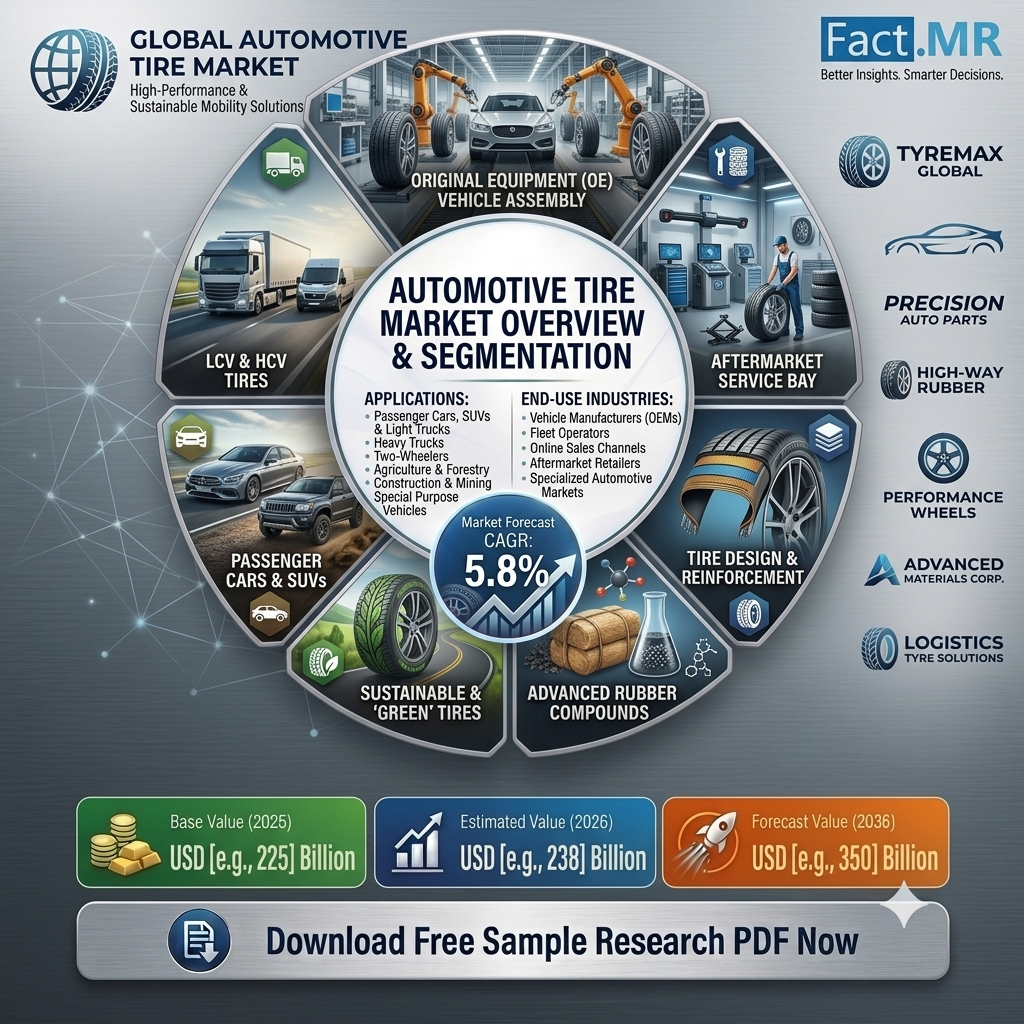
The automotive tire market is forecast to expand from USD 433.11 billion in 2026 to USD 616.87 billion by 2036, registering a 3.6% CAGR over the forecast period. Fact.MR attributes this expansion to growing vehicle fleets, recurring tire replacement requirements, and rising demand for tires designed for electric vehicles. Increasing vehicle ownership in China and India is supporting aftermarket demand, while changing performance and efficiency requirements are creating opportunities for advanced tire technologies.
The market is also being shaped by the growing adoption of electric vehicles, stricter tire performance requirements, and the preference for products that offer better durability, handling, and fuel efficiency. Electric vehicles require tires designed to support higher vehicle weight, reduce rolling resistance, and manage road noise. Meanwhile, replacement demand continues to provide a stable source of sales as tires wear out or require replacement because of damage and seasonal driving conditions.
Get detailed market forecasts, competitive benchmarking, and pricing trends:
https://www.factmr.com/connectus/sample?flag=S&rep_id=12
Radial Tires Maintain Dominant Position
By tire structure, radial tires are expected to account for 61.4% of the automotive tire market in 2026. Their leading position reflects their established use across passenger cars and light commercial vehicles, supported by ride comfort, handling, tread life, and fuel efficiency. These characteristics make radial tires a preferred option for both original equipment manufacturers and replacement buyers.
All-season tires represent another major category, accounting for 52.7% of the market by tire type in 2026. Their ability to provide practical performance across different weather conditions makes them attractive to drivers who prefer a single tire specification throughout the year. In markets without severe winter conditions, all-season tires can also reduce the expense and inconvenience associated with seasonal tire changes.
The aftermarket distribution channel accounts for 58.3% of market sales in 2026. Replacement purchases remain important because tire demand continues throughout a vehicle's operating life, independently of new vehicle sales. Wear, road damage, and routine maintenance create recurring requirements for replacement tires. As vehicle ownership increases across emerging economies, the expanding installed vehicle base is expected to support additional aftermarket sales.
Passenger vehicles are another significant demand category. This segment is projected to reach USD 407.96 billion by 2036, advancing at a 4.1% CAGR. Increasing vehicle ownership, improving road infrastructure, and developments in tire technology are supporting demand. The expansion of electric passenger vehicles is also encouraging manufacturers to develop products with suitable load ratings, lower rolling resistance, and improved acoustic performance.
China, India, and Germany Show Growth Potential
China is expected to record a 4.4% CAGR from 2026 to 2036, making it the fastest-growing country in the report's headline country comparison. The country's large vehicle fleet and expanding replacement market are supporting demand. Vehicles purchased during earlier periods of rapid ownership growth are increasingly entering replacement cycles, creating additional opportunities for tire manufacturers and aftermarket suppliers.
India is projected to register a 4.1% CAGR through 2036. Rising incomes, infrastructure investment, and continued vehicle fleet expansion are contributing to market development. As more consumers purchase vehicles, demand for replacement tires is expected to increase alongside the need for products that balance durability, performance, and affordability. The growing vehicle base also creates opportunities for manufacturers serving both standard and premium tire categories.
Germany is expected to advance at a 3.7% CAGR during the same period. Its established automotive manufacturing base and consumer preference for premium and performance tires support demand. Tire quality, handling characteristics, and performance specifications remain important purchasing considerations. European requirements relating to winter driving conditions, rolling resistance, and tire performance also influence product selection and replacement activity.
Other markets are expected to record more moderate growth. Brazil is projected to register a 3.4% CAGR, while the United States is forecast to grow at 3.1%. The United Kingdom is expected to advance at 2.8%, and Japan at 2.5%. In these markets, established vehicle fleets and recurring replacement requirements continue to support demand, although growth rates vary with market maturity and vehicle ownership trends.
Competitive Landscape
Competition in the automotive tire market includes established manufacturers with extensive product portfolios, global distribution networks, and automotive industry relationships. Key companies profiled by Fact.MR include Bridgestone Corporation, Michelin, Goodyear Tire and Rubber Company, Continental AG, Pirelli, Yokohama Rubber Company, Sumitomo Rubber Industries, Apollo Tyres Ltd., Hankook Tire, and MRF Limited.
Manufacturers are competing through product development, manufacturing expansion, and partnerships with vehicle producers. Bridgestone Corporation introduced its R192E electric bus tire in May 2023, addressing the specific operating requirements of electric buses. Hankook Tire also announced an expansion of its Clarksville, Tennessee, manufacturing facility in August 2022, with planned investment exceeding USD 1.6 billion by 2026. These developments illustrate how manufacturers are responding to changing vehicle technology and regional production requirements.
Electric Vehicles and Raw Material Costs Shape the Market
The transition toward electric mobility is creating new opportunities for tire manufacturers. Electric vehicles require products capable of carrying higher loads while maintaining low rolling resistance and managing road noise. Fact.MR notes that EV-specific tires with features such as acoustic foam inner liners and specialized compounds can command price premiums of 15% to 25% over conventional equivalents. This creates opportunities for manufacturers to increase product value as electric vehicle adoption expands.
Raw material costs remain a challenge for the industry. Natural and synthetic rubber, steel, textiles, carbon black, and other inputs influence manufacturing expenses. Natural rubber supply concentration in Thailand, Indonesia, and Malaysia also exposes manufacturers to potential supply disruptions and price volatility. These factors can affect production costs, pricing decisions, and profit margins.
Sustainability requirements are encouraging manufacturers to explore lower rolling resistance compounds, alternative raw materials, and tire designs that improve vehicle efficiency. Continued product development will remain important as tire makers respond to electric vehicle requirements, changing regulations, and consumer expectations for performance and durability.
As vehicle fleets expand and replacement demand continues, the automotive tire market is expected to maintain growth through 2036. The full Fact.MR report provides further analysis of market forecasts, vehicle and tire categories, country-level opportunities, and the competitive landscape.
Top Reports:
https://adamaamresearch.blogspot.com/2026/10/memory-foam-market-to-reach-usd-2294.html
https://net-pals.com/blogs/51649/Memory-Foam-Market-Expansion-to-Reach-USD-22-94-Billion
https://ikofficial.com/blogs/57905/Memory-Foam-Market-Forecast-at-USD-22-94-Billion-by
https://acmingle.com/blogs/29355/Memory-Foam-Market-Projected-to-Be-Worth-USD-22-94
About Fact.MR
Fact.MR is a market research and consulting company providing market intelligence, competitive analysis, and forecasting across global industries. Its research supports businesses with data-driven insights into emerging markets, technology trends, competitive dynamics, regional opportunities, and changing demand patterns.

 English
 Arabic
 Spanish
 Portuguese
 Deutsch
 Turkish
 Dutch
Dutch
 Italiano
 Russian
 Romaian
 Portuguese (Brazil)
 Greek
Greek
