
Aerial Firefighting Market Forecast to Reach USD 2.28 Billion by 2036, China Records 6.8% CAGR
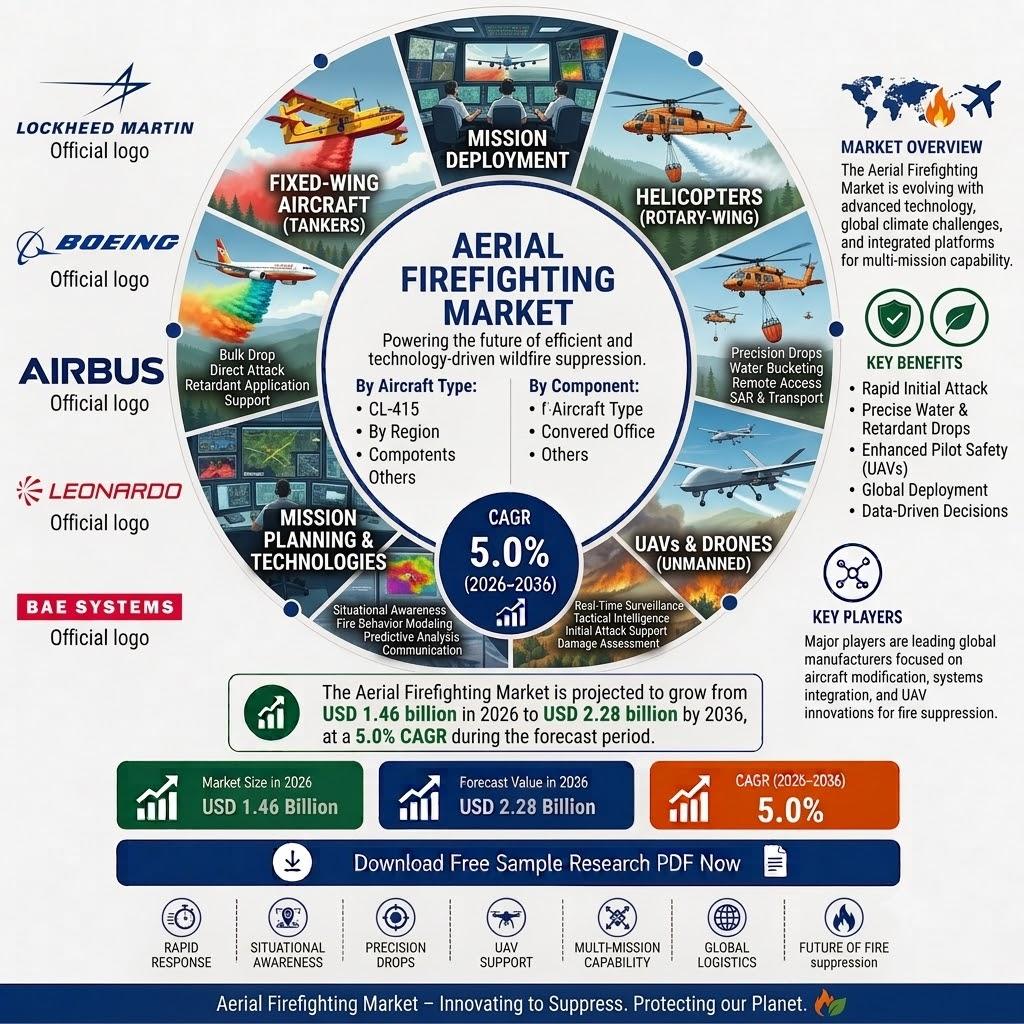
The global aerial firefighting market is projected to grow from USD 1.46 billion in 2026 to USD 2.28 billion by 2036, registering a compound annual growth rate (CAGR) of 5.0%, according to Fact.MR. Valued at approximately USD 1.36 billion in 2025, the market is expected to generate an additional USD 820 million over the forecast period as governments and firefighting operators invest in aircraft readiness, fleet modernization, and wildfire response capabilities.
Aerial firefighting involves the use of fixed-wing aircraft, helicopters, and specialized aerial platforms to deliver water, fire retardants, and other suppression agents to wildfire locations. These aircraft also support reconnaissance, fire mapping, and coordination with ground crews. Their ability to reach remote terrain and cover large areas makes them an important part of emergency response strategies in wildfire-prone regions.
Longer fire seasons, increasingly complex wildfire events, and the need to protect communities and critical infrastructure are encouraging public agencies to review their aerial response capabilities. Demand is also influenced by aircraft availability, maintenance requirements, seasonal leasing arrangements, and the ability to mobilize resources quickly during emergencies.
Get detailed market forecasts, competitive benchmarking, and pricing trends: https://www.factmr.com/connectus/sample?flag=S&rep_id=14419
Fixed-Wing Aircraft Lead Market Demand
Fixed-wing aircraft are projected to account for 50% of the aerial firefighting market in 2026. Their payload capacity and operational range make them suitable for large-scale retardant deployment across expansive forest and grassland areas. Depending on aircraft configuration, these platforms can support repeated missions and coordinate with ground teams to help contain advancing fires.
Helicopters provide a complementary capability. They can operate in areas where terrain, access, or mission requirements make fixed-wing aircraft less suitable. Rotary-wing platforms are used for water delivery, personnel transport, and other support activities, with deployment depending on aircraft capacity, local conditions, and operational safety requirements.
Unmanned aerial vehicles are also becoming more relevant to wildfire management. Surveillance drones can support fire detection, mapping, hotspot identification, and situational awareness. Their integration with established firefighting operations can help agencies assess changing fire conditions and coordinate response resources. However, surveillance and suppression applications have different technical requirements, and aircraft certification, airspace coordination, and operating procedures remain important considerations.
Firefighting Operations Account for the Largest Service Share
Firefighting operations are projected to represent 55% of the market by service in 2026. This segment includes water drops, retardant delivery, and foam applications used during active wildfire suppression. Demand is linked to emergency response needs and the deployment of aerial resources in coordination with ground crews and incident management teams.
Aerial surveillance and monitoring provide another important service category. Fire mapping and hotspot identification help response teams assess fire behavior, identify priority areas, and allocate resources. Aerial logistics and support services, including personnel and equipment transport, can also help maintain operations in remote locations.
Government procurement and multi-year service agreements influence market development. Maintaining aircraft that can be deployed at short notice requires investment in trained personnel, maintenance, equipment, and operational readiness. Contractors with dependable fleets and the ability to meet seasonal deployment requirements can be well positioned to compete for public-sector contracts.
Wildfire Preparedness Drives Fleet Modernization
Aircraft modernization is becoming a strategic priority as firefighting agencies seek reliable platforms with suitable payload capacity, operational range, and mission equipment. Operators must balance the cost of acquiring and modifying aircraft with maintenance requirements and the need to keep existing fleets available during fire seasons.
In early 2026, Israel Aerospace Industries and Fire Free Forests announced a strategic agreement to develop the 767FF aerial firefighting platform, based on a converted Boeing 767. The proposed aircraft is designed for high-capacity retardant delivery, reflecting interest in platforms that can support large-scale wildfire response. The development also points to experimentation with service models intended to broaden access to specialized aerial firefighting capacity.
Canada also announced a federal investment of approximately CAD 316.7 million in February 2026 to strengthen provincial and territorial aerial wildfire firefighting capacity. The initiative focuses on improving access to aircraft and supporting coordinated response capability across jurisdictions. Such investments illustrate how governments are treating aerial resources as part of broader wildfire preparedness planning.
Despite these developments, the sector faces constraints related to aircraft supply, specialized maintenance, pilot availability, and the cost of acquiring or converting suitable platforms. Operators must also comply with aviation safety requirements and coordinate flight activity with other emergency response assets.
China Leads Country-Level Growth
China is projected to record the fastest growth among the countries covered in Fact.MR's analysis, with a CAGR of 6.8% through 2036. India follows at 6.3%, while Germany is forecast to grow at 5.8%. The United Kingdom is expected to register a 4.8% CAGR, and the United States is projected to expand at 4.3%.
China's growth outlook reflects investment in wildfire monitoring, emergency response programs, and aerial fleet capabilities. India is also expected to see rising demand as forest protection initiatives and disaster response planning create requirements for improved aerial support.
Germany's projected growth is associated with wildfire preparedness and coordination within European emergency response frameworks. In the United Kingdom, demand is influenced by contracted aerial services and seasonal response requirements. The United States remains a major market for specialized firefighting aircraft, although growth is shaped by government budgets, aircraft replacement cycles, and the availability of operational fleets.
Regional growth will depend on public funding, wildfire exposure, aircraft procurement strategies, and the ability to coordinate aerial operations safely. Leasing and shared-capacity arrangements may help agencies access specialized aircraft without requiring every jurisdiction to maintain a complete fleet independently.
Analyst Perspective
Shambhu Nath Jha, Principal Consultant at Fact.MR, observes that fleet readiness, aircraft modernization, and contract structures are central to long-term value creation in aerial firefighting. As operators face increasingly complex deployment requirements, investment in payload capability, operational reliability, and integrated surveillance systems will influence their ability to serve government agencies and other customers.
Competitive Landscape
The aerial firefighting market includes aircraft manufacturers, specialized conversion companies, and contracted firefighting operators. Key companies profiled by Fact.MR include Embraer, Air Tractor, Inc., Boeing Company, Bombardier Inc., Airbus Defence and Space, Conair Group Inc., Coulson Aviation, Bridger Aerospace Group Holdings, LLC, Dauntless Air, Inc., Erickson Incorporated, and Neptune Aviation Services.
Competition depends on aircraft performance, payload capacity, fleet availability, maintenance support, and operational experience. Manufacturers and conversion specialists focus on platforms and equipment suited to specific missions, while service providers compete through deployment readiness, contract execution, and coordination with emergency agencies. Drone and mapping technology suppliers contribute to the broader ecosystem by supporting detection and operational planning.
Market Snapshot
- Market value (2025): USD 1.36 billion
- Market value (2026): USD 1.46 billion
- Forecast value (2036): USD 2.28 billion
- Global CAGR (2026–2036): 5.0%
- Leading country by growth: China, at 6.8% CAGR
- Leading aircraft type: Fixed-wing aircraft, with a projected 50% share in 2026
- Leading service segment: Firefighting operations, with a projected 55% share in 2026
To View Top Reports
https://afgbfh.blogspot.com/2026/10/session-border-controllers-market-set.html
https://social.art-inpa.com/blogs/37713/Global-Session-Border-Controllers-Industry-to-Reach-USD-2-2
https://sportgalax.com/read-blog/25615
About Fact.MR
Fact.MR is a market research and competitive intelligence provider delivering market intelligence, competitive analysis, and forecasting across global industries. Its research helps businesses evaluate demand trends, understand competitive developments, and assess growth opportunities across established and emerging markets.

 English
 French
 Spanish
 Portuguese
 Deutsch
 Turkish
 Dutch
Dutch
 Italiano
 Russian
 Romaian
 Portuguese (Brazil)
 Greek
Greek
