
Fresh Herbs Market Potential Strengthens With Rising Demand for Organic Produce
The Fresh Herbs Market is growing beyond its traditional role as a kitchen staple. Consumers are paying closer attention to ingredient quality, nutritional value, food origin, and the flavors they bring to everyday meals. At the same time, restaurants are expanding their use of fresh herbs, while retailers are responding with organic, locally sourced, and convenient product options. These changes are creating new opportunities across the fresh herbs supply chain.
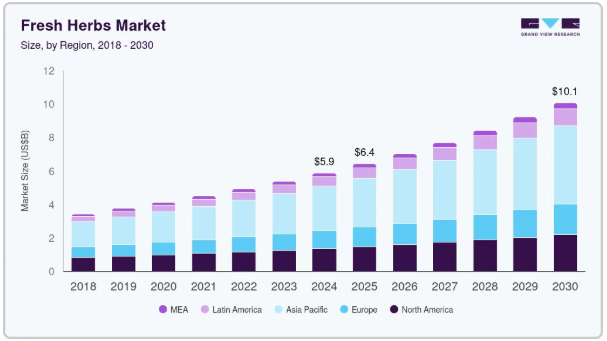
The global Fresh Herbs Market was valued at USD 5.9 billion in 2024 and is projected to reach USD 10.1 billion by 2030, expanding at a CAGR of 9.4% from 2025 to 2030. The market is projected to grow from USD 7.0 billion in 2026. Asia Pacific represented a leading regional market, with a reported revenue share of 45.0% in 2024.
Three Signals Defining the Market
Signal 1 — Fresh ingredients are becoming everyday choices. Consumers increasingly prefer fresh and natural ingredients over processed alternatives. Fresh herbs offer a way to enhance flavor without adding significant calories or sodium, making them attractive to shoppers focused on healthier eating. Their antioxidant properties and perceived nutritional benefits also contribute to rising interest.
Signal 2 — Global cuisine is expanding the herb basket. Basil, cilantro, mint, and other herbs are no longer limited to specific culinary traditions. Home cooks are experimenting with Italian, Mediterranean, Latin American, Middle Eastern, and Asian recipes. Cooking shows, social media, and meal kits are helping introduce unfamiliar ingredients and encouraging repeat purchases.
Signal 3 — Convenience is influencing how herbs are sold. Pre-washed, pre-chopped, and ready-to-use products appeal to consumers seeking faster meal preparation. Living herbs and potted plants are also creating additional retail options, while online grocery platforms make a wider variety of herbs accessible.
Product Spotlight: Basil and Cilantro Lead Consumption
Basil and cilantro/coriander together accounted for more than 65% of the global market, making these two products central to the industry's demand profile.
Basil: Versatility meets premium food preferences
Basil is widely used in Italian and Mediterranean dishes, including pesto, Caprese salad, sauces, and other preparations. Growing interest in home cooking and fresh ingredients supports its use in household kitchens and food service establishments. Demand for organic basil is also benefiting from preferences for produce cultivated without synthetic pesticides and fertilizers.
Product development adds another dimension to this segment. Improved preservation techniques, including vacuum-sealing and freeze-drying, can help address availability challenges. Basil-infused oils and ready-to-use herb blends also appeal to consumers looking for convenient ways to incorporate fresh flavors into meals.
Cilantro and coriander: Strong culinary roots, expanding applications
Fresh cilantro is projected to grow at a CAGR of 9.7% from 2024 to 2030. Its role in Asian, Latin American, and Middle Eastern cuisine supports demand across multiple food traditions. It is used in curries, soups, salads, and salsas, while increasing interest in natural foods reinforces its appeal.
Distribution improvements, online grocery services, and packaging innovations are helping make cilantro more accessible. Parsley is another important product, with demand expected to exceed USD 1.1 billion by 2030. The expansion of private-label products is supporting its availability to value-conscious consumers.
Download a free sample report or claim your copy of this full market intelligence report
Where Demand Is Concentrated
The Fresh Herbs Market has two major demand channels, each shaped by different purchasing priorities.
- Food service: The food service industry accounted for more than 55% of the market in 2023. Restaurants and other food service businesses use fresh herbs to improve flavor, presentation, and menu differentiation. Farm-to-table dining has also encouraged partnerships between restaurants and local growers.
- Retail: Supermarkets, specialty stores, convenience stores, and online grocery platforms serve consumers who want fresh ingredients for home cooking. Organic offerings, smaller packages, recipe promotions, and expanded herb selections can encourage trial and repeat purchases.
- Direct and digital access: E-commerce and subscription services help consumers explore herb varieties that may be difficult to find through nearby stores. These channels also give suppliers additional ways to reach customers.
Regional Demand: Different Traditions, Shared Momentum
Asia Pacific held a reported revenue share of 45.0% in 2024 and is projected to grow at a CAGR of 10.0% from 2024 to 2030, according to the supplied market information. Diverse culinary traditions and established use of herbs in cooking support regional demand. Traditional wet markets coexist with supermarkets and online grocery channels, while local coriander production helps supply consumers.
North America generated USD 1.25 billion in fresh herb market revenue in 2023 and is expected to grow at a CAGR of 8.4% over the forecast period. Interest in organic and locally sourced foods, along with established retail distribution, supports accessibility. In the U.S., culinary experimentation and health-conscious eating contribute to the use of herbs in everyday meals.
Europe benefits from longstanding culinary traditions in countries such as Italy, France, and Spain. Demand for sustainably sourced and organic produce, together with the growth of e-commerce, is supporting product access.
Key Companies
The supplied market information identifies the following participants in the Fresh Herbs Market:
- Vitacress Salads Ltd.
- Rocket Farms, Inc.
- Shenandoah Growers, Inc.
- Pacific Botanicals, LLC
- HerbThyme Farms
- Superior Fresh
- Wing Seed Company
- Oliver Kay Produce
These companies operate within a market shaped by demand for fresh, organic, and locally sourced herbs. Production practices, distribution capabilities, product quality, and the ability to meet changing consumer preferences are relevant competitive considerations.
The Operational Challenge: Keeping Freshness Intact
Freshness is a major selling point, but it also creates a practical supply-chain challenge. Fresh herbs are highly perishable and typically need to be consumed within one to two weeks after harvest. Producers and retailers must manage handling, storage, transportation, and inventory carefully to limit waste and preserve quality.
Cold-chain infrastructure can increase operating costs, while seasonal growing patterns affect availability and pricing. Supply may tighten outside peak seasons, making consistent year-round availability more difficult. Dried herbs compete by offering longer shelf life, easier storage, and often lower costs.
For market participants, packaging, preservation, distribution efficiency, and reliable sourcing are therefore important areas of focus. Pre-packaged products and improved storage solutions can help address convenience needs, while locally sourced supply may support freshness and reduce transportation requirements.
Outlook: Growth Depends on Quality and Access
The Fresh Herbs Market is positioned for continued expansion as consumers seek natural ingredients and food businesses emphasize flavor and presentation. Basil and cilantro remain major demand drivers, while parsley, organic offerings, convenient formats, and digital distribution provide additional opportunities.
However, growth will depend not only on consumer interest but also on suppliers' ability to manage perishability, seasonal availability, and competition from dried alternatives. Businesses that combine reliable sourcing with freshness-preserving practices and convenient product formats will be better placed to respond to evolving market needs through 2030.
Explore Our Research & Intelligence Solutions
Prism AI: Ask. Analyze. Get Cited Market Insights. – Explore Now
Grand View Signal: Understand the Factors Shaping Commodity Prices – Explore the Platform

 English
 Arabic
 French
 Portuguese
 Deutsch
 Turkish
 Dutch
Dutch
 Italiano
 Russian
 Romaian
 Portuguese (Brazil)
 Greek
Greek
