
Surgical Retractors Market Outlook for Self-Retaining Technologies
A successful surgical procedure depends not only on the surgeon’s expertise but also on clear visibility and reliable access to the surgical site. Surgical retractors help hold back tissues and organs, allowing medical professionals to operate with greater precision across a wide range of procedures. As surgical volumes rise and medical technologies advance, these instruments are becoming increasingly important in operating rooms.
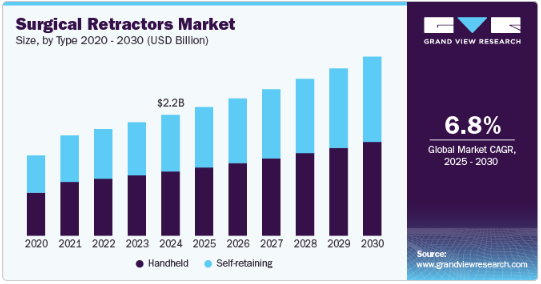
The global Surgical Retractors Market was valued at USD 2.2 billion in 2024 and is projected to reach USD 3.3 billion by 2030, growing at a CAGR of 6.8% from 2025 to 2030.
What Is Creating Greater Demand for Surgical Retractors?
The growing prevalence of chronic diseases, an aging population, and increasing adoption of minimally invasive procedures are contributing to market expansion. Cardiovascular conditions, neurological disorders, and other health complications often require surgical intervention, increasing the need for instruments that provide effective access and visibility.
Greater awareness of women's health is also contributing to surgical demand. Conditions requiring obstetric and gynecological procedures create opportunities for specialized retractors designed for different anatomical and clinical requirements.
Which Retractor Designs Are Used Most Widely?
The market includes handheld and self-retaining retractors, each serving different surgical needs.
Handheld retractors accounted for 53.2% of market revenue in 2024. These instruments are held by a surgeon or another medical professional to maintain tissue positioning and expose the operating area. Their availability in different designs makes them useful across general, orthopedic, thoracic, abdominal, and neurological procedures.
Self-retaining retractors are expected to grow at the fastest rate during the forecast period. Once positioned, these devices remain in place without requiring continuous manual support. This can reduce operating-room crowding, improve surgical-site exposure, and allow medical staff to use their hands for other tasks.
Why Are Specialized Surgical Applications Expanding?
Surgical retractors serve a broad range of specialties, and their design often depends on the procedure being performed.
- Orthopedic surgery: Orthopedic retractors accounted for 18.4% of market revenue in 2024 and are expected to register the fastest growth among product categories. They help protect incisions and provide access to structures such as tendons, arteries, veins, and surrounding tissues.
- Obstetrics and gynecology: This application led the market with a 24.6% revenue share in 2024. Retractors support procedures involving female reproductive organs, including cervical cerclage and episiotomy.
- Neurosurgery: This segment is projected to grow at a CAGR of 7.8%. Neurological and spinal procedures require instruments that provide access while helping protect delicate tissues.
These applications demonstrate why manufacturers must balance accessibility, tissue protection, durability, and ease of use when developing surgical instruments.
Download a free sample report or claim your copy of this full market intelligence report
How Is Product Innovation Changing Surgical Workflows?
Manufacturers are focusing on designs that improve positioning, reduce assistance requirements, and make surgical procedures more efficient.
Examples from the industry illustrate this direction:
Table-mounted retraction systems: Thompson Surgical developed a hip retraction system using flexible tethers to secure retractor blades, reducing the need for staff to hold them manually.
Specialized self-retaining designs: June Medical introduced the Galaxy II surgical retractor series in October 2020, including a design intended for male anatomy.
Three-dimensional printing: Low-cost 3D-printed retractors developed in 2022 demonstrated another approach to making specialized surgical instruments more accessible.
These developments reflect an industry increasingly focused on practical improvements in surgical access, ergonomics, and procedural efficiency.
Where Are Healthcare Facilities Creating the Strongest Demand?
Hospitals accounted for 49.3% of market revenue in 2024, supported by their high volume of surgical procedures and access to advanced medical infrastructure. Their requirements span cardiovascular operations, transplants, trauma treatment, and other complex interventions.
Ambulatory surgical centers are expected to register the highest growth rate during the forecast period. Their appeal includes lower facility costs, improved accessibility, and the ability to perform suitable procedures with shorter recovery periods.
As outpatient surgical services expand, demand for instruments that support efficient and reliable procedures may increase alongside it.
Which Regions Are Shaping Market Development?
North America held the largest regional share, accounting for 30.3% of global revenue in 2024. Established healthcare infrastructure, high surgical volumes, and the adoption of advanced medical technologies support demand in the region.
Asia Pacific is experiencing growth supported by rising chronic disease prevalence, expanding healthcare infrastructure, and wider adoption of minimally invasive procedures in countries such as India, China, and Japan. An aging population in Japan and increasing healthcare investment across emerging economies are contributing to the region's potential.
Europe remains another important market, with demand supported by established healthcare systems, chronic disease management, and growing adoption of robotic-assisted surgery and outpatient care.
What Challenges Could Influence Future Growth?
Regulatory compliance remains essential because surgical retractors must meet requirements related to medical-device safety, quality, and performance. Compliance can increase development costs and extend innovation timelines.
Alternative technologies, including robotic surgical systems, laparoscopic tools, and advanced table-mounted devices, also influence competition. Manufacturers must demonstrate that their products deliver practical benefits in terms of surgical exposure, ease of use, and compatibility with existing workflows.
Key Companies
- Medtronic
- BD
- Medical Devices Business Services, Inc.
- Teleflex Incorporated
- Medline Industries, Inc.
- B. Braun Melsungen AG
What Is the Future Outlook for the Surgical Retractors Market?
The surgical retractors market is projected to reach USD 3.3 billion by 2030 as surgical demand and technological development continue to shape the industry. Handheld devices currently lead revenue, while self-retaining retractors offer opportunities to improve operating-room efficiency.
Product specialization, ergonomic design, and demand across hospitals and ambulatory surgical centers are expected to remain important factors influencing the market's development.
Explore Our Research & Intelligence Solutions
Prism AI: Ask. Analyze. Get Cited Market Insights. – Explore Now
U.S. Healthcare Facility Intelligence: Make Better Decisions with Comprehensive Data – Explore the Platform

 English
 Arabic
 French
 Spanish
 Portuguese
 Deutsch
 Turkish
 Dutch
Dutch
 Russian
 Romaian
 Portuguese (Brazil)
 Greek
Greek
