
A Practical Guide to Choosing Burger Boxes for Different Menu Items and Order Sizes
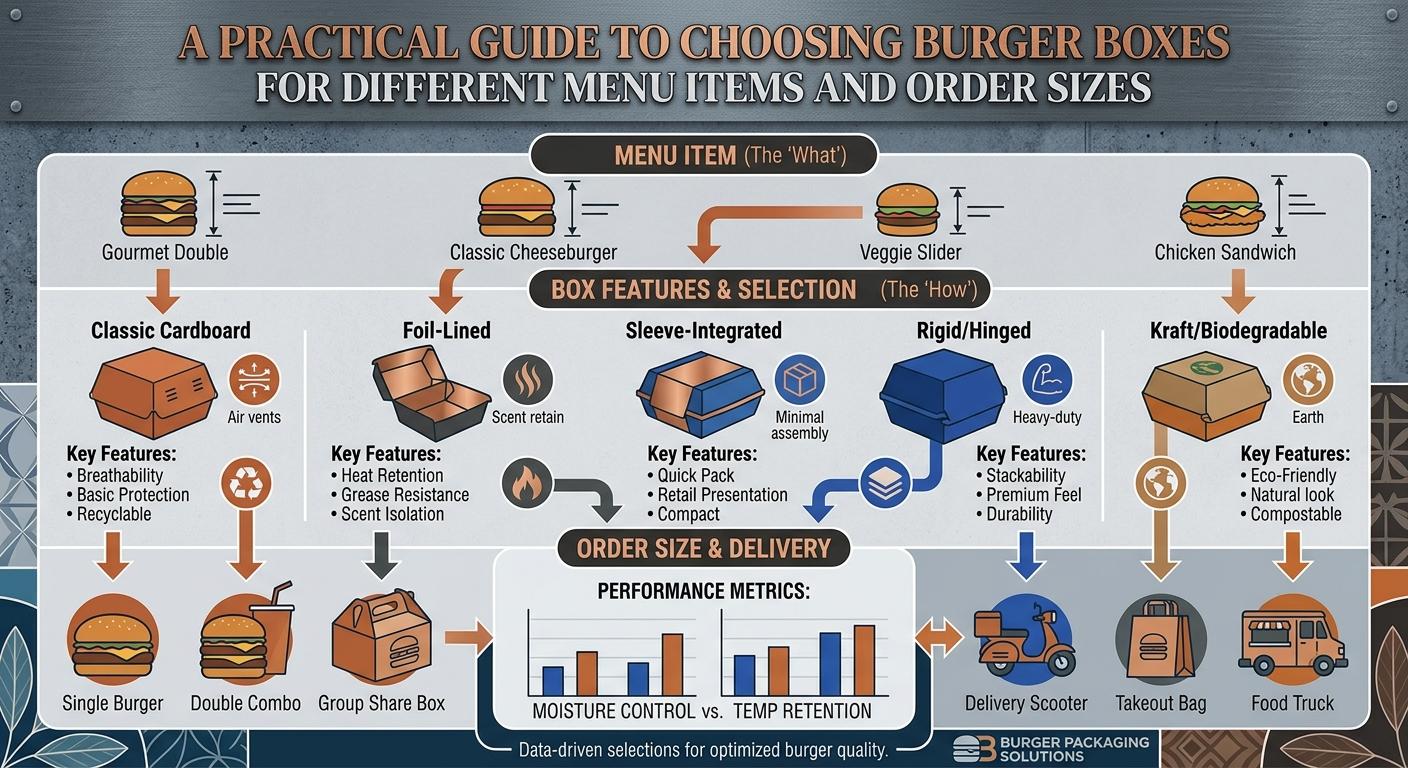
Choosing the right burger box may seem like a small decision, but it can make a significant difference to food presentation, delivery quality, and daily restaurant operations. A box that works perfectly for a standard cheeseburger may not provide enough space for a double-stacked burger, while an oversized container can allow smaller burgers to move around during transportation.
For restaurants, food trucks, takeaway businesses, and delivery kitchens, burger packaging needs to match the food being served. The right box should protect the burger, manage grease and moisture, maintain its structure, and make the order easy for customers to handle.
However, selecting burger boxes involves more than measuring the width of a bun. Restaurants must also consider the height of the burger, the type of toppings, the quantity ordered, the delivery distance, and whether additional items such as fries or sauces need to be packed separately.
This practical guide explains how to choose burger boxes for different menu items and order sizes, helping food businesses select packaging that balances functionality, presentation, storage, and cost.
Start With the Burger, Not the Box: Understanding Your Menu Requirements
The most effective way to choose burger packaging is to begin with the products on your menu. Different burgers have different shapes, heights, moisture levels, and structural requirements.
A classic single-patty burger may fit comfortably inside a compact box, while a gourmet burger with multiple patties, melted cheese, fresh vegetables, and generous sauces may require additional height and stronger construction.
Before contacting a packaging supplier, list the main burger varieties you sell and identify the packaging challenges associated with each one.
Consider these important details:
-
Burger diameter: The box should accommodate the bun without squeezing its edges.
-
Burger height: Tall burgers need enough headroom to prevent the lid from pressing against the toppings.
-
Ingredient moisture: Sauces, juicy patties, and fresh vegetables can increase the need for suitable grease resistance and moisture management.
-
Structural weight: Double burgers and heavily loaded creations may require a stronger base.
-
Serving style: A burger intended for immediate consumption may need different packaging from one that travels for an extended period.
-
Additional components: Wrappers, sauce cups, fries, and other meal components may influence the overall packaging arrangement.
These details help businesses avoid choosing boxes based solely on appearance or price. A package that fits the actual menu is more likely to protect the food and deliver a consistent customer experience.
Classic Cheeseburgers and Single Patties: Why a Close Fit Matters
Classic cheeseburgers, single-patty burgers, and smaller menu items are often the easiest products to package. Their relatively simple construction generally allows restaurants to use standard burger box sizes.
However, a box that is too large can still create problems. Excess space may allow the burger to slide during transportation, increasing the chance of displaced toppings and messy presentation.
On the other hand, a box that is too small can compress the bun or cause cheese and sauces to stick against the lid.
The goal is to select a container that provides enough clearance around the burger while keeping the product reasonably stable.
For these menu items, lightweight paperboard boxes may be suitable when their material grade, construction, and grease resistance meet the requirements of the food.
Restaurants with high sales volumes can benefit from standardizing the packaging used for similar burger sizes. This simplifies stock management and reduces the number of different box types employees need to handle.
Before making a bulk purchase, test the selected box with a freshly prepared cheeseburger to confirm that it closes comfortably and maintains an appealing presentation.
Double Burgers and Tall Gourmet Creations: Packaging That Protects Every Layer
Double-patty burgers, stacked cheeseburgers, and gourmet creations often need more attention because their height and weight can place greater demands on packaging.
A standard low-profile burger box may press against the top bun, flattening the product and pushing sauces or toppings out of position.
For these burgers, restaurants should evaluate boxes with additional internal height and enough structural strength to support the meal during handling.
The base should remain stable when the burger is lifted or carried, while the lid should close without applying unnecessary pressure. A wider box may also be useful when the burger contains large toppings or a generously sized bun.
Material selection matters as well. A thicker or more rigid paperboard construction may provide better support, depending on the box design and burger weight.
However, choosing the largest possible box is not always the best solution. Excess space can allow a tall burger to shift, and unnecessarily large packaging can increase material use and storage requirements.
A practical approach is to measure the tallest and widest products in the menu, then test packaging options that provide sufficient clearance without compromising stability.
Smash Burgers and Thin Patties: Keeping Compact Burgers Neat
Smash burgers are typically flatter than many traditional gourmet burgers, which creates a different packaging challenge.
Although they may not require significant internal height, they still need protection against movement, grease leakage, and excessive moisture.
A compact box can help keep the burger in place and prevent it from sliding during delivery. The selected material should also be suitable for the grease produced by the patty, cheese, and sauces.
Because smash burgers often emphasize a crisp, browned patty and soft bun, moisture management deserves particular attention. Steam trapped inside unsuitable packaging can soften the bun and reduce the contrast between textures.
Restaurants should test how their burgers perform over the expected delivery period rather than assuming that a tight-fitting box will automatically preserve quality.
For businesses with several smash burger variations, using one well-tested box size for products with similar dimensions may simplify purchasing without sacrificing presentation.
Chicken, Crispy, and Saucy Burgers: Managing Moisture and Grease
Chicken burgers and heavily sauced menu items can require packaging that handles different combinations of moisture, grease, and texture.
A crispy chicken burger may lose some of its crunch when steam accumulates inside a closed container. A saucy burger, meanwhile, may create a greater risk of leakage or staining if the packaging material has insufficient grease resistance.
Restaurants should therefore look beyond box dimensions when selecting packaging for these products.
Important features include suitable food-contact materials, a stable structure, appropriate grease resistance, and a design that manages moisture effectively.
Ventilation may help reduce condensation in certain applications, but too much ventilation can increase heat loss. The right balance depends on the food, packaging construction, and expected delivery conditions.
Sauce-heavy burgers may also benefit from secure wrapping or a suitable food-contact liner, provided these additions are compatible with the packaging and do not create unnecessary waste.
The best way to identify the right solution is to test the complete serving process, from the moment the burger is packed until it reaches the customer.
Plant-Based and Specialty Burgers: Matching Packaging to Different Ingredients
Plant-based burgers, specialty patties, and customized creations deserve the same careful packaging consideration as traditional meat burgers.
These products may use different bun sizes, vegetables, sauces, cheese alternatives, or other ingredients that affect their shape and moisture levels.
A plant-based patty does not automatically require a different box. In many cases, a standard container may work perfectly well if its dimensions and performance match the product.
The important factor is the finished burger rather than the label attached to it.
Restaurants should also consider clear identification when handling several burger varieties in the same order. Printed labels, packaging stickers, or other suitable identification methods can help employees distinguish between products and reduce mix-ups.
Where allergen or ingredient information is required, businesses should ensure that the relevant details are communicated accurately and in accordance with applicable requirements.
Selecting packaging based on the actual construction of each menu item makes it easier to accommodate dietary variations while maintaining a consistent presentation.
Choosing the Right Box for Small, Regular, and Large Burger Portions
Burger size is one of the most useful starting points when selecting packaging, but there is no universal set of box dimensions that suits every restaurant.
Bun diameters, burger heights, folding styles, and material thicknesses vary between products and suppliers. Consequently, businesses should use their own measurements instead of relying entirely on generic size labels.
A simple way to organize packaging requirements is to group burgers into three practical categories.
Small or Compact Burgers
Smaller burgers and junior menu items generally work well with compact boxes that reduce unnecessary movement and material use.
The box should still provide enough room for the bun and toppings without squeezing the product.
Regular-Sized Burgers
Standard cheeseburgers and everyday menu items can often share a common box size if their dimensions are sufficiently similar.
Using a standardized option for these products can simplify inventory management and reduce the number of packaging variations required.
Large or Oversized Burgers
Large burgers and premium creations may require wider or taller boxes with stronger construction.
The container should accommodate the full burger without flattening its ingredients or becoming difficult to close.
Rather than selecting sizes by category alone, measure the actual products and compare them against the supplier's internal box dimensions. This creates a more reliable basis for choosing packaging.
Single Burgers Versus Family Orders: Planning Packaging Around Order Size
Packaging requirements change when a customer orders several burgers instead of one.
A single burger may need only an individual box, while a family order can involve multiple burger containers, fries, sauces, drinks, and other meal components.
The key is to distinguish between the box used for each burger and the outer packaging used to carry the complete order.
Individual burger boxes should protect their contents and fit comfortably inside the delivery bag. The outer bag or carrier should provide enough room to hold the order securely without crushing the boxes or allowing containers to tip over.
For family orders, restaurants should consider how the boxes will be arranged, whether different burger sizes can be stacked safely, and how hot and cold items will be separated.
Sauce containers should remain secure, and drinks should be packed in a way that reduces the risk of spills.
Using one oversized box to hold several unprotected burgers is not always a practical solution. Individual containers generally provide better separation and make it easier for customers to distribute meals among family members.
The most suitable arrangement depends on the number of items, their dimensions, and the delivery conditions.
Combo Meals and Add-Ons: When a Burger Box Is Only One Part of the Solution
Combo meals introduce another layer of packaging decisions. A burger may be sold with fries, nuggets, onion rings, dipping sauces, or drinks, each of which can have different packaging requirements.
Although combining everything into one container may seem convenient, it can create problems when different foods need different levels of moisture control or separation.
For example, placing hot fries directly beside a moist burger can affect the texture of both items. Sauce cups may also leak if they are not secured properly.
Restaurants should decide whether their menu is better served by individual containers, separate compartments, or a combination of burger boxes and an outer meal carrier.
Compartmentalized packaging may be useful for certain products, but it should not be selected without checking its actual dimensions, structural strength, and performance.
The objective is to keep each component organized while avoiding unnecessary packaging complexity.
Businesses should also consider how the complete meal fits into the delivery bag, because a well-designed burger box is only effective when it works within the larger packaging system.
Paperboard, Kraft, and Other Materials: Selecting the Right Construction
Box dimensions are important, but material selection also determines how well the packaging performs.
Different materials provide different levels of rigidity, printability, grease resistance, and moisture tolerance. Their performance depends on the material grade, thickness, construction, and any coatings or treatments applied.
Paperboard Burger Boxes
Paperboard is widely used for takeaway burger packaging because it can provide a lightweight structure and a suitable surface for printing.
Its suitability depends on whether the selected grade can support the burger and resist the conditions expected during service and delivery.
Kraft-Style Burger Boxes
Kraft-style boxes are often chosen for their natural appearance and understated presentation.
They can suit many restaurant styles, but buyers should still check strength, grease resistance, and food-contact suitability. A brown appearance alone does not establish the material's environmental credentials.
Specialized and Coated Packaging
Some burgers may benefit from packaging with additional grease resistance or a specialized structural design.
However, coatings and mixed-material construction can affect disposal options. Restaurants should verify the specifications of any proposed packaging and confirm that its performance matches the intended use.
Regardless of material, boxes should be tested with real food before a large order is placed.
Delivery Performance: Choosing Boxes That Hold Up Beyond the Kitchen
Packaging that works well at the counter may not perform equally well after a longer delivery journey.
During transportation, burgers can experience movement, stacking pressure, temperature changes, and exposure to moisture. These conditions can reveal weaknesses that are not obvious when the box is first assembled.
Restaurants should test packaging under realistic conditions based on their typical delivery times and handling practices.
Observe whether the box remains closed, whether the burger moves excessively, and whether grease or moisture affects the packaging structure.
Check the condition of the bun and toppings after the journey, too. A container may remain intact while the food inside loses its intended texture.
The delivery bag is also part of the system. Even a well-designed burger box can be damaged if several heavy containers are stacked incorrectly or if the bag is overloaded.
A useful testing routine involves packing representative menu items, transporting them as a delivery order would be handled, and inspecting the results before choosing a standard box.
This helps businesses select packaging based on actual performance rather than appearance alone.
Cost Control Without Sacrificing Burger Quality
Packaging expenses can add up quickly for restaurants with high order volumes. However, choosing the cheapest available box may create additional problems if it damages food, leaks grease, or requires frequent replacement.
The goal should be to find packaging that offers reliable performance at a reasonable total cost.
Start by comparing the price per box at realistic order quantities. Then consider printing charges, shipping, storage requirements, minimum order quantities, and the amount of packaging waste generated by an unsuitable fit.
Standardizing box sizes across compatible menu items can help reduce complexity. For example, if several regular burgers fit comfortably in the same container, the restaurant may be able to maintain fewer packaging products in stock.
At the same time, standardization should not force oversized or premium burgers into boxes that compromise their presentation.
Businesses can also request samples from suppliers before committing to bulk purchases. Testing a small number of options may prevent costly mistakes when ordering thousands of units.
A practical packaging budget balances material quality, appropriate sizing, food protection, and purchasing efficiency.
A Simple Burger Box Selection Checklist for Restaurant Owners
Before placing an order, restaurant owners can use a short checklist to confirm that their chosen packaging meets the needs of their menu.
-
Measure the width and height of each burger type.
-
Confirm that the box closes without pressing against the toppings.
-
Check the base strength and overall structural stability.
-
Test grease resistance with the actual burger ingredients.
-
Evaluate moisture management during realistic delivery times.
-
Confirm that the packaging is suitable for its intended food-contact application.
-
Check how individual boxes fit inside delivery bags.
-
Determine whether combo meals require separate containers.
-
Compare unit prices, minimum order quantities, and storage needs.
-
Request and test physical samples before ordering in bulk.
This checklist can help businesses make more consistent purchasing decisions and reduce the likelihood of selecting packaging that looks appropriate but performs poorly in daily service.
Conclusion: The Best Burger Box Is the One Designed Around Your Menu
Choosing burger boxes for different menu items and order sizes requires a practical understanding of the food, the packaging, and the way customers receive their meals.
Compact burgers generally benefit from boxes that minimize unnecessary space, while tall gourmet burgers may require greater height and stronger construction. Crispy chicken burgers, saucy creations, and family orders introduce additional considerations involving moisture control, grease resistance, and the organization of multiple items.
Material selection, delivery conditions, storage requirements, and overall cost also influence the final decision.
Restaurants do not necessarily need a different box for every burger on the menu. In many cases, a small selection of carefully tested sizes can accommodate several products without sacrificing food protection or presentation.
The key is to measure actual menu items, evaluate packaging samples, and test performance under realistic conditions before placing a large order.
When burger boxes are selected with the menu and customer experience in mind, they help maintain food quality, simplify restaurant operations, and deliver a more reliable takeaway experience with every order.
Click Here: https://ibexpackaging.com/burger-boxes/

 English
 Arabic
 French
 Spanish
 Portuguese
 Deutsch
 Dutch
Dutch
 Italiano
 Russian
 Romaian
 Portuguese (Brazil)
 Greek
Greek
