
Global Lubricant Market Analysis: Industry Trends, Growth Drivers and Future Outlook
Lubricant Market: Industry Analysis, Growth Drivers, Trends, and Forecast
Market Overview
The global lubricant market plays a vital role in the automotive, manufacturing, construction, marine, aerospace, and energy industries. Lubricants are substances used to reduce friction between moving surfaces, minimize wear and heat generation, and improve the operational efficiency of machinery and equipment. They also provide corrosion protection, support heat transfer, and extend the service life of industrial components.
Lubricants are available in different forms, including mineral oil, synthetic oil, semi-synthetic oil, and bio-based oil. Common products include engine oil, hydraulic oil, gear oil, compressor oil, turbine oil, and greases. These products are essential for maintaining vehicle engines, industrial machinery, manufacturing equipment, and heavy-duty transportation systems.
Increasing automotive production, expanding industrial activities, and growing demand for equipment maintenance are supporting market development. At the same time, manufacturers are focusing on high-performance formulations that improve fuel efficiency, reduce maintenance requirements, and meet evolving environmental standards.
Download Free PDF Brochure@https://www.maximizemarketresearch.com/request-sample/29070/
Market Size and Growth
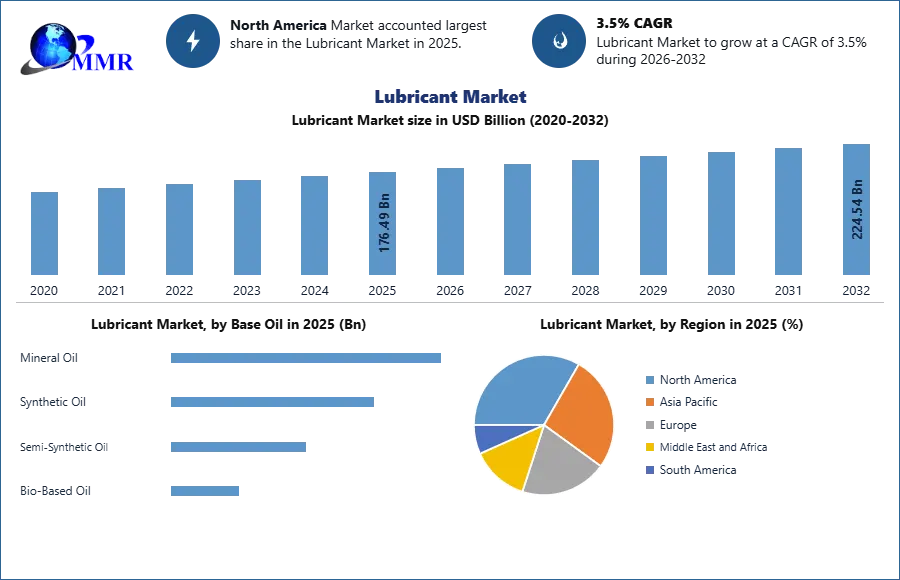
According to Maximize Market Research, the global lubricant market was valued at USD 176.49 billion in 2025 and is projected to reach USD 224.54 billion by 2032, growing at a compound annual growth rate (CAGR) of 3.5% during the 2026–2032 forecast period. <Cite refs={["turn534295search0"]}/>
Market growth is supported by rising demand from the automotive and industrial sectors. Vehicle maintenance, expanding manufacturing capacity, and the increasing use of heavy machinery create consistent demand for lubricating products. The development of synthetic and specialized lubricants is also creating opportunities for manufacturers seeking improved performance and longer service intervals.
However, fluctuating crude oil prices, raw material costs, environmental regulations, and changing automotive technologies may influence market growth. Companies are responding through product innovation, supply chain improvements, and the development of more sustainable lubricant formulations.
Key Market Segmentation
The lubricant market can be segmented by base oil, product type, application, distribution channel, and region.
By Base Oil: The market includes mineral oil, synthetic oil, semi-synthetic oil, and bio-based oil. Mineral oils remain widely used because of their availability and cost advantages. Synthetic lubricants offer enhanced performance under demanding operating conditions, while bio-based products are gaining attention because of their potential environmental benefits.
By Product Type: Major products include engine oil, hydraulic oil, gear oil, compressor oil, turbine oil, and greases. Engine oil is essential for vehicle engine protection, while hydraulic and gear oils support industrial machinery, construction equipment, and manufacturing systems.
By Application: Automotive and industrial applications account for important portions of market demand. Other applications include marine, aerospace, and construction, where lubricants help improve equipment reliability and operational efficiency.
By Distribution Channel: Lubricants are supplied through original equipment manufacturers (OEMs), aftermarket distributors, online platforms, and direct sales channels. Aftermarket sales are important for vehicle servicing and replacement, while direct supply supports industrial customers and large commercial operators.
Growth Drivers
The expansion of the automotive industry is a major driver of the lubricant market. Increasing vehicle ownership, commercial transportation, and demand for regular maintenance support consumption of engine oils, transmission fluids, gear oils, and greases. Modern engines also require formulations that meet specific performance and fuel-efficiency standards.
Industrial development is another significant growth factor. Manufacturing plants, construction projects, mining operations, power generation facilities, and agricultural equipment depend on lubricants to maintain smooth operations. Effective lubrication reduces friction, minimizes component wear, and can help prevent costly equipment failures.
Technological advancements are further supporting market growth. High-performance lubricants can provide improved oxidation stability, temperature resistance, and protection under heavy loads. These characteristics are valuable for industries seeking better productivity and lower maintenance costs.
Emerging Trends
The growing adoption of synthetic lubricants is an important market trend. These products can provide improved performance in demanding environments and may support longer oil change intervals when recommended by equipment manufacturers. Demand is increasing for specialized formulations designed for modern engines and advanced industrial machinery.
Sustainability is another major trend. Manufacturers are developing bio-based and biodegradable lubricants for applications where environmental impact is an important consideration. Re-refined base oils and improved recycling practices are also attracting attention as companies seek to reduce waste and use resources more efficiently.
The growth of electric vehicles is influencing product development. Although electric vehicles generally require less engine oil than conventional vehicles, they still use specialized fluids and greases for transmissions, bearings, thermal management, and other components. Lubricant producers are adapting their portfolios to meet these changing requirements.
Digital maintenance technologies are also becoming more important. Oil condition monitoring, predictive maintenance, and lubricant analysis help industrial operators assess equipment health and identify potential problems before major failures occur.
Regional Analysis
Asia Pacific is a key region in the global lubricant market, supported by expanding automotive production, industrialization, construction activities, and manufacturing investment. China, India, Japan, and other regional economies offer substantial demand from vehicle manufacturers, industrial facilities, and transportation operators.
North America represents an established market, benefiting from automotive maintenance, advanced manufacturing, heavy equipment operations, and demand for high-performance industrial lubricants. Technological development and the presence of major lubricant suppliers also support regional activity.
Europe is driven by automotive engineering, industrial production, environmental standards, and demand for energy-efficient lubricant formulations. Manufacturers are increasingly focused on products that meet stringent technical and sustainability requirements.
The Middle East and Africa benefit from demand associated with oil and gas operations, construction, transportation, and infrastructure development. South America also presents opportunities through agricultural machinery, mining, automotive servicing, and industrial expansion.
Competitive Landscape
The global lubricant market is highly competitive, with major petroleum companies, specialty chemical manufacturers, and independent lubricant producers competing through product innovation, pricing, distribution, and technical services. Companies are investing in advanced formulations to meet the requirements of modern engines, industrial machinery, and environmentally sensitive applications.
Key players include Shell plc, ExxonMobil Corporation, BP plc, Chevron Corporation, TotalEnergies SE, PetroChina Company Limited, Sinopec Limited, FUCHS SE, Idemitsu Kosan Co., Ltd., Phillips 66 Company, Valvoline, PETRONAS, Castrol, Motul, Indian Oil Corporation, and Bharat Petroleum Corporation.
Market participants are strengthening their product portfolios, expanding distribution networks, and developing synthetic and bio-based lubricants. Strategic partnerships, research investments, and improvements in manufacturing efficiency are important approaches for maintaining competitiveness.
Download Free PDF Brochure@https://www.maximizemarketresearch.com/request-sample/29070/
Recent Developments
Recent industry developments highlight the increasing focus on lubricant supply capacity, sustainability, and advanced formulations. According to the referenced market report, Chevron restarted its Pascagoula base-oil unit in January 2026, supporting the availability of base oils used in lubricant production.
The report also identifies growing industry interest in biodegradable industrial lubricants and environmentally acceptable marine lubricants. In March 2025, the American Petroleum Institute introduced updated API SQ and ILSAC GF-7 engine oil standards, reflecting the industry's continuing emphasis on engine protection and fuel efficiency.
These developments demonstrate how manufacturers are adapting to changing technical requirements, environmental expectations, and demand for higher-performance lubricant products.
Future Outlook
The lubricant market is expected to maintain steady growth through 2032, supported by automotive servicing, industrial expansion, infrastructure development, and demand for reliable machinery performance. Synthetic lubricants, specialized industrial oils, and environmentally considerate formulations are likely to create additional business opportunities.
Electric vehicle adoption will encourage manufacturers to develop specialized transmission fluids, thermal management fluids, and greases suited to electric powertrains. Industrial operators are also expected to increase their use of oil analysis and predictive maintenance to improve equipment reliability and reduce downtime.
However, raw material price volatility, environmental regulations, and the gradual transition toward electric mobility may affect conventional lubricant demand. Companies that invest in innovation, sustainable production, and customer-focused solutions will be better positioned to address these challenges.
For full access to the comprehensive strategic report, visit:https://www.maximizemarketresearch.com/market-report/global-lubricant-market/29070/
Conclusion
The global lubricant market remains essential to automotive transportation, industrial manufacturing, construction, marine operations, and power generation. Valued at USD 176.49 billion in 2025, the market is projected to reach USD 224.54 billion by 2032, registering a CAGR of 3.5%. Growing demand for high-performance lubricants, improvements in synthetic formulations, and increasing interest in sustainable products will shape future market development. Manufacturers that combine product quality, technological advancement, and efficient distribution are likely to maintain strong competitive positions.
About Maximize Market Research
Maximize Market Research is a multifaceted market research and consulting company with professionals from several industries. Some of the industries we cover include medical devices, pharmaceutical manufacturers, science and engineering, electronic components, industrial equipment, technology and communication, cars and automobiles, chemical products and substances, general merchandise, beverages, personal care, and automated systems. To mention a few, we provide market-verified industry estimations, technical trend analysis, crucial market research, strategic advice, competition analysis, production and demand analysis, and client impact studies.
Contact Maximize Market Research
3rd Floor, Navale IT Park, Phase 2
Pune Bangalore Highway, Narhe,
Pune, Maharashtra 411041, India
sales@maximizemarketresearch.com
+91 96071 95908, +91 9607365656

 English
 Arabic
 French
 Spanish
 Deutsch
 Turkish
 Dutch
Dutch
 Italiano
 Russian
 Romaian
 Portuguese (Brazil)
 Greek
Greek
