
Sodium Benzoate Market Projected to Hit USD 2.85 Billion by 2036, India Records 7.0% CAGR
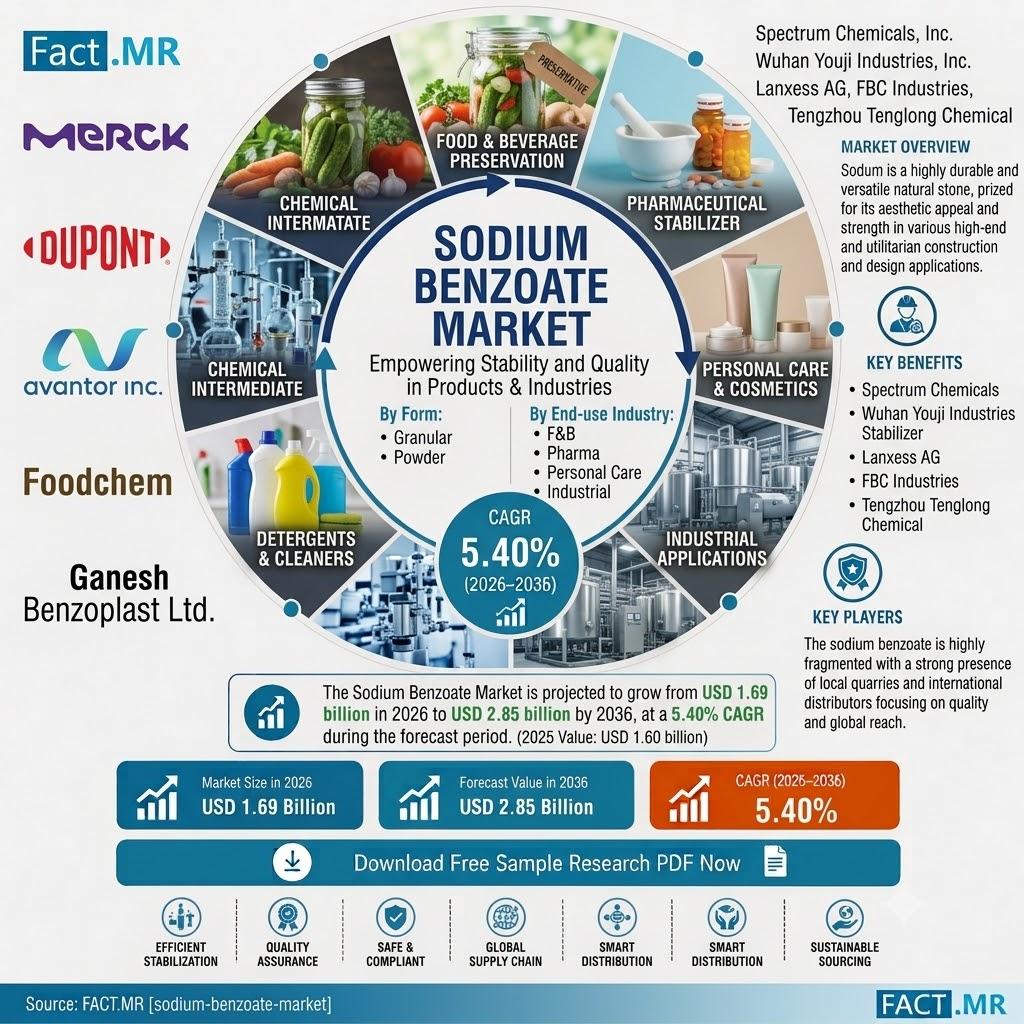
The global sodium benzoate market is projected to grow from USD 1.69 billion in 2026 to USD 2.85 billion by 2036, registering a compound annual growth rate (CAGR) of 5.4%, according to Fact.MR. Demand is supported by processed food production, carbonated beverage manufacturing, and the need for effective preservation in water-based cosmetic and pharmaceutical formulations. The forecast represents an incremental market opportunity of USD 1.16 billion over the 2026–2036 period.
Sodium benzoate is the sodium salt of benzoic acid and is used to inhibit the growth of yeasts, molds, and bacteria in acidic environments. Food processors rely on it to help maintain product stability, while cosmetic manufacturers use it in selected personal care formulations. Pharmaceutical applications provide an additional demand base, particularly where manufacturers require documented excipient quality and compliance with relevant standards.
Get detailed market forecasts, competitive benchmarking, and pricing trends: https://www.factmr.com/connectus/sample?flag=S&rep_id=11703
Food and Beverage Preservation Supports Market Demand
Food and beverage manufacturers represent a leading customer group for sodium benzoate suppliers. The preservative is used in carbonated soft drinks, fruit beverages, sauces, condiments, and other acidic food products. Its established use and compatibility with acidic formulations support continued procurement across large-scale production operations.
Growth in packaged food consumption is creating opportunities in emerging economies, where expanding retail distribution and beverage production increase the need for preservation systems. Manufacturers also need ingredients that perform consistently during storage and transportation, particularly when products move through complex distribution networks.
However, food manufacturers are paying close attention to ingredient transparency and formulation requirements. Some product developers are exploring clean-label alternatives, creating pressure on suppliers to provide technical documentation and evidence of appropriate use. For sodium benzoate producers, consistent purity, traceable sourcing, and reliable analytical testing remain important commercial requirements.
Cosmetics and Pharmaceutical Applications Expand the Customer Base
Cosmetics accounted for 30.5% of the sodium benzoate market by application in 2025, according to Fact.MR. Water-based skincare, haircare, and personal care formulations require preservation systems that help prevent microbial contamination during storage and use. Sodium benzoate can serve these applications when formulation conditions and regulatory requirements support its use.
Pharmaceutical manufacturers represent another source of demand. Sodium benzoate is used in selected pharmaceutical formulations as an excipient, with procurement decisions influenced by purity specifications, documentation, and applicable pharmacopeial standards. Suppliers serving this segment need to maintain appropriate quality controls and provide evidence that their products meet customer requirements.
These application groups create different opportunities for manufacturers. Food-grade products require compliance with food additive standards, while cosmetic and pharmaceutical customers may require distinct specifications and supporting documentation. Producers that can supply multiple grades may serve a wider range of customers, provided they maintain the necessary quality systems.
Powder Form Leads the Market
Powder is projected to account for 61.0% of the sodium benzoate market by form in 2026. According to Fact.MR, its leading position reflects ease of handling, dosing precision, and compatibility with dry blending and aqueous dissolution processes. Standard powder grades also fit established production workflows across food, beverage, and personal care manufacturing.
Granules serve applications where controlled handling, improved flowability, and precise dosing are important. Fact.MR identifies granules as a specialized segment, with demand supported by pharmaceutical excipient applications and requirements for consistent material measurement. Other forms, including solutions, serve more specific processing needs.
By application, beverages and food are projected to hold a 46.0% share in 2026. This reflects the preservative’s established role in carbonated beverages, fruit juices, acidified foods, and condiments. Cosmetics and pharmaceuticals provide additional demand, supporting a market that serves multiple industries with different technical and regulatory requirements.
India Leads Country-Level Growth
India is projected to record the fastest growth among the countries covered in Fact.MR’s analysis, with a CAGR of 7.0% through 2036. Expanding packaged food consumption, beverage production, pharmaceutical manufacturing, and personal care formulation activity support the outlook. Manufacturing hubs in Maharashtra, Gujarat, and Tamil Nadu contribute to demand for food and pharmaceutical ingredients.
China follows with a projected CAGR of 6.7%, supported by its large food-processing base and expanding cosmetic and pharmaceutical manufacturing industries. The United States is forecast to grow at 5.9%, while Japan is expected to record 5.8%. Germany and the United Kingdom are projected to register CAGRs of 5.6% and 5.5%, respectively. Brazil follows at 5.4%.
These markets present different opportunities for suppliers. Emerging economies offer growth linked to expanding production volumes, while established markets place strong emphasis on product quality, regulatory documentation, and technical support. Across regions, sodium benzoate producers must manage feedstock price changes and maintain consistent product specifications to retain customer confidence.
Analyst Perspective
Shambhu Nath Jha, Principal Consultant for Food and Beverage at Fact.MR, explains how beverage production and formulation changes are shaping the market:
“In my analysis, I have observed that the sodium benzoate market is structurally tied to carbonated beverage production volumes in emerging economies and the clean-label reformulation trend in developed markets.
The clean-label movement presents a dual dynamic: while some food manufacturers seek preservative-free formulations, the majority of acidic beverage and condiment products cannot achieve adequate shelf life without sodium benzoate at approved use levels. Suppliers that provide transparent sourcing documentation and analytical certificates of analysis with benzene formation potential data will retain formulator confidence against clean-label substitution pressure.”
The analysis points to the importance of technical support alongside product supply. Manufacturers need documentation that helps customers evaluate ingredient quality, application suitability, and regulatory compliance. For beverage suppliers in particular, formulation-specific testing and transparent analytical records can support continued qualification.
Competitive Landscape
Competition in the sodium benzoate market is influenced by manufacturing scale, product purity, multi-grade production capabilities, and regulatory documentation. Suppliers serving food, cosmetic, and pharmaceutical customers must meet different quality specifications while maintaining reliable supply and competitive pricing.
Key companies profiled by Fact.MR include Merck KGaA, DuPont de Nemours, Inc., Avantor Inc., Foodchem International Corporation, Ganesh Benzoplast Ltd., Spectrum Chemicals, Wuhan Youji Industries Co. Ltd., LANXESS AG, FBC Industries, Inc., and Tengzhou Tenglong Chemical Co., Ltd.
Suppliers can strengthen their market position through batch consistency, transparent sourcing records, and application-specific technical assistance. Pharmaceutical-grade producers must maintain relevant documentation, while food-grade suppliers need to support customers with quality certificates and information relevant to the intended formulation.
Market Snapshot
The global sodium benzoate market was valued at USD 1.60 billion in 2025 and is projected to reach USD 1.69 billion in 2026. Fact.MR forecasts the market to reach USD 2.85 billion by 2036, representing a 5.4% CAGR during 2026–2036. The market is expected to generate an incremental opportunity of USD 1.16 billion. Powder is projected to account for 61.0% of the form segment, while beverages and food are expected to hold a 46.0% share of applications in 2026.
To View Related Reports
https://afgbfh.blogspot.com/2026/10/data-as-service-market-growth-forecast.html
https://sportgalax.com/read-blog/25379
About Fact.MR
Fact.MR is a market research and consulting company providing market intelligence, competitive analysis, and forecasting across global industries. Its research covers emerging technologies, evolving consumer trends, industrial developments, and changing business environments. Fact.MR delivers data-driven insights designed to support strategic planning, investment decisions, and market-entry initiatives.

 English
 Arabic
 French
 Spanish
 Portuguese
 Turkish
 Dutch
Dutch
 Italiano
 Russian
 Romaian
 Portuguese (Brazil)
 Greek
Greek
