
Lithium-ion Battery Recycling Market Projected to Hit USD 17.4 Billion by 2036, China Records 48.3% CAGR
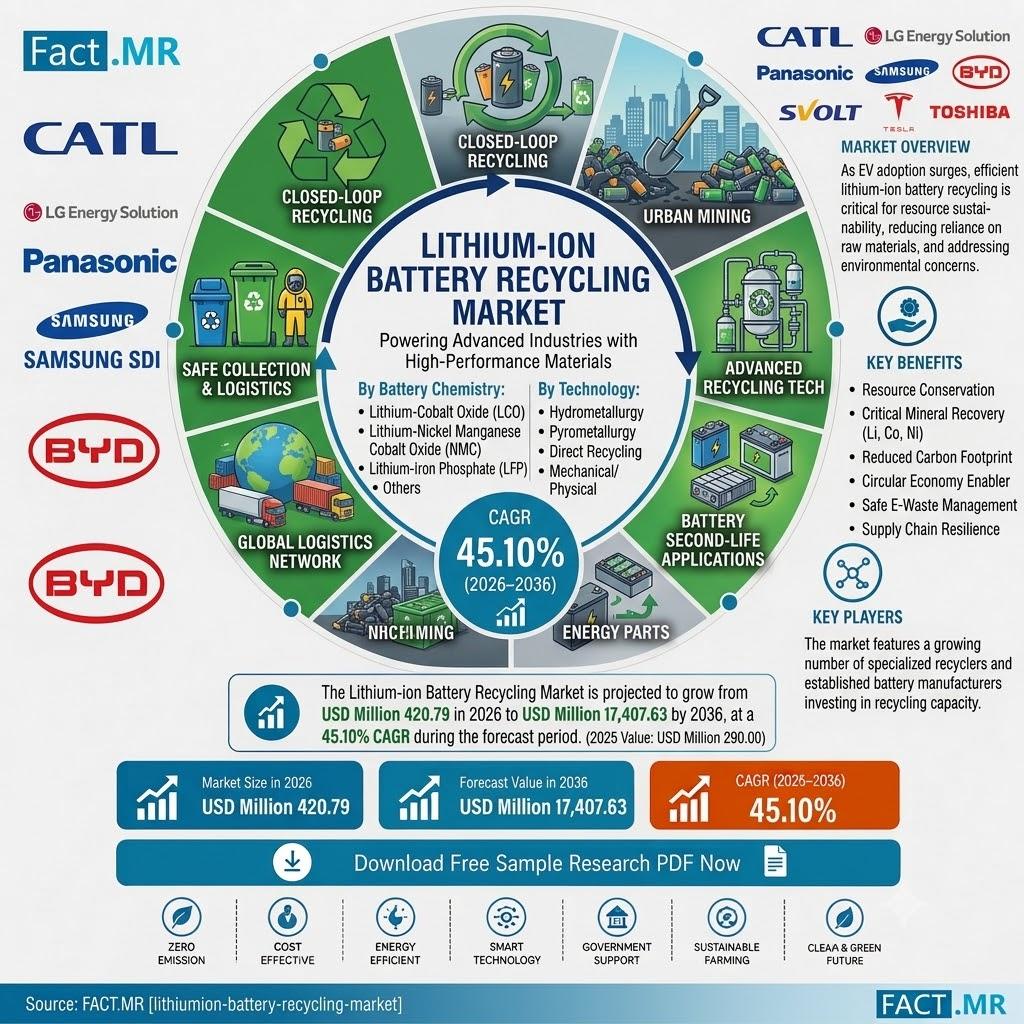
The global lithium-ion battery recycling market is projected to grow from USD 420.79 million in 2026 to USD 17.41 billion by 2036, according to Fact.MR. The forecast reflects a reported compound annual growth rate (CAGR) of 45.1% and an incremental market opportunity of approximately USD 16.99 billion. Rising electric vehicle adoption, demand for recovered lithium and other battery metals, and efforts to strengthen domestic supply chains are increasing the need for effective battery collection and recycling systems.
Battery manufacturers and automotive companies are looking beyond primary mineral supplies to secure materials for future production. Recycling can recover valuable metals from end-of-life batteries and manufacturing scrap, helping return these materials to battery supply chains. However, the economics of recycling depend on feedstock availability, battery chemistry, recovery efficiency, processing costs, and the quality of recovered materials.
Get detailed market forecasts, competitive benchmarking, and pricing trends: https://www.factmr.com/connectus/sample?flag=S&rep_id=5520
Electric Vehicle Battery Retirements Support Recycling Demand
Transportation accounted for 69.8% of the lithium-ion battery recycling market by application in 2025, according to Fact.MR. Electric vehicle battery packs represent a major potential source of recyclable material because they contain lithium and, depending on chemistry, nickel, cobalt, manganese, and other recoverable components.
As electric vehicle adoption expands, recycling companies are preparing for higher volumes of batteries reaching the end of their useful service life. Establishing collection networks and processing capacity ahead of these retirement waves can help recyclers secure feedstock and build relationships with automotive manufacturers.
Critical mineral security is another growth driver. Battery producers face supply-chain exposure when important raw materials are concentrated in a limited number of countries. Recovering materials domestically can diversify supply sources and support circular production models.
Regulatory requirements are also influencing investment decisions. Battery collection targets, producer-responsibility obligations, and recycled-content requirements can encourage manufacturers to develop partnerships with recycling specialists. Nevertheless, commercial viability remains a challenge where collection volumes are low or logistics and processing costs are high.
Hydrometallurgy and Direct Recycling Shape Technology Investment
Battery recycling technologies differ in their processing requirements and the materials they can recover. Hydrometallurgical processes use chemical solutions to extract and separate metals, while pyrometallurgical processes use high-temperature treatment. Physical recycling methods focus on dismantling, sorting, and separating battery materials.
Direct recycling is attracting attention because it seeks to preserve and regenerate cathode materials rather than recover their constituent metals entirely and manufacture new cathodes from scratch. Its commercial potential depends on battery chemistry, the condition of recovered materials, and the ability to meet quality specifications.
Lithium iron phosphate (LFP) batteries and nickel-manganese-cobalt (NMC) batteries present different recycling economics. NMC batteries contain valuable nickel and cobalt, while LFP batteries have a different material composition and recovery-value profile. Recycling facilities therefore need adaptable processes and reliable battery identification systems.
The market also faces infrastructure challenges. Safe transportation, discharge, dismantling, and sorting require specialized procedures. Facilities must handle different cell formats and chemistries while maintaining worker safety and environmental compliance. Companies that secure long-term feedstock agreements and improve recovery efficiency may be better positioned to manage these operating demands.
China Leads Country-Level Growth
China is projected to record the fastest growth among the countries covered by Fact.MR, with a CAGR of 48.3% through 2036. Its extensive electric vehicle manufacturing base, battery production capacity, and investment in recycling infrastructure support the outlook. Major battery and automotive companies are also pursuing greater control over material recovery and reuse.
The United States is forecast to grow at a CAGR of 45.9%, supported by domestic battery manufacturing investments and efforts to strengthen critical mineral supply chains. Germany follows at 44.4%, reflecting its automotive industry and focus on circular material flows.
India is projected to register a CAGR of 42.7%. Electric two-wheelers and three-wheelers, expanding battery manufacturing, and growing electric mobility adoption create opportunities for recycling infrastructure. Industrial centers in Maharashtra, Gujarat, Tamil Nadu, and Karnataka are relevant to the development of collection, processing, and battery supply-chain operations.
Japan and South Korea are expected to record CAGRs of 40.3% and 39.1%, respectively, while the United Kingdom is projected to grow at 37.8%. Across these markets, investment opportunities depend on local battery retirement volumes, regulatory frameworks, and the availability of technologies capable of producing materials suitable for reuse in battery manufacturing.
Analyst Perspective
Shambhu Nath Jha, Principal Consultant at Fact.MR, highlights the importance of documented performance and dependable supply chains in the lithium-ion battery recycling market:
“In my analysis, I have observed that procurement decisions in the lithium-ion battery recycling market increasingly depend on application-specific performance documentation and supply chain reliability credentials rather than per-unit pricing alone. Suppliers investing in technical service capabilities and quality consistency documentation hold procurement advantages over commodity-positioned competitors.”
This perspective underscores the need for recyclers to demonstrate material quality, recovery performance, and reliable delivery. Battery manufacturers evaluating recovered materials need evidence that those materials meet the specifications required for downstream processing. Strong supplier qualification and transparent quality controls can support longer-term commercial relationships.
Competitive Landscape
Competition in the lithium-ion battery recycling market involves battery manufacturers, automotive companies, and specialist recycling businesses developing material recovery capabilities. Strategic priorities include access to end-of-life batteries, efficient processing, recovered-material quality, and partnerships that connect recycling operations with battery production.
Key companies profiled by Fact.MR include Contemporary Amperex Technology Co., Limited (CATL), LG Energy Solution, Ltd., Panasonic Corporation, Samsung SDI Co., Ltd., BYD Company Limited, SVOLT Energy Technology Co., Ltd., Tesla, Inc., and Shenzhen Manly Battery Co., Ltd.
Battery manufacturers and automotive companies are increasingly interested in closed-loop material flows that can help secure raw materials and reduce reliance on primary supply. Recycling specialists can compete by establishing dependable collection networks, improving process yields, and producing recovered materials that meet battery-industry specifications.
Market Snapshot
The global lithium-ion battery recycling market is reported by Fact.MR to be valued at USD 420.79 million in 2026 and projected to reach USD 17.41 billion by 2036, at a reported CAGR of 45.1%. Transportation represented 69.8% of the market by application in 2025, while Asia Pacific accounts for a projected 33.1% regional share. China leads the country-level growth outlook with a forecast CAGR of 48.3% through 2036.
To View Related Reports
https://afgbfh.blogspot.com/2026/10/hose-protection-sleeves-market-to.html
https://sportgalax.com/read-blog/25358
About Fact.MR
Fact.MR is a market research and consulting company providing market intelligence, competitive analysis, and forecasting across global industries. Its research covers emerging technologies, evolving consumer trends, industrial developments, and changing business environments. Fact.MR delivers data-driven insights designed to support strategic planning, investment decisions, and market-entry initiatives.

 English
 Arabic
 Spanish
 Portuguese
 Deutsch
 Turkish
 Dutch
Dutch
 Italiano
 Russian
 Romaian
 Portuguese (Brazil)
 Greek
Greek
