
The Ultimate Manuscript Preparation Checklist Before You Publish Your Book
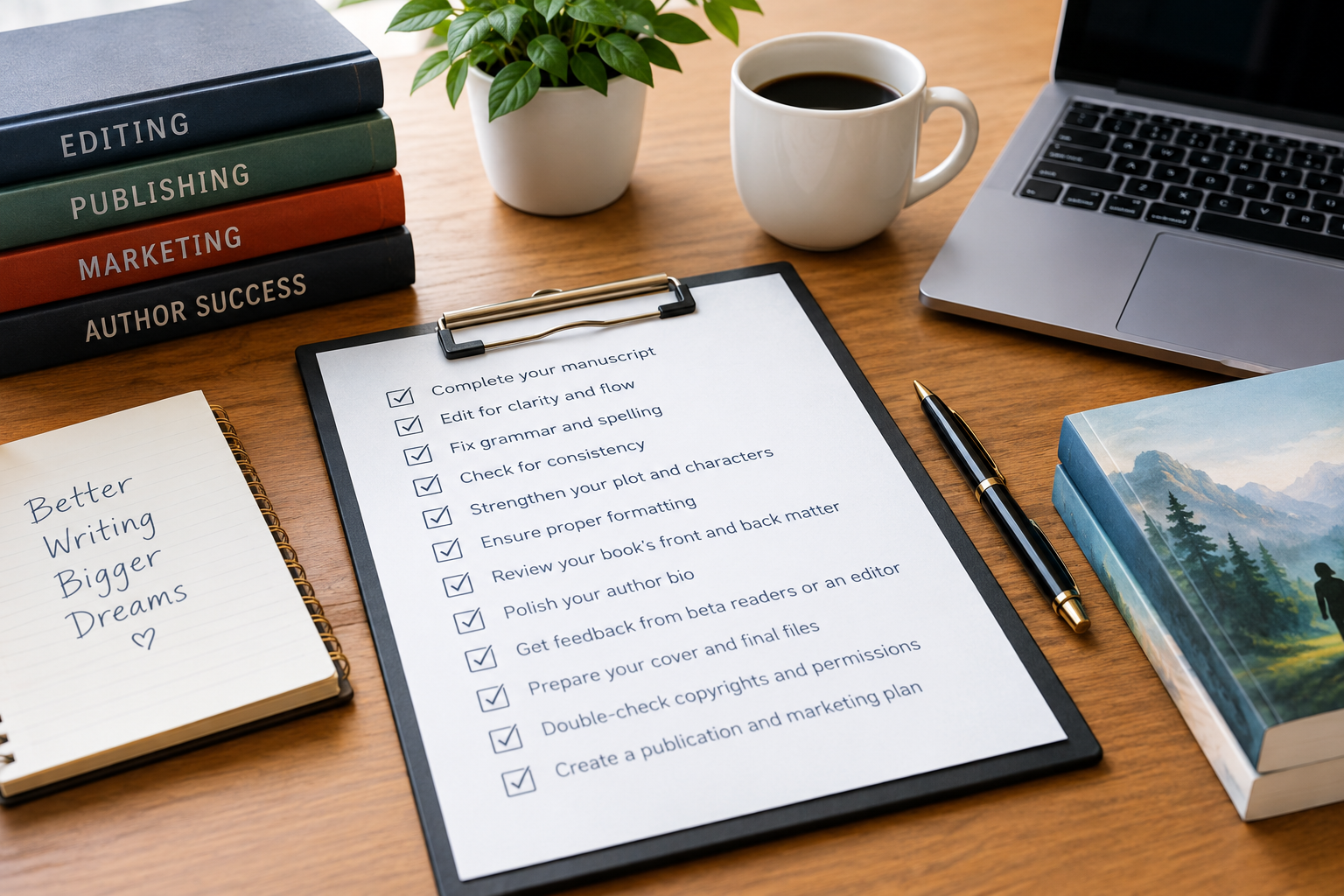
Preparing a manuscript for publication requires more than finishing the final chapter. Authors must review their writing, correct errors, organize the content, and ensure that every section meets professional publishing standards. Whether you are publishing your first book or preparing another title for release, a structured manuscript preparation checklist can help you avoid costly revisions and move confidently toward publication.
A well-prepared manuscript also creates a better reading experience. Clear writing, consistent formatting, accurate information, and professional editing allow readers to focus on your ideas rather than distractions. By completing each stage carefully, you can transform your draft into a polished book that reflects your vision and meets your publishing goals.
1. Complete Your Manuscript Before Starting the Final Review
Before sending your manuscript for editing or formatting, ensure that the main content is complete. Although you can revise individual chapters along the way, a complete draft allows you to evaluate the book as a whole. It also helps you identify missing information, unnecessary sections, and inconsistencies that may not become obvious when reviewing chapters separately.
Check the Structure and Organization
Start by examining your manuscript's overall structure. For nonfiction, check whether the chapters follow a logical sequence and guide readers through your subject. For fiction, review the plot, character development, pacing, and resolution. A professional book publishing company can also help you assess your manuscript's organization and ensure that each chapter serves a clear purpose and contributes to the book's central message or story.
Remove Unnecessary Content
Next, identify repeated explanations, irrelevant examples, lengthy introductions, and sections that interrupt the flow. Removing unnecessary material makes your writing more focused without sacrificing important details. However, avoid cutting content simply to reduce the word count. Every revision should improve clarity, strengthen the narrative, or provide greater value to your intended audience.
2. Revise Your Manuscript for Clarity and Readability
Once your draft is complete, review it from the reader's perspective. Your goal is to communicate ideas clearly while maintaining an engaging voice. Read each chapter carefully and look for confusing explanations, awkward sentences, weak transitions, and paragraphs that contain too many ideas. These improvements create a smoother reading experience and make your manuscript easier to understand.
Improve Sentence Structure and Flow
Vary sentence length to maintain a natural rhythm. Replace complicated phrases with straightforward language when appropriate, and divide long paragraphs that contain several unrelated points. Additionally, check transitions between sections so that readers can follow your argument or story without unnecessary interruptions. Strong writing does not need to sound complicated to communicate meaningful ideas.
Maintain a Consistent Writing Style
Consistency helps readers recognize your voice throughout the book. Review your preferred spelling conventions, capitalization, terminology, point of view, and tense. For example, if you write in the past tense, avoid switching to the present without a clear reason. Similarly, use consistent terms for recurring concepts, characters, places, and technical subjects.
3. Complete Professional Editing and Proofreading
Editing and proofreading are essential steps before you publish your book. Although both processes improve manuscript quality, they address different concerns. Editing examines the writing's clarity, structure, accuracy, and effectiveness, while proofreading identifies remaining spelling, punctuation, grammar, and typographical errors. Understanding these differences helps you choose the right services for your manuscript.
Consider Developmental Editing
Developmental editing focuses on the book's overall structure and content. An editor may evaluate chapter organization, pacing, argument development, character motivation, or gaps in the material. This stage is particularly valuable when your manuscript needs substantial revisions. Addressing structural weaknesses before formatting prevents you from spending time polishing passages that may later require significant changes.
Use Copyediting and Proofreading
Copyediting improves sentence-level consistency, grammar, punctuation, word choice, and readability. After completing those revisions, proofreading provides a final check for errors that remain in the text. For the strongest results, avoid treating a single read-through as sufficient. If your budget allows, work with qualified professionals who can review your manuscript objectively and identify problems you may overlook.
4. Verify Facts, Sources, and Originality
Accuracy is important in every genre, especially nonfiction, educational books, biographies, and professional guides. Before publication, verify names, dates, statistics, quotations, references, and other factual claims. Check that examples support your arguments and that your explanations do not rely on outdated information. Correcting these details protects your credibility and helps readers trust the material you present.
Check Citations and Permissions
If your manuscript includes quotations, photographs, illustrations, song lyrics, or other third-party material, determine whether you need permission to reproduce them. Follow the relevant citation style when referencing external sources, and distinguish your own ideas from borrowed material. Copyright rules vary by jurisdiction and context, so consult an appropriate professional when a use is legally uncertain.
Review Originality and Attribution
Confirm that your manuscript presents original work or properly acknowledges material from other sources. Similarity-checking tools can help identify passages that deserve closer examination, but their reports require human judgment. Common phrases and correctly cited quotations may produce matches. Review potential issues individually, revise where necessary, and ensure that your final manuscript respects intellectual property rights.
5. Prepare Front Matter and Back Matter
A professional book includes more than its main chapters. Front matter introduces the publication and helps readers navigate its contents, while back matter provides supplementary information and encourages further engagement. The specific elements depend on your genre, audience, and publishing format. Planning these sections early makes the final manuscript more complete and easier to prepare for production.
Organize the Front Matter
Depending on your book, front matter may include a title page, copyright page, dedication, acknowledgments, table of contents, foreword, preface, or introduction. Choose elements that serve a clear purpose rather than including every possible section. Confirm that the title, author name, subtitle, and other publication details remain consistent across the manuscript and the information supplied to your publishing team.
Complete the Back Matter
Back matter may include an author's biography, references, glossary, appendix, index, discussion questions, or recommended reading list. Fiction authors might add acknowledgments and a preview of another book, while nonfiction writers may provide practical resources. Include only relevant material, verify all details, and ensure that each section supports the reader's experience or provides a useful next step.
6. Create a Consistent Manuscript Formatting Style
Manuscript formatting helps editors, designers, and publishing professionals work with your content efficiently. However, a manuscript file is not necessarily the same as a finished book layout. Unless your publishing provider requests print-ready formatting, focus on creating a clean, consistent document that preserves the structure of your writing and makes revisions straightforward.
Standardize Headings and Paragraphs
Use consistent chapter titles, section headings, paragraph spacing, and text alignment. Apply built-in heading styles in your word processor instead of manually changing the appearance of every heading. These styles make navigation easier and help your production team identify the manuscript's hierarchy. Also, remove unnecessary spaces, repeated blank lines, and inconsistent manual formatting.
Check File Format and Organization
Save your manuscript in the file format requested by your editor or publishing provider, commonly DOCX for editable text or PDF for a fixed-layout proof. Use a clear filename and maintain separate copies of important revisions. Before submitting, confirm that page breaks, chapter divisions, special characters, footnotes, tables, and other elements appear as intended in the document.
7. Review Images, Tables, and Other Visual Elements
Visual content can strengthen a book, but poorly prepared graphics may create production problems. If your manuscript includes photographs, charts, illustrations, maps, or tables, review each item for quality, relevance, and consistency. Ensure that visuals support the surrounding text and that readers can understand their purpose without unnecessary explanation.
Check Image Quality and Placement
Confirm that images meet your publisher's technical requirements for resolution, dimensions, color, and file format. Print and digital publications may require different specifications, so request guidance before finalizing your files. Label each image clearly, identify its intended placement, and provide captions or credits where appropriate. Avoid relying on low-quality images copied from websites or screenshots.
Verify Tables and Captions
Review tables for accurate figures, readable labels, consistent formatting, and clear headings. Check that every chart or illustration mentioned in the text appears in the correct location and that cross-references point to the right item. If the book contains complex visuals, ask your production team how to supply the original files and whether additional accessibility descriptions are required.
8. Confirm Your Book's Title, Audience, and Positioning
A polished manuscript should have a clear identity before it enters production. Review your working title and subtitle to ensure they represent the book accurately and appeal to the intended audience. With professional publishing consulting services, authors can refine their book's positioning and ensure the title communicates its value effectively. Your title should give readers a meaningful idea of what they can expect from the finished publication.
Identify Your Target Readers
Define who will benefit most from your book. Consider their interests, experience level, challenges, and expectations. A manuscript written for beginners may require more explanations and examples than one intended for experienced professionals. Understanding your audience helps you make informed decisions about tone, vocabulary, chapter length, and the amount of background information readers need.
Prepare a Clear Book Description
Draft a concise description that communicates your book's main value. For fiction, introduce the central premise, conflict, and atmosphere without revealing important surprises. For nonfiction, explain the problem your book addresses and what readers can learn. You can refine this description later for sales platforms, but preparing it now helps clarify your manuscript's purpose and positioning.
9. Prepare for ISBNs, Copyright Details, and Publishing Requirements
Before publication, identify the administrative requirements associated with your chosen publishing route. Depending on your format, distribution plans, and location, you may need an ISBN, copyright information, metadata, or other documentation. Requirements differ among countries, platforms, and publishing services, so confirm the details with the relevant issuing authority or publishing provider rather than relying on assumptions.
Verify Publication Information
Check the spelling of the author's name, book title, subtitle, edition details, and any contributor credits. If you use a pen name, make sure your publishing records reflect your chosen arrangement. Also, confirm who will obtain the ISBN, prepare the copyright page, and manage distribution metadata. Clear responsibilities help prevent delays and inconsistencies during production.
Understand Your Publishing Agreement
If you work with a publishing company or independent publishing partner, review the agreement before approving services. Pay attention to ownership, licensing, royalties, distribution, fees, revision policies, and control over creative decisions. Ask questions about anything unclear. Understanding these terms helps you make informed choices while protecting your interests throughout the publishing process.
10. Request a Proof Copy and Complete the Final Review
Even a carefully edited manuscript can develop problems during formatting and production. A proof copy allows you to examine the actual reading experience before releasing the book. Depending on your publishing method, this may be a printed proof, a digital preview, or both. Review the complete book rather than checking only the opening chapters.
Inspect the Interior Layout
Check chapter openings, page numbers, margins, running headers, fonts, line spacing, and paragraph breaks. Look for blank pages that should not be present, text that extends beyond the margins, awkward page breaks, and headings separated from their content. For illustrated books, confirm that images and captions appear correctly. Make a detailed list of corrections before approving the final files.
Complete a Final Approval Checklist
Before giving final approval, confirm that all agreed revisions have been completed and that no important changes remain outstanding. Check the cover, spine, back-cover text, author information, and publication details against the approved versions. If you make changes after reviewing a proof, request another proof when necessary to verify the corrections and prevent new production errors.
11. Build a Practical Manuscript Submission Checklist
A checklist turns the preparation process into manageable tasks and helps you track progress. Rather than trying to complete every stage at once, divide the work into writing, editing, formatting, administrative, and proofing tasks. Set realistic deadlines for each stage and leave time for unexpected revisions, professional feedback, and production adjustments.
Use the following list to assess your manuscript before submission:
-
Complete all chapters and resolve major structural issues.
-
Revise sentences, paragraphs, transitions, and overall readability.
-
Complete the appropriate editing and proofreading stages.
-
Verify facts, citations, quotations, and permissions.
-
Finalize front matter, back matter, and acknowledgments.
-
Standardize headings, paragraph styles, and document formatting.
-
Check images, tables, captions, and other visual elements.
-
Confirm the title, subtitle, author details, and target audience.
-
Review copyright information, ISBN arrangements, and publishing terms.
-
Submit files in the requested formats and review the proof.
-
Correct final production errors before approving publication.
Completing these tasks in sequence reduces avoidable problems and gives you a clearer view of what remains. If you collaborate with editors, designers, or publishing professionals, share the checklist so everyone understands their responsibilities. A coordinated process makes it easier to maintain quality while keeping your publishing project organized and moving forward.
Conclusion
Preparing your manuscript before you publish your book requires careful revision, professional editing, accurate information, consistent formatting, and a thorough final review. Each step contributes to a publication that reflects your ideas and provides a better experience for readers. By following this checklist, you can identify weaknesses early, reduce unnecessary revisions, and approach production with greater confidence.
Remember that a finished draft is only the beginning of the publishing process. Give your manuscript the attention it deserves, seek qualified feedback when needed, and verify the requirements of your chosen publishing route. With thoughtful preparation and a clear plan, you can move from an unfinished draft to a polished book that is ready to share with the world.

 Arabic
 French
 Spanish
 Portuguese
 Deutsch
 Turkish
 Dutch
Dutch
 Italiano
 Russian
 Romaian
 Portuguese (Brazil)
 Greek
Greek
