
Predictive Dialer vs AI: Key Differences, Benefits, and Use Cases
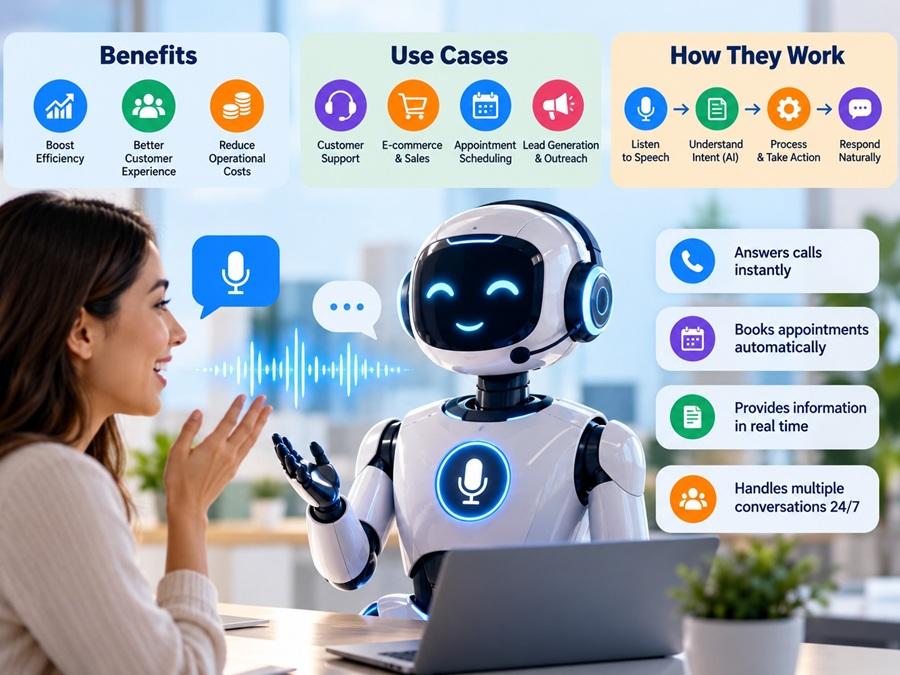
The main difference between a predictive dialer vs AI is that a predictive dialer automates outbound call initiation, while AI can automate conversations, understand customer responses, and perform tasks during calls. Predictive dialers help contact centers connect human agents with more prospects, whereas AI calling systems can handle certain conversations without requiring a human agent for every call.
Businesses can use either technology independently or combine them to improve outbound calling efficiency, lead qualification, appointment scheduling, and customer engagement.
What Is a Predictive Dialer?
A predictive dialer is an automated calling system that places multiple outbound calls and estimates when human agents will become available. Its purpose is to reduce agent idle time by connecting representatives with answered calls.
Predictive dialers are commonly used by sales teams, debt collection agencies, telemarketing businesses, and contact centers that handle large volumes of outbound calls.
Key Features of Predictive Dialers
Predictive dialers automate outbound call scheduling and adjust dialing rates based on agent availability and call outcomes. They can detect busy signals, unanswered calls, and certain disconnected numbers, depending on the system's capabilities.
Many platforms also provide campaign management, call reporting, agent performance tracking, and CRM integration.
However, a predictive dialer does not inherently understand customer intent or conduct intelligent conversations. Human agents typically handle the actual discussion after a call connects.
What Is an AI Calling System?
An AI calling system uses artificial intelligence to interact with people through voice conversations. Depending on its capabilities, it can recognize speech, interpret requests, generate spoken responses, and execute approved actions through connected business systems.
AI voice agents can support inbound and outbound calls for lead qualification, appointment reminders, customer follow-ups, and routine support inquiries.
Key Features of AI Calling Systems
AI calling platforms can provide natural-language conversations, automated question-and-answer workflows, lead qualification, appointment scheduling, and conversation summaries.
Advanced systems may integrate with CRM software, retrieve customer information, and transfer complex requests to human representatives.
Their performance depends on speech recognition accuracy, response latency, integration quality, and the complexity of the task.
Predictive Dialer vs AI: Key Differences
|
Feature |
Predictive Dialer |
AI Calling System |
|---|---|---|
|
Primary purpose |
Automates outbound dialing |
Automates voice conversations |
|
Who handles conversations? |
Human agents |
AI agents, human agents, or both |
|
Call initiation |
Predictive and automated |
Automated or workflow-triggered |
|
Lead qualification |
Usually handled by agents |
Can be automated using AI |
|
Customer responses |
Interpreted by human agents |
AI can understand spoken responses |
|
Scalability |
Depends on dialing capacity and agent availability |
Depends on AI capacity and workflow complexity |
|
Best use case |
High-volume human-led calling |
Conversational automation and qualification |
Benefits of Predictive Dialers
Predictive dialers help contact centers increase agent utilization by reducing the time representatives spend manually dialing numbers or waiting between calls.
They are useful for large outbound campaigns where agents follow structured scripts and need to contact many prospects within a limited period.
Predictive dialers can also improve campaign visibility through call reports, connection rates, and agent performance data.
However, aggressive dialing settings can create abandoned calls when answered calls cannot be connected to available agents. Businesses must configure these systems carefully and comply with applicable calling regulations.
Benefits of AI Calling Systems
AI calling systems can automate repetitive conversations, reducing the need for human agents to handle every routine interaction.
They can qualify prospects by asking questions about customer requirements, business needs, and purchase timelines. Qualified prospects can then be transferred to sales representatives or scheduled for meetings.
AI agents can also provide consistent responses, capture structured information, and operate beyond normal business hours when appropriately configured.
Nevertheless, AI is not automatically better for every conversation. Sensitive complaints, negotiations, and complex customer issues may still require human judgment.
When Should You Choose a Predictive Dialer vs AI?
Choose a predictive dialer when your business has a large team of human agents making outbound calls and your main objective is to improve dialing efficiency.
For example, a sales contact center contacting thousands of prospects may benefit from a predictive dialer that connects answered calls to available representatives.
Choose an AI calling system when you want to automate conversations, qualify leads, answer routine questions, or schedule appointments without requiring a human agent for every call.
For example, a B2B company can use AI voice agents to contact inbound leads, identify their requirements, and schedule qualified prospects for sales meetings.
Businesses with more complex requirements may benefit from combining both technologies. A predictive dialer can support human-led campaigns, while AI handles selected conversations or assists agents with information and summaries.
How to Measure Performance
Before selecting a solution, identify the business outcome you want to improve. Relevant metrics include:
-
Contact rate: Percentage of attempted calls that reach the intended audience.
-
Conversion rate: Percentage of calls that produce the desired result.
-
Cost per qualified lead: Cost of generating each qualified prospect.
-
Average handling time: Average time spent managing a call, including relevant after-call work.
-
Customer satisfaction: How customers evaluate the calling experience.
-
Compliance rate: Whether calls follow applicable consent, disclosure, and contact restrictions.
Compare these metrics using similar campaigns and audiences. Include software, telephony, staffing, implementation, and maintenance costs when calculating the total cost of each solution.
Expert Tip: Do not choose a calling technology based only on the number of calls it can make. Evaluate how effectively it produces qualified leads, completes tasks, and delivers a positive customer experience.
Conclusion
The choice between a predictive dialer vs AI depends on whether your business primarily needs efficient outbound dialing or automated customer conversations. Predictive dialers are designed to improve the productivity of human calling teams, while AI calling systems can handle selected interactions and qualification tasks independently.
For many organizations, the best approach is to start with a specific business need, test the available technology, and measure its impact on conversion rates, costs, and customer experience before scaling.
Frequently Asked Questions
Is an AI dialer better than a predictive dialer?
An AI dialer is better for automating conversations and qualifying leads, while a predictive dialer is effective for connecting human agents with large numbers of prospects. The right choice depends on the workflow.
Can AI replace predictive dialers?
AI can replace some dialing workflows, particularly when automated voice agents handle the conversations. However, predictive dialers remain useful for human-led outbound campaigns.
Can predictive dialers and AI work together?
Yes. Businesses can combine predictive dialing with AI-powered qualification, agent assistance, conversation analysis, or automated follow-up, depending on platform capabilities.
Which solution is more cost-effective?
Cost-effectiveness depends on call volume, staffing requirements, software pricing, integration costs, and conversion outcomes. Businesses should compare total operating costs against qualified leads and completed tasks.

 English
 Arabic
 French
 Spanish
 Portuguese
 Deutsch
 Turkish
 Dutch
Dutch
 Italiano
 Romaian
 Portuguese (Brazil)
 Greek
Greek
