
Veterinary Surgical Instruments Market: Impact of Advanced Veterinary Hospitals
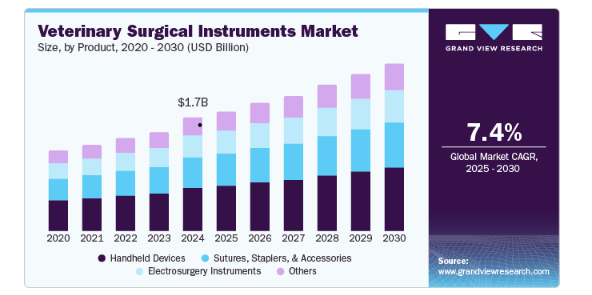
The veterinary surgical instruments market is increasingly reflecting a major shift in how animal healthcare is delivered. The global Veterinary Surgical Instruments Market was valued at USD 1.7 billion in 2024 and is projected to reach USD 2.5 billion by 2030, expanding at a CAGR of 7.4% from 2025 to 2030. Rising pet ownership, higher spending on animal healthcare, expanding veterinary facilities, and growing demand for specialized procedures are creating new opportunities for surgical instrument manufacturers.
A Market Shaped by Changing Pet Healthcare Priorities
Pet owners are increasingly willing to invest in procedures that improve the quality of life of their animals. This growing trend of pet humanization is strengthening demand for surgical care, particularly as companion animals live longer and experience chronic conditions requiring intervention.
The most common veterinary surgeries include:
- Dental procedures
- Spay and neuter procedures
- Hip dysplasia procedures
- Cataract procedures
- Wound repair
- Orthopedic procedures
The expansion of specialized veterinary hospitals is adding another layer of demand. In July 2024, VSSOC Surgery Center introduced a 10,000-square-foot U.S. facility with five surgical suites, a 128-slice CT system, and dedicated recovery areas for cats and dogs.
Where Is Instrument Demand Concentrated?
Handheld devices represented the leading product category in 2024. This category covers forceps, scalpels and blades, surgical scissors, hooks and retractors, trocars and cannulas, clamps/hemostats, and other instruments.
Download a free sample report or claim your copy of this full market intelligence report
The demand environment is being influenced by both increasing veterinary procedures and improvements in instrument design. Manufacturers are developing specialized products according to differences in animal size and anatomy, while material and design advancements are improving instrument quality and efficacy.
Pet healthcare expenditure further illustrates the expanding market opportunity. In the U.S., pet-owning households spent around $1,515 on pets on average, while veterinary care remained an important component of overall spending.
Small Animals Are at the Center of Surgical Demand
The small-animal segment held the largest market share in 2024 and is expected to register the highest CAGR through 2030.
The expansion of this segment is closely connected with rising pet ownership and chronic diseases among companion animals. U.S. dog ownership reached 89.7 million dogs, while cat ownership reached 73.8 million cats in 2024.
Surgical requirements are also increasing as conditions such as cancer, orthopedic disorders, fractures, ligament injuries, patellar luxation, and osteoarthritis become important areas of veterinary care.
Dental Surgery Creates a Major Instrument Opportunity
Dental surgery emerged as the leading application segment in 2024.
Growing awareness of animal dental health and the prevalence of periodontal conditions are encouraging more veterinary dental procedures. Banfield Pet Hospital reported that 73% of dogs and 64% of cats treated in 2023 had dental health issues.
This environment is increasing the need for precision instruments designed specifically for veterinary dental procedures, particularly for smaller breeds that may experience oral health complications.
Orthopedic surgery represents another important growth area. The introduction of 3D printing technologies for custom-fit implants and surgical guides is improving precision in complex procedures and supporting demand for specialized instruments.
Why Are Veterinary Hospitals Becoming More Important?
Veterinary hospitals held the largest end-use share in 2024 and are expected to record the highest CAGR through 2030.
Their advantage comes from their ability to handle specialized and complex procedures, including:
Orthopedic surgery — requiring specialized instruments and expertise.
Dental procedures — supported by growing awareness of animal oral health.
Soft-tissue surgery — benefiting from advanced surgical capabilities.
Emergency procedures — creating demand for reliable and precise instruments.
The expansion of advanced facilities is reinforcing this trend. In January 2024, the Schwarzman Animal Medical Center expanded its surgical capabilities through a 7,000-square-foot facility featuring advanced technologies and human-grade instruments.
Online Purchasing Is Reshaping Procurement
The online purchasing channel dominated the market in 2024 and is projected to grow at an 8.22% rate in the near future.
For veterinary professionals, online channels provide access to broader product portfolios, specifications, reviews, and surgical kits. This makes it easier to compare functionality, accuracy, and durability before purchasing.
Offline channels continue to remain relevant for professionals who value product inspection, personalized assistance, and local support.
Regional Growth Is Becoming More Diverse
North America accounted for 40.4% of global revenue in 2024, supported by established veterinary infrastructure, high pet ownership, chronic animal diseases, and strong healthcare spending.
The U.S. remains a major contributor as rising pet healthcare expenditure, spay and neuter procedures, obesity-related conditions, and technological advancements increase surgical demand.
Europe is benefiting from widespread pet ownership and expanding advanced veterinary services. Around 50% of European households, representing approximately 166 million households, owned pets in 2024.
Asia Pacific is emerging as the fastest-growing regional market, with a projected CAGR of about 8.8%. Japan benefits from its aging pet population and rapid adoption of advanced veterinary diagnostics, while India is seeing rising pet spending and investment in veterinary infrastructure. India's pet spending reached $3.6 billion in 2024, compared with $1.6 billion in 2019.
Latin America is also developing through rising pet ownership, specialized veterinary services, and expanding hospital networks. Brazil is increasingly adopting high-tech surgical and diagnostic capabilities.
Meanwhile, the Middle East & Africa market is gaining momentum as veterinary facilities expand their capabilities in complex procedures, including orthopedic and cardiac surgeries.
The direction of the veterinary surgical instruments market is increasingly defined by specialized care, advanced facilities, precision technologies, and higher expectations from pet owners. As veterinary hospitals expand and complex procedures become more accessible, demand for specialized surgical instruments is expected to continue rising through 2030.
Explore Our Research & Intelligence Solutions
Prism AI: Ask. Analyze. Get Cited Market Insights. – Explore Now
U.S. Healthcare Facility Intelligence: Make Better Decisions with Comprehensive Data – Explore the Platform

 English
 Arabic
 French
 Spanish
 Portuguese
 Deutsch
 Turkish
 Dutch
Dutch
 Russian
 Romaian
 Portuguese (Brazil)
 Greek
Greek
