
Immunotherapy Drugs Market Trends Influencing Future Drug Development
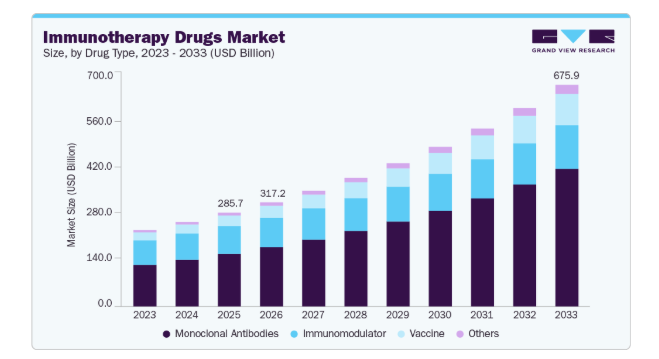
A growing disease burden is changing the economics and direction of modern drug development. As cancer and chronic immune-related conditions become more widespread, healthcare systems are looking for therapies that can deliver more targeted responses. This shift is creating a powerful growth environment for the Immunotherapy Drugs Market, which reached USD 285.7 billion in 2025 and is expected to reach USD 676.0 billion by 2033, expanding at a CAGR of 11.4% from 2026 to 2033.
The market's development can be understood through several interconnected changes taking place across disease prevalence, treatment technology, research, and healthcare access.
Rising Disease Burden → Greater Need for Advanced Treatment
Cancer remains the most important force behind immunotherapy demand. The cancer segment generated 88.42% of market revenue in 2025, reflecting the extensive adoption of immune-based therapies across oncology.
The increasing global cancer burden has strengthened demand for treatment options that can address limitations associated with conventional approaches such as chemotherapy and radiation. Immunotherapy's ability to stimulate or direct immune responses has helped establish it as an increasingly important component of cancer treatment.
The opportunity is also expanding into autoimmune diseases, infectious diseases, and rare genetic disorders. As clinical research progresses, these applications can create additional sources of demand beyond oncology.
Established Therapies → Broader Technology Platforms
The market is no longer dependent on one type of immunotherapy.
Monoclonal antibodies currently provide the strongest foundation, accounting for 56.16% of revenue in 2025. Their specificity and established use across cancer and autoimmune conditions have supported widespread adoption.
Download a free sample report or claim your copy of this full market intelligence report
At the same time, cell-based therapies, including CAR-T approaches, are introducing more advanced treatment possibilities. Immune checkpoint inhibitors are expanding across cancer indications, while cancer vaccines are receiving increasing research attention.
The vaccines segment is expected to register the fastest CAGR during the forecast period, supported by developments in therapeutic vaccines, antigen identification, personalized immunization strategies, and combination treatments.
Scientific Progress → Stronger Competitive Activity
As immunotherapy technology becomes more sophisticated, competition is increasingly being determined by research capabilities.
Pharmaceutical and biotechnology companies are investing in new immune targets, antibody engineering, combination therapies, biomarkers, and next-generation platforms. Clinical trials are helping companies expand therapeutic indications and validate new approaches.
The competitive environment is also being accelerated by strategic collaborations, mergers, acquisitions, fast-track regulatory pathways, and orphan drug designations.
This creates a market where innovation carries substantial value—but also where entry remains difficult. Complex biologic manufacturing, specialized infrastructure, extensive clinical development, regulatory requirements, and intellectual property protection create high barriers for new participants.
North America Leads → Asia Pacific Accelerates
The geographical pattern of the market is shifting from established leadership toward broader global expansion.
North America accounted for 41.8% of global revenue in 2025, supported by advanced healthcare infrastructure, high healthcare expenditure, strong research activity, and widespread access to precision medicine. The U.S. remains the largest country-level market.
Asia Pacific represents the faster-growth side of the equation. The region is projected to expand at a 12.45% CAGR, supported by increasing cancer and autoimmune disease prevalence, rising healthcare expenditure, improving infrastructure, government initiatives, and greater awareness of immunotherapy.
China's large patient population and expanding treatment capabilities provide significant growth potential, while Japan contributes through advanced diagnostics, pharmaceutical innovation, and strong adoption of novel oncology therapies.
Europe continues to benefit from established pharmaceutical capabilities and hospital networks, while Latin America and the Middle East & Africa are gradually improving access to advanced treatment.
Cancer Dominates → New Indications Broaden the Opportunity
The dominance of cancer does not mean the market's future will remain limited to oncology.
The infectious diseases segment is projected to grow at a 9.74% CAGR, supported by growing interest in immune-based treatments, therapeutic vaccines, immunomodulatory approaches, and therapies targeting complex or treatment-resistant infections.
This expansion is important because it creates a broader therapeutic foundation for the industry. As research progresses, immunotherapy can potentially address increasingly diverse disease mechanisms.
Innovation Accelerates → Accessibility Becomes the Next Test
Scientific progress alone cannot guarantee market expansion.
High treatment costs remain a major restraint, while complex manufacturing and stringent regulatory requirements can increase development expenses. Access can also vary considerably between developed and emerging healthcare systems.
This makes affordability, reimbursement, healthcare infrastructure, and patient awareness increasingly important to future adoption.
The industry's long-term opportunity therefore sits at the intersection of innovation and accessibility. More precise therapies can expand clinical possibilities, while stronger healthcare systems can help bring those therapies to larger patient populations.
Key Companies
The competitive landscape includes Amgen Inc., Novartis AG, AbbVie Inc., Pfizer Inc., F. Hoffmann-La Roche Ltd., Johnson & Johnson Services, Inc., AstraZeneca, GSK plc, Sanofi, and Bayer AG. These companies are strengthening their positions through biologics, immuno-oncology research, clinical development, precision medicine, strategic collaborations, and expansion of therapeutic applications.
The Market's Next Chapter
The immunotherapy drugs market is moving toward a more personalized and diversified treatment ecosystem. Biomarker identification is improving patient selection, while advances in biologics, checkpoint inhibitors, vaccines, and cell-based therapies are expanding the technology base.
With the market projected to rise from USD 285.7 billion in 2025 to USD 676.0 billion by 2033, the next phase will be shaped not only by the number of new therapies entering development, but by how effectively the industry can translate scientific breakthroughs into accessible treatment options.
Explore Our Research & Intelligence Solutions
Prism AI: Ask. Analyze. Get Cited Market Insights. – Explore Now
U.S. Healthcare Facility Intelligence: Make Better Decisions with Comprehensive Data – Explore the Platform

 English
 Arabic
 French
 Spanish
 Portuguese
 Deutsch
 Dutch
Dutch
 Italiano
 Russian
 Romaian
 Portuguese (Brazil)
 Greek
Greek
