
Vacuum Blood Collection Tube Market: Demand for Safer Sample Collection
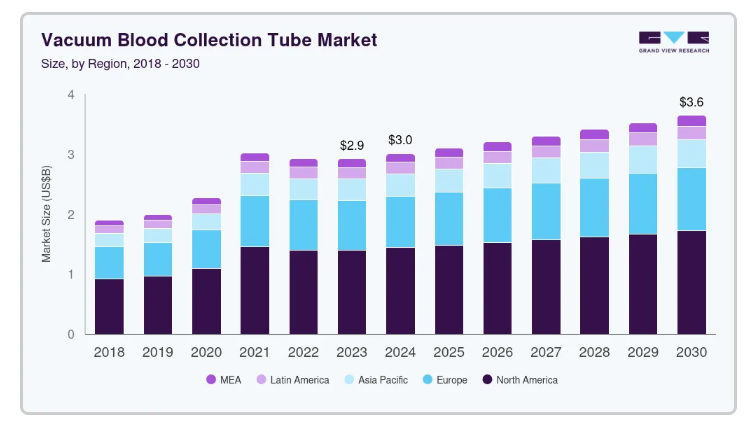
Every accurate blood test begins with something simple: the collection of the right sample in the right way. As healthcare systems perform more diagnostic tests for chronic diseases, infections, blood disorders, and routine health monitoring, the importance of reliable sample collection continues to increase.
The global Vacuum Blood Collection Tube Market was valued at USD 2.9 billion in 2023 and is projected to reach USD 3.6 billion by 2030, growing at a CAGR of 3.2% from 2024 to 2030. North America dominated the market with a 47.8% revenue share in 2023.
Why Is the Demand for Blood Collection Tubes Increasing?
The growing prevalence of chronic diseases is creating a continuous need for diagnostic testing. Conditions such as diabetes and cardiovascular diseases require regular blood tests for monitoring and treatment management.
The same requirement extends to infectious diseases and hematological disorders. Vacuum blood collection devices provide a hygienic and efficient method for collecting samples while helping maintain sample quality and reduce contamination risks.
The growing volume of diagnostic testing therefore creates a recurring demand for collection tubes across healthcare facilities.
Download a free sample report or claim your copy of this full market intelligence report
What Role Does Diabetes Play in Market Growth?
Diabetes is one of the major factors contributing to demand.
According to the source, approximately 537 million adults were living with diabetes in 2021, with the number anticipated to reach 643 million by 2030. Regular blood glucose testing and monitoring create repeated requirements for blood collection devices.
As diabetes becomes more prevalent, diagnostic testing becomes an increasingly important part of disease management. This supports continued demand for vacuum blood collection tubes.
Why Are Blood Transfusions Another Important Demand Generator?
Blood collection and transfusion activity creates another significant application area.
In the U.S., 10.76 million RBC units were transfused in 2021, while 11.78 million RBC units were collected. The same year also saw substantial collection of whole blood and apheresis RBC units.
The constant requirement for blood products means collection infrastructure must support high volumes of samples and blood-related procedures. This contributes to the broader need for reliable collection systems.
Which Tube Type Currently Leads?
The serum separating tube segment accounted for 28.89% of the market in 2023.
Why does it hold such an important position?
Increasing diagnostic testing is one reason. Serum separating tubes are widely used in laboratory procedures, while improvements in gel formulations and tube materials are helping enhance performance and sample stability.
The growing interest in personalized medicine is also creating demand for specialized diagnostic testing, opening additional opportunities for serum separating tube applications.
Which Tube Type Is Growing Faster?
Coagulation tubes are expected to register the fastest growth during the forecast period.
These tubes are essential for coagulation testing, particularly as the prevalence of conditions associated with clotting disorders increases. They are also important for preoperative testing, where understanding blood-clotting ability can influence surgical decisions.
The expansion of coagulation testing therefore gives this segment a strong growth opportunity.
PET or Glass: Where Is the Material Shift Happening?
PET/plastic dominated the tube-material landscape in 2023 and is expected to grow at a 3.39% rate during the forecast period.
Its durability, versatility, chemical resistance, and compatibility with medical applications make PET suitable for preserving samples during transportation and storage.
Glass remains relevant because of its inert and nonreactive nature. However, safety concerns associated with breakage have reduced its use compared with plastic in many applications.
Why Does Routine Testing Matter So Much?
Blood routine examination represented 25.06% of the market in 2023.
Routine blood testing is increasingly connected with preventive healthcare and regular monitoring of chronic conditions. Diabetes, cardiovascular diseases, and cancer all contribute to the need for repeated diagnostic examinations.
As healthcare infrastructure expands in emerging economies and access to diagnostic services improves, the number of patients undergoing blood tests can increase, supporting demand for collection tubes.
Where Are These Tubes Used Most?
Pathology laboratories accounted for 55.23% of market revenue in 2023, making them the leading end-use segment.
Laboratories conduct a wide range of diagnostic tests for disease detection, health monitoring, and treatment decisions. Hospitals and clinics also represent major users because of their high patient volumes and the continuous need for routine, emergency, and disease-specific testing.
Is North America Still the Main Market?
Yes. North America accounted for 47.81% of global revenue in 2023.
Established healthcare infrastructure, the presence of major market participants, and the prevalence of chronic diseases support regional demand. The U.S. market is expected to continue expanding as chronic conditions require regular monitoring and blood testing.
But the regional growth story does not end there.
Asia Pacific is expected to record the fastest CAGR, supported by rising diabetes and cardiovascular disease prevalence, expanding healthcare infrastructure, and growing diagnostic activity in countries such as China and India.
Europe also represents a lucrative market, while Latin America and the Middle East & Africa are benefiting from improving healthcare infrastructure and growing awareness of diagnostics.
Explore Our Dedicated Business Service –
Grand View Signal – Commodity Pricing Intelligence -
Grand View Signal is a pricing intelligence platform that delivers monthly price assessments, historical benchmarks, forward outlook and risk valuation. It turns complex pricing data into clear insights, helping leaders make better decisions and reduce risk through a simple three-stage workflow.

 Arabic
 French
 Spanish
 Portuguese
 Deutsch
 Turkish
 Dutch
Dutch
 Italiano
 Russian
 Romaian
 Portuguese (Brazil)
 Greek
Greek
