
Vehicle Roadside Assistance Market Opportunities Across Electric Vehicles
A vehicle breakdown rarely happens at a convenient time. A flat tire on a highway, a dead battery in a crowded city, or a mechanical failure during a long-distance journey can quickly turn a routine trip into a safety and mobility challenge. As vehicle ownership and traffic volumes continue to rise globally, the need for dependable roadside support is becoming an increasingly important part of the automotive ownership experience.
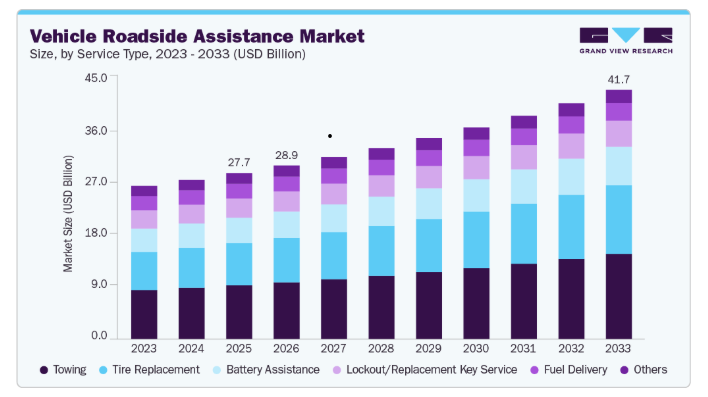
The global Vehicle Roadside Assistance Market was valued at USD 27.7 billion in 2025 and is projected to reach USD 41.7 billion by 2033, expanding at a 5.3% CAGR from 2026 to 2033. Europe led the market with a 35.2% revenue share in 2025.
2025 market size: USD 27.7 billion
2033 projected size: USD 41.7 billion
CAGR: 5.3%, 2026–2033
Largest region: Europe
Largest service: Towing
Largest provider segment: Auto manufacturers
Largest vehicle segment: Passenger cars
The Roadside Assistance Experience Is Being Rebuilt Around Technology
Traditional roadside assistance depended heavily on telephone-based requests and manual dispatch. The modern model is increasingly digital.
AI can help identify the nearest available service provider while considering traffic conditions, vehicle location, and the type of assistance required. Telematics can transmit real-time vehicle information to service providers, helping technicians understand potential problems before reaching the customer.
Mobile applications are adding another layer of convenience. Drivers can request assistance, track technicians, communicate with providers, make digital payments, and receive status notifications from a single platform.
The result is a shift from simply responding to breakdowns toward creating a more connected emergency-support experience.
Download a free sample report or claim your copy of this full market intelligence report
Three Forces Are Expanding the Service Opportunity
More vehicles on the road
Growing vehicle ownership and rising traffic volumes increase the potential frequency of breakdowns and on-road emergencies. This directly supports demand for towing, battery assistance, tire services, and emergency repairs.
More connected vehicles
Connected vehicle technologies are allowing roadside providers to receive information directly from vehicles. This creates opportunities for faster diagnosis, predictive maintenance, and more targeted service dispatch.
More electric and autonomous vehicles
The changing vehicle mix is creating new service requirements. EVs require specialized diagnostic tools, battery assistance, and mobile charging capabilities, while autonomous vehicles may require new protocols for technology and software-related issues.
Service Demand Has a Clear Hierarchy
The market's service landscape reveals where roadside assistance is most frequently required.
Towing remains the anchor service.
The towing segment captured 32.2% of market revenue in 2025, supported by vehicle breakdowns, accidents, mechanical failures, urban congestion, and long-distance travel.
Tire replacement is the faster-moving opportunity.
The tire replacement segment is expected to record the fastest CAGR during the forecast period. Increasing vehicle ownership, tire wear, maintenance awareness, and partnerships between roadside providers and tire manufacturers are supporting this expansion.
Automakers Are Becoming Part of the Assistance Network
Roadside assistance is no longer limited to independent service providers.
Automotive manufacturers are increasingly incorporating assistance into warranty and service packages to strengthen customer convenience and ownership experience. Ford, Tesla, Nissan, and Chevrolet are among the manufacturers offering roadside assistance to customers.
Insurance companies are also expanding their role. Roadside benefits are increasingly being included in motor insurance policies, while partnerships with third-party assistance providers help insurers improve service coverage and response times.
This creates a broader ecosystem connecting automakers, insurers, roadside operators, technology platforms, and vehicle owners.
Passenger Cars Lead, Commercial Vehicles Add a New Growth Layer
Passenger cars accounted for the largest vehicle-type share in 2025. Continued demand for SUVs, sedans, luxury vehicles, and both electric and internal combustion engine passenger cars supports the need for roadside services.
Commercial vehicles, however, represent a faster-growing opportunity. Expanding e-commerce and freight transportation are increasing the number of commercial vehicles operating across longer distances and challenging routes. For fleet operators, roadside downtime can directly affect deliveries and operational continuity, making rapid assistance increasingly important.
Europe Leads While Asia Pacific Accelerates
Europe remains the market leader.
The region accounted for 35.25% of global revenue in 2025, supported by established roadside assistance providers and strong adoption of subscription-based vehicle support services. Germany held a substantial share within Europe, while the U.K. is benefiting from high vehicle density, urbanization, and an aging vehicle fleet.
Asia Pacific is becoming the growth engine.
The region is projected to register the fastest CAGR, supported by increasing vehicle ownership, urbanization, rising disposable incomes, and expanding middle-class populations.
India presents a particularly important opportunity as vehicle ownership, highway infrastructure, long-distance travel, and consumer awareness of emergency support continue to expand. China is also seeing increasing demand for EV-related roadside services, including fast charging and mobile battery-swapping support.
The Business Model Is Moving Beyond Emergency Calls
Subscription-based assistance programs, digital dispatch systems, connected vehicle support, and predictive maintenance are changing how roadside services are delivered.
For automotive OEMs and insurers, roadside assistance can strengthen customer retention and brand loyalty. For service providers, digital platforms can improve dispatch efficiency and service coverage. For drivers, mobile tracking and real-time updates can reduce uncertainty during emergencies.
At the same time, high operational and service management costs remain a restraint. Increasing connectivity also introduces cybersecurity concerns as vehicles, infrastructure, and service platforms become more interconnected.
Key Vehicle Roadside Assistance Companies
The competitive landscape remains fragmented, with global, regional, and local providers operating across different markets. Key companies include GEICO, Viking Assistance Group AS, ARC Europe, Allstate Insurance Company, Ford Motor Company, Nissan Motor Co., Ltd., Chevrolet, Allianz Partners, Agero, Inc., and Falck A/S.
Competition is increasingly centered on service-network strength, digital dispatch capabilities, connected vehicle support, subscription models, partnerships, and the ability to provide specialized assistance for emerging vehicle technologies.
The Next Roadside Assistance Market Will Be More Predictive
The future of the vehicle roadside assistance market is moving toward prevention as well as response. Connected vehicles can provide data before a breakdown occurs, while AI and telematics can help determine what assistance is required and where it should be dispatched.
As electric vehicles, connected cars, and increasingly automated vehicles become more common, roadside assistance providers will need to evolve alongside the vehicles they support. The opportunity is therefore shifting from simply helping stranded drivers toward building a connected safety and mobility network around the vehicle.
About us:
Grand View Research, a market research and consulting company, provides syndicated research reports, customized research reports, and consulting services. Grand View Research database is used by the world's renowned academic institutions and Fortune 500 companies to understand the global and regional business environment. Our database features thousands of statistics and in-depth analysis on 46 industries in 25 major countries worldwide.

 English
 Arabic
 French
 Spanish
 Portuguese
 Deutsch
 Turkish
 Italiano
 Russian
 Romaian
 Portuguese (Brazil)
 Greek
Greek
