
Protein Expression Market Trends in Monoclonal Antibody Development
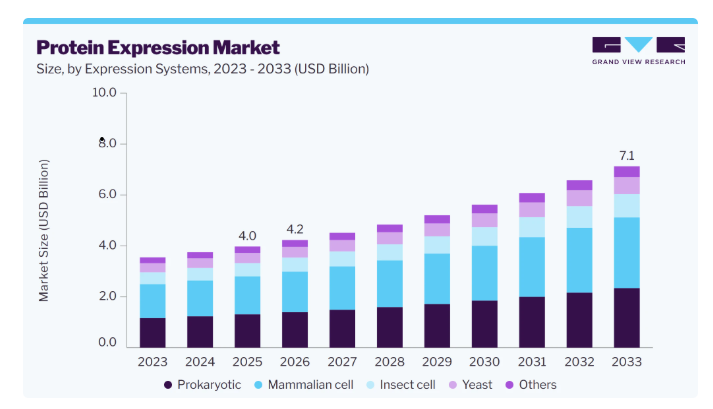
Protein expression has become an increasingly important part of the biotechnology value chain as pharmaceutical and biotechnology companies expand their focus on recombinant proteins, monoclonal antibodies, biosimilars, vaccines, and personalized therapies. Improvements in expression systems are helping researchers produce complex proteins with greater efficiency while supporting faster drug discovery and therapeutic development.
The global Protein Expression Market was valued at USD 4.0 billion in 2025 and is projected to reach USD 7.1 billion by 2033, expanding at a 7.7% CAGR from 2026 to 2033. North America led the market with a 40.8% revenue share in 2025, while Asia Pacific is expected to record the fastest growth.
Key Highlights
- 2025 market size: USD 4.0 billion
- 2033 projected size: USD 7.1 billion
- CAGR: 7.7%, 2026–2033
- Largest region: North America, with 40.8% share in 2025
- Leading expression system: Mammalian cells, with 37.6% share
- Leading product: Reagents, with 44.3% share
- Leading application: Therapeutics, with 43.6% share
- Leading end use: Pharmaceutical and biotechnology companies, with 43.4% share
The Market Is Moving Closer to Complex Therapeutics
The expansion of biologics is changing the requirements for protein production. Pharmaceutical companies increasingly need expression platforms capable of producing proteins with specific structures, functions, and post-translational modifications.
Download a free sample report or claim your copy of this full market intelligence report
Mammalian systems have benefited strongly from this shift. By June 2022, around 70% of commercialized recombinant products were produced using mammalian expression technologies, compared with a much more balanced distribution between mammalian and microbial systems in 2002.
This evolution reflects the growing importance of complex protein-based therapies, particularly monoclonal and bispecific antibodies.
The FDA approved 50 new therapeutics in 2024, including 16 protein-based therapies, representing 32% of total approvals. The approvals included 10 new monoclonal antibodies and three bispecific antibodies, reinforcing the role of protein expression technologies in modern drug development.
Expression Systems: Mammalian Cells Set the Pace
Mammalian cell expression held 37.6% of the market in 2025, making it the leading expression system. Its importance is closely connected with pharmaceutical applications requiring sophisticated proteins and therapeutic molecules.
Technological improvements are also increasing productivity. ProteoGenix introduced its XtenCHO Transient Expression System in 2022, designed to improve plasmid stability and cellular metabolism while increasing protein yields.
At the same time, prokaryotic systems remain attractive because they can support large-scale recombinant protein production quickly and at comparatively lower costs. Advances in synthetic biology are improving control over gene expression in bacterial hosts such as E. coli, creating further opportunities for this segment.
Reagents Lead, While Services Expand the Market
The product landscape is led by reagents, which accounted for 44.3% of revenue in 2025. Reagents remain fundamental to transfection, cell culture, protein production, and expression optimization.
However, the market is increasingly extending beyond products.
The services segment is expected to grow rapidly as pharmaceutical and biotechnology companies outsource protein production and expression activities. Contract providers can support antibody production, stable cell line development, protein purification, and customized discovery programs without requiring companies to build every capability internally.
This outsourcing trend is also strengthening the role of CROs in the protein expression ecosystem.
Therapeutics Remain the Commercial Center
The therapeutic application segment represented 43.6% of the market in 2025.
Protein-based therapies can provide highly targeted treatment and can also serve as replacement therapies where patients lack functional proteins because of genetic conditions. Growing investment in protein engineering and recombinant technologies is therefore creating a strong connection between protein expression research and therapeutic development.
The industrial application segment is another emerging opportunity. High-quality proteins are increasingly relevant to enzymes, food and feed additives, biofuels, and other biomanufacturing applications. New production approaches, including alternative systems for yeast-based protein expression, are also being investigated to improve safety and efficiency.
Pharmaceutical Companies Remain the Largest Buyers
Pharmaceutical and biotechnology companies accounted for 43.4% of revenue in 2025.
Their demand is being supported by expanding biologics pipelines, personalized medicine, protein engineering, and increasing use of cultured cells for therapeutic development. Companies are also experimenting with genetic variants and newly designed proteins to improve therapeutic value and stability.
The CRO segment is expected to record the fastest growth, supported by specialized protein production services offered at competitive costs. New platforms combining cell-line and transposon technologies are helping improve protein production efficiency and accelerate preclinical and clinical development.
Innovation Is Redefining Protein Production
Innovation remains one of the strongest characteristics of the protein expression market. Recombinant DNA technology, CRISPR-based approaches, synthetic biology, cell-free synthesis, and improved expression vectors are expanding the range of proteins that can be produced.
The industry is also seeing growing interest in technologies that reduce production timelines and improve scalability. Cell-free systems and engineered host cells are particularly relevant as researchers seek faster routes from protein design to functional protein.
Strategic collaborations are contributing to this progress. In February 2025, India's Department of Biotechnology and BIRAC launched a joint call focused on “Smart Proteins,” encouraging academic-industry collaboration around sustainable and affordable protein production.
Regulation Remains a Critical Consideration
The market's opportunities are accompanied by considerable production complexity. Biologic manufacturing is subject to stringent regulatory requirements covering safety, quality, clinical development, and manufacturing processes.
FDA and EMA requirements can increase development costs and extend timelines, particularly for companies working with complex biological products.
At the same time, regulatory frameworks can support market stability by establishing quality expectations and addressing supply interruptions. This creates a balance between compliance costs and the need for safe, reliable protein-based products.
North America Leads as Asia Pacific Accelerates
North America captured 40.8% of global revenue in 2025, supported by major industry participants, strong biotechnology infrastructure, R&D investment, and biosimilar pipelines. The U.S. represented the largest share within the region.
Europe remains an important innovation center, supported by academic-industry collaboration and established biopharmaceutical infrastructure. Germany, France, and the UK are contributing to developments in therapeutic proteins, protein engineering, and high-throughput expression technologies.
Asia Pacific is expected to register the fastest CAGR. China and India are expanding biotechnology capabilities, while government initiatives and increasing research activity are creating opportunities for protein therapeutics and biomanufacturing.
The Middle East and Africa are also gradually developing their biotechnology capabilities, with Saudi Arabia pursuing protein production and biotechnology investment as part of its broader economic diversification strategy.
Competition Is Built Around Breadth and Innovation
The competitive environment combines established life sciences companies with specialized technology providers. Thermo Fisher Scientific, Merck KGaA, Bio-Rad Laboratories, and Agilent Technologies hold strong positions through broad product portfolios, global reach, and strategic initiatives.
Key companies in the protein expression market include Agilent Technologies, Inc., Bio-Rad Laboratories, Thermo Fisher Scientific, Inc., Merck Millipore, and New England BioLabs, Inc.
As biologics pipelines become more complex, competition is expected to increasingly center on expression efficiency, scalability, specialized services, and technologies capable of supporting next-generation protein therapeutics.
The Next Phase of Protein Expression
The protein expression market is moving beyond basic recombinant protein production toward highly optimized systems designed for complex and personalized therapies. Mammalian platforms continue to lead high-value applications, while prokaryotic, yeast, insect, and cell-free approaches expand the range of production possibilities.
With biologics, personalized medicine, CRO outsourcing, and biotechnology R&D continuing to expand, protein expression is becoming an increasingly important enabling technology across the pharmaceutical and life sciences industries.
About us:
Grand View Research, a market research and consulting company, provides syndicated research reports, customized research reports, and consulting services. Grand View Research database is used by the world's renowned academic institutions and Fortune 500 companies to understand the global and regional business environment. Our database features thousands of statistics and in-depth analysis on 46 industries in 25 major countries worldwide.

 English
 Arabic
 French
 Spanish
 Portuguese
 Deutsch
 Turkish
 Dutch
Dutch
 Italiano
 Russian
 Romaian
 Greek
Greek
