
Biomaterials Market Projected to Reach USD 1,194 Billion by 2036, India - CAGR 17.4%, China - CAGR 16.9%, USA - CAGR 16.5%
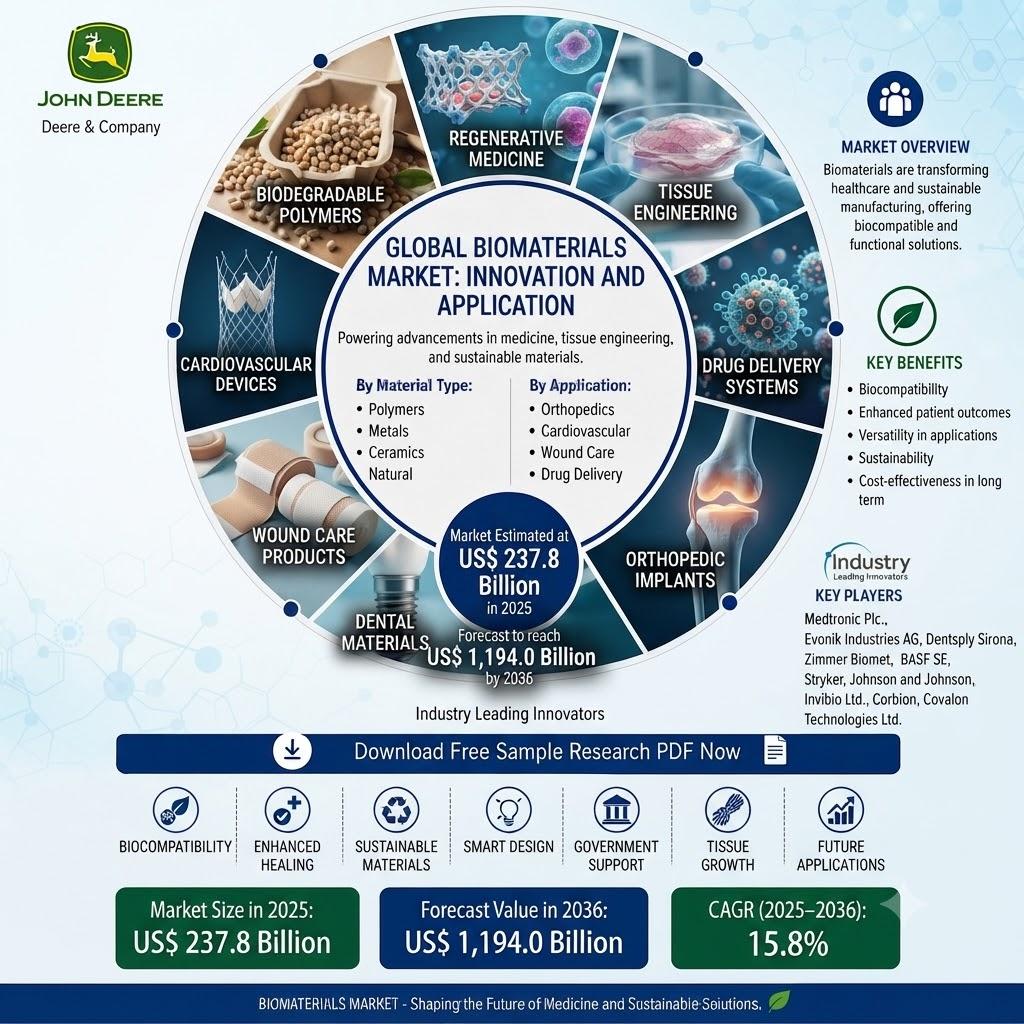
The global biomaterials market is estimated at USD 275.4 billion in 2026 and is projected to reach USD 1,194.0 billion by 2036, expanding at a 15.8% CAGR during the forecast period. Fact.MR estimates an absolute dollar opportunity of USD 918.6 billion between 2026 and 2036, as growing surgical implant volumes, expanding medical device manufacturing, and rising adoption of advanced biocompatible and bioresorbable materials support demand across healthcare applications.
Biomaterials encompass metallic, polymeric, ceramic, and natural materials engineered for medical applications including orthopedic implants, cardiovascular devices, dental prosthetics, and wound healing products. Growing surgical volumes are increasing demand for materials that offer mechanical strength, biocompatibility, controlled degradation, and compatibility with advanced manufacturing technologies.
Medical device manufacturers are also increasing their use of specialized biomaterial powders, filaments, and resins as 3D printing adoption expands. At the same time, development of bioresorbable materials is creating opportunities for products that can naturally degrade after tissue healing.
Get detailed market forecasts, competitive benchmarking, and pricing trends: https://www.factmr.com/connectus/sample?flag=S&rep_id=11909
Metallic biomaterials lead the product landscape
Metallic biomaterials are projected to account for 46.0% of the product type segment in 2026, making them the leading product category. Titanium alloys and cobalt chromium alloys remain widely used for load-bearing orthopedic implants, dental implants, and cardiovascular device components because of their mechanical strength, corrosion resistance, and established biocompatibility profiles.
Polymeric and natural biomaterials represent other important categories as manufacturers develop materials for drug delivery, tissue regeneration, wound healing, and temporary fixation. Bioresorbable polymers are gaining attention in applications where materials are designed to degrade following tissue healing.
Orthopedic applications are expected to account for 48.0% of application demand in 2026, retaining their position as the leading application segment. Joint replacement implants, spinal fusion devices, fracture fixation hardware, and sports medicine products generate substantial biomaterial consumption across metallic, polymeric, and ceramic categories.
Polymer engineering technology is also projected to account for 48.0% of the technology segment in 2026, supported by advanced polymer synthesis, bioresorbable material development, and medical-grade polymer compounding.
India, China, and the USA create strong country-level opportunities
India is projected to be the fastest-growing major country market, advancing at a 17.4% CAGR through 2036. Expanding medical device manufacturing, growing surgical implant demand, and government healthcare investment programs are supporting increased biomaterial procurement.
China follows with a projected 16.9% CAGR, reflecting domestic biomaterial production capacity, medical device manufacturing expansion, and hospital infrastructure development. The United States is forecast to expand at a 16.5% CAGR, supported by advanced implant development, 3D printing adoption, and demand for premium biomaterial grades.
Germany is projected to grow at a 15.8% CAGR, while Japan is expected to advance at 15.3%. Brazil and the UAE are forecast to register CAGRs of 14.6% and 13.9%, respectively.
The contrast between emerging and mature markets is influencing supplier strategies. Developing markets offer opportunities through medical device manufacturing expansion and growing surgical capacity, while established markets place greater emphasis on premium materials, advanced implant development, regulatory qualification, and specialized manufacturing technologies.
3D printing and bioresorbable materials reshape competitive priorities
3D printing-compatible biomaterials are emerging as a major product trend in the market. Metal powders, polymer filaments, and photopolymer resins are enabling patient-specific implant fabrication and customized tissue scaffold development.
The growing use of additive manufacturing is particularly relevant to orthopedic and craniofacial applications, where customized implants can be designed around individual patient anatomy. As regulatory pathways for 3D-printed medical devices mature, demand for compatible biomaterial grades is expected to increase.
Bioresorbable fixation devices are another important opportunity. Their ability to degrade naturally following tissue healing can shift selected applications away from permanent metallic implants toward polymer-based alternatives.
Smart biomaterials with integrated sensing or drug-delivery capabilities are also emerging as a next-generation product category. However, stringent biocompatibility and regulatory testing requirements, specialty raw material price volatility, and limited long-term clinical data for newer formulations remain important market constraints.
Analyst Perspective
Shambhu Nath Jha, Principal Consultant at Fact.MR, said: “The biomaterials market is undergoing a structural expansion driven by the convergence of medical device manufacturing growth, additive manufacturing adoption, and bioresorbable material development. The market spans from commodity metals and polymers to highly specialized surface modified and nano-engineered materials, with the highest value growth concentrated in advanced polymer engineering, 3D printing compatible grades, and smart biomaterial platforms. Companies that control both material science and device manufacturing integration are positioned to capture the greatest value.”
Growing implant demand opens new market opportunities
Growing global demand for orthopedic, cardiovascular, and dental implants remains a central volume driver for biomaterial consumption. Aging populations, increasing surgical volumes, and expanding medical device manufacturing are supporting demand across established and emerging healthcare markets.
3D-printed patient-specific implants are creating a higher-value customized product category. Orthopedic and craniofacial procedures can benefit from materials and manufacturing processes that enable customized structures, while tissue engineering applications are creating additional demand for scaffold materials.
Emerging economies represent an important opportunity as healthcare infrastructure and medical device manufacturing capacity expand. Institutional procurement and investment in hospital infrastructure can increase adoption of advanced biomaterials as healthcare providers expand surgical capacity.
At the same time, manufacturers must address strict quality and regulatory requirements. Biomaterials intended for medical applications require appropriate biocompatibility validation, while new formulations can face extended development timelines before achieving regulatory acceptance and broader clinical adoption.
Competitive landscape
The biomaterials market includes companies competing through material portfolios, regulatory approvals, manufacturing capabilities, device integration, institutional relationships, and geographic distribution. Key companies profiled by Fact.MR include Medtronic Plc., Evonik Industries AG, Dentsply Sirona, Zimmer Biomet, BASF SE, Stryker, Johnson and Johnson, Invibio Ltd., Corbion, and Covalon Technologies Ltd.
Medtronic Plc. holds a leading position with approximately 20% share, supported by its broad product portfolio and established institutional relationships. Evonik Industries AG, Dentsply Sirona, and Zimmer Biomet maintain positions across specific biomaterial categories and regional markets.
Evonik is continuing development of its RESOMER bioresorbable polymer portfolio for medical device applications. Zimmer Biomet has advanced additive manufacturing programs for patient-specific orthopedic implants, while BASF has expanded its medical-grade polymer portfolio for medical device manufacturing.
Competitive priorities increasingly include product differentiation, next-generation material development, 3D printing compatibility, bioresorbable technologies, and integration between biomaterial manufacturing and finished medical devices.
Market Snapshot
The biomaterials market is valued at USD 275.4 billion in 2026 and is forecast to reach USD 1,194.0 billion by 2036 at a 15.8% CAGR. Metallic biomaterials account for 46.0% of the product segment, while orthopedic applications represent 48.0% of application demand. Polymer engineering technology leads the technology segment with a 48.0% share. India leads country-level growth at 17.4%, followed by China at 16.9% and the USA at 16.5%.
The detailed Biomaterials Market report by Fact.MR provides forecasts through 2036, including analysis by product type, application, end use, technology, formulation, distribution channel, region, country, competitive landscape, and emerging biomaterial technologies.
To View Top Reports
https://afgbfh.blogspot.com/2026/10/automotive-telematics-market-to-be.html
https://sportgalax.com/read-blog/24632
About Fact.MR
Fact.MR is a market research and consulting company providing market intelligence, competitive analysis, and forecasting across global industries. Its research covers emerging technologies, evolving consumer trends, industrial developments, and changing business environments. Fact.MR delivers data-driven insights designed to support strategic planning, investment decisions, and market-entry initiatives.

 Arabic
 French
 Spanish
 Portuguese
 Deutsch
 Turkish
 Dutch
Dutch
 Italiano
 Russian
 Romaian
 Portuguese (Brazil)
 Greek
Greek
