
Automotive Lightweight Material Market Growth Across Commercial Vehicles
The automotive industry is increasingly treating vehicle weight as a design variable rather than simply a manufacturing outcome. As emission regulations become stricter and electric vehicles place greater emphasis on battery efficiency and driving range, automakers are looking for materials that can reduce mass without compromising strength, safety, or design flexibility. This shift is placing composites, plastics, aluminum, advanced steels, and other lightweight solutions at the center of vehicle development.
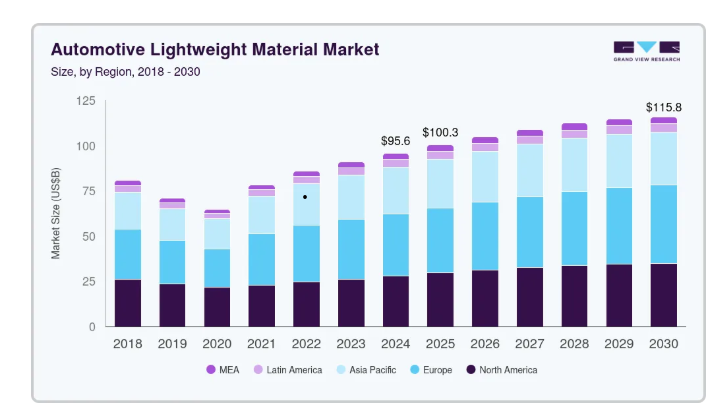
The global Automotive Lightweight Material Market was estimated at USD 95.64 billion in 2024 and is projected to reach USD 115.85 billion by 2030, expanding at a 2.3% CAGR from 2025 to 2030.
What Is Changing Inside the Vehicle?
Weight reduction is no longer limited to one component. Automakers are exploring lightweight solutions throughout the vehicle, from the structural frame and closures to interiors and other components.
The reason is straightforward: a lighter vehicle can require less energy to move. In conventional vehicles, this can contribute to fuel efficiency, while in EVs, lower weight can help support battery performance and driving range.
At the same time, lightweight materials can improve acceleration, handling, and vehicle dynamics. The challenge is achieving these advantages while maintaining structural integrity and crash performance.
The Numbers Behind the Market
- USD 95.64 Billion: Global market size, 2024
- USD 115.85 Billion: Projected market size, 2030
- 3%: CAGR, 2025–2030
- 7%: Europe's revenue share, 2024
- 0%: Composites' revenue share, 2024
- 2%: Passenger cars' revenue share, 2024
Download a free sample report or claim your copy of this full market intelligence report
Materials Are Taking Different Routes to Weight Reduction
Composites: The Current Market Leader
Composites accounted for 66.0% of market revenue in 2024, making them the dominant material segment. Their combination of lightweight characteristics, durability, and moldability allows manufacturers to create vehicle components without sacrificing design flexibility.
The expanding production of electric vehicles is also creating additional demand for composites as automakers look for ways to reduce vehicle mass.
Plastics: The Faster-Growing Material
Plastics are projected to record the fastest CAGR of 3.8% through 2030. Their lower weight compared with traditional materials and their versatility across body panels, interiors, and under-the-hood applications make them increasingly relevant.
As emission requirements become more demanding, the ability to reduce mass while maintaining performance is giving automotive plastics a stronger role in vehicle design.
The Body in White Remains the Main Battleground
The body in white (BiW) represented 25.3% of market revenue in 2024.
Because the BiW forms the vehicle's structural frame, reducing its weight can have a meaningful impact on overall vehicle efficiency. Advanced high-strength steel, aluminum, and composites are therefore being incorporated into structural designs to balance weight reduction with strength and safety.
The next notable opportunity is closures, including doors, hoods, and trunk lids. This segment is projected to grow at a 2.6% CAGR, supported by the industry's continued focus on fuel efficiency and emissions reduction.
Meanwhile, interiors are gaining attention for a different reason. Lightweight and moldable materials allow manufacturers to create more sophisticated cabin designs while limiting additional vehicle mass.
Passenger Cars Dominate, But Commercial Delivery Is Creating New Demand
Passenger cars accounted for 83.2% of market revenue in 2024, reflecting the scale of consumer demand for efficient and sustainable vehicles.
EV and hybrid adoption is reinforcing this position because reducing vehicle weight becomes particularly important when manufacturers are trying to maximize energy efficiency and battery range.
However, light commercial vehicles are expected to record the fastest CAGR of 3.3%.
The growth of e-commerce and delivery activity is increasing demand for vehicles capable of carrying heavier loads while remaining efficient. Lightweight construction can help fleets increase payload capability without proportionally increasing vehicle weight, supporting operational efficiency in logistics applications.
Regulation Is Turning Weight Reduction Into a Strategic Requirement
Environmental regulations are one of the strongest forces shaping the market.
The U.S. EPA and European Union have established ambitious targets for reducing vehicle greenhouse gas emissions. Fuel economy standards in North America are also encouraging manufacturers to find ways to improve vehicle efficiency.
This is changing how automakers evaluate materials. A material that may initially cost more than a conventional alternative can become attractive when its use contributes to lower fuel consumption, improved efficiency, or reduced lifecycle operating costs.
Manufacturers are therefore also investing in production optimization to address the cost challenge associated with advanced lightweight materials.
Regional Market Direction
Europe
Europe held the largest regional revenue share at 35.7% in 2024. The region's stringent emissions targets are encouraging automakers to increase the use of lightweight materials.
Germany stands out within Europe, with its automotive lightweight materials market projected to grow at a 6.3% CAGR. The country's automotive industry is increasingly adopting aluminum, CFRP, and AHSS to balance performance requirements with emissions objectives.
North America
North America is expected to record the fastest regional CAGR of 2.7%. Fuel economy requirements in the U.S. and Canada are encouraging automakers to integrate aluminum, carbon fiber, and advanced high-strength steel into vehicle designs.
Asia Pacific
Asia Pacific is also developing significant opportunities through advances in high-strength steels, aluminum alloys, and composite materials. Collaboration among automotive manufacturers, research institutions, and universities is supporting the development of materials with improved strength-to-weight ratios and corrosion resistance.
The Competitive Focus Is Shifting Toward Material Innovation
Competition in the automotive lightweight material market is increasingly centered on developing materials that combine low weight with strength, durability, manufacturability, and sustainability.
Companies are also expanding their material portfolios to address different vehicle architectures and applications. This creates opportunities for both established material manufacturers and specialized suppliers developing advanced solutions for next-generation vehicles.
Key companies include BASF, Toray Industries, Inc., LyondellBasell, and Novelis Inc. The broader competitive landscape also includes major players such as ArcelorMittal.
Lightweighting Is Becoming Part of the Vehicle's Core Architecture
The future of the automotive lightweight material market is being shaped by a simple but increasingly important equation: less weight, greater efficiency, and stronger vehicle performance.
As EVs, fuel-efficient vehicles, stricter emissions requirements, and commercial delivery fleets continue influencing automotive design, lightweight materials will increasingly move from individual components into broader vehicle architecture.
The opportunity is no longer simply to replace steel with a lighter material. It is to engineer the right combination of materials for every part of the vehicle while balancing cost, safety, performance, and sustainability.
About us:
Grand View Research, a market research and consulting company, provides syndicated research reports, customized research reports, and consulting services. Grand View Research database is used by the world's renowned academic institutions and Fortune 500 companies to understand the global and regional business environment. Our database features thousands of statistics and in-depth analysis on 46 industries in 25 major countries worldwide.

 English
 Arabic
 French
 Spanish
 Deutsch
 Turkish
 Dutch
Dutch
 Italiano
 Russian
 Romaian
 Portuguese (Brazil)
 Greek
Greek
