
Route Optimization Software Market: How IoT Is Reshaping Route Planning
Transportation is becoming a data problem as much as a logistics problem. More vehicles, more delivery points, tighter delivery windows, traffic uncertainty, and rising expectations for speed are forcing businesses to rethink how routes are planned and managed.
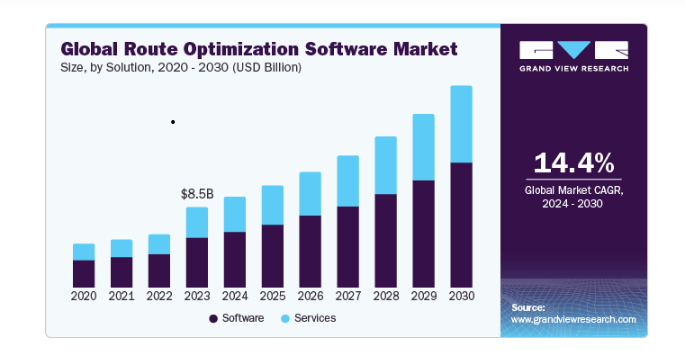
Against this backdrop, the global Route Optimization Software Market was valued at USD 8.5 billion in 2023 and is projected to reach USD 21.5 billion by 2030, expanding at a 14.4% CAGR from 2024 to 2030. North America represented the largest regional revenue share at 27.0% in 2023.
From Route Planning to Continuous Transportation Management
The role of route optimization software is expanding beyond simply finding the shortest path between two locations. Modern platforms can help businesses coordinate delivery schedules, manage multiple stops, monitor routes, and respond to changing transportation conditions.
Traffic, road closures, weather, vehicle availability, and customer requirements can all affect transportation efficiency. The integration of IoT, big data analytics, and cloud computing is therefore creating a more responsive approach to route planning, allowing businesses to adjust decisions using real-time and historical information.
Download a free sample report or claim your copy of this full market intelligence report
Market size: USD 8.5 billion, 2023
Projected size: USD 21.5 billion, 2030
Growth rate: 14.4% CAGR, 2024–2030
Largest region: North America
Fastest regional growth: Asia Pacific
Fastest country growth highlighted: India
Core opportunity: Connected, cloud-enabled, data-driven transportation optimization
A Market Being Reshaped by Efficiency and Sustainability
The growth story is not only about faster deliveries.
Businesses are also looking for ways to reduce unnecessary vehicle movement, fuel consumption, and transportation-related emissions. Route optimization can minimize travel distances and allow routes to be adjusted when traffic or weather conditions create avoidable delays and idling.
Sustainability is therefore becoming connected with operational efficiency: better routing can support both environmental objectives and transportation cost reduction.
Segment Snapshot
Software remains the foundation.
The software segment accounted for 62.31% of revenue in 2023, supported by fleet routing, automated carrier operations, online route schedules, and real-time delivery-status tracking.
Services are becoming the growth engine.
Services are expected to expand at a 14.6% CAGR from 2024 to 2030. Consulting, software deployment, map integration, training, support, and maintenance are increasingly important because businesses often require specialized expertise to maximize the value of complex platforms.
On-demand delivery remains a major use case.
Food and grocery delivery represented the largest industry-vertical segment in 2023, where faster and more reliable delivery can directly influence customer experience.
Ride-hailing is gaining momentum.
The ride-hailing and taxi services segment is projected to grow at a 14.8% CAGR, supported by the importance of ETA accuracy, congestion avoidance, and real-time route adjustments.
The Deployment Landscape Is Changing
The market still reflects a strong presence of traditional infrastructure.
On-premises deployment held the largest share in 2023 because organizations handling sensitive information often value direct control over applications and data. Customization and integration with existing enterprise systems also support this model.
At the same time, cloud deployment is the faster-growing direction. Scalability, easier implementation, centralized data management, and lower upgrade costs are encouraging organizations to adopt cloud-based route optimization platforms.
Enterprise Adoption Is Moving Down the Size Spectrum
Large enterprises currently represent the dominant enterprise-size segment. Complex field operations across utilities, telecommunications, healthcare, and other industries create strong demand for software capable of coordinating technicians, vehicles, schedules, and locations.
The more notable growth opportunity is emerging among SMEs. Smaller businesses increasingly need technology that can help them manage multiple delivery stops, reduce inefficient routing, control costs, and compete with larger operators without creating excessive operational complexity.
Outbound Logistics Still Sets the Pace
E-commerce has placed enormous pressure on outbound transportation. Customers increasingly expect faster and more convenient deliveries, making route efficiency an important component of last-mile operations.
The outbound segment therefore held the largest functionality share in 2023. Route optimization can reduce travel distances, improve vehicle utilization, support service-level commitments, and contribute to lower fuel and maintenance expenses.
Meanwhile, inbound functionality is positioned for faster growth, supported by supply-chain optimization, just-in-time inventory practices, and the increasing need to coordinate raw-material and component deliveries across manufacturing networks.
Regional Growth Is Creating Different Market Opportunities
North America — Established Leadership
North America accounted for 27.01% of global revenue in 2023. The region benefits from established technology providers, advanced infrastructure, high e-commerce penetration, strong logistics activity, and early adoption of digital technologies.
The U.S. represented 43.47% of the North American market in 2023, supported by its extensive logistics network, major e-commerce companies, and continued focus on supply-chain efficiency and sustainability.
Asia Pacific — The Growth Center
Asia Pacific is expected to register the fastest regional CAGR of 15.0% through 2030. Rapid e-commerce development in China and India is creating demand for cost-efficient and scalable logistics technologies.
India stands out with an expected 16.8% CAGR from 2024 to 2030, supported by e-commerce expansion, logistics activity, infrastructure development, digitalization, and the growing need for efficient last-mile delivery.
Europe — Efficiency With a Sustainability Focus
European adoption is being supported by sustainable transportation initiatives, emission-reduction objectives, expanding e-commerce, and the presence of major logistics hubs. The U.K. is also benefiting from e-commerce growth and policies encouraging lower-carbon logistics operations.
Competitive Landscape: From Standalone Routing to Connected Operations
Competition in the route optimization software market is increasingly centered on technological depth and integration.
Vendors are combining route planning with AI, IoT, telematics, fleet management, analytics, real-time tracking, and cloud infrastructure. Customization is also becoming important as businesses seek solutions designed around last-mile delivery, field services, transportation logistics, and other specialized workflows.
Key companies include Trimble Inc., Caliper Corporation, The Descartes Systems Group Inc., ESRI, Blue Yonder, Inc., Coupa Software Inc., and Microlise Limited. Other notable participants include Verizon, Samsara Inc., and WorkWave.
The Road Ahead
The next phase of the route optimization software market is likely to be defined by connected transportation rather than isolated route planning.
As businesses combine cloud platforms with IoT data, telematics, analytics, and increasingly intelligent optimization capabilities, route decisions can become more dynamic and responsive. The market is consequently moving toward software that does not simply determine where a vehicle should go, but helps organizations continuously improve how transportation resources are deployed.
About us:
Grand View Research, a market research and consulting company, provides syndicated research reports, customized research reports, and consulting services. Grand View Research database is used by the world's renowned academic institutions and Fortune 500 companies to understand the global and regional business environment. Our database features thousands of statistics and in-depth analysis on 46 industries in 25 major countries worldwide.

 English
 Arabic
 French
 Spanish
 Portuguese
 Deutsch
 Turkish
 Italiano
 Russian
 Romaian
 Portuguese (Brazil)
 Greek
Greek
