
Insulin Delivery Devices Market and the Future of Diabetes Technology
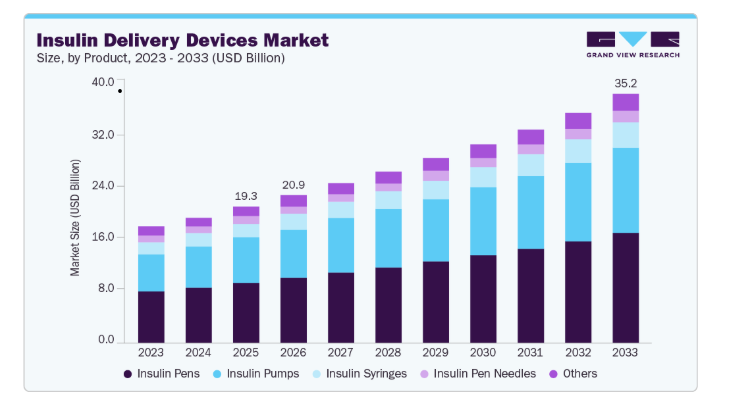
Diabetes management is undergoing a significant technological shift. Insulin delivery is no longer limited to conventional injections, as patients and healthcare providers increasingly have access to pens, pumps, patch pumps, continuous glucose monitoring, and connected systems that can adjust therapy more intelligently. The Insulin Delivery Devices Market was valued at USD 19.3 billion in 2025 and is projected to reach USD 35.2 billion by 2033, expanding at a 7.8% CAGR from 2026 to 2033.
What makes this market particularly interesting is the transition from simply delivering insulin to creating a more connected and responsive diabetes management experience.
Five Shifts Reshaping Insulin Delivery
- Convenience is becoming a major product differentiator.
Insulin pens held the largest product share at 43.7% in 2025. Their portability, dosing accuracy, discreet design, and ease of self-administration have made them highly suitable for home-based diabetes management. The preference for pens over traditional syringes is also supported by their ability to reduce discomfort and make insulin administration easier in everyday situations. - Pumps are moving toward automated therapy.
Although pens currently lead the market, insulin pumps are expected to register the fastest growth during the forecast period. Modern pump systems increasingly work alongside CGM technology, allowing insulin delivery to respond to real-time glucose information. This is helping move diabetes management toward more automated and personalized treatment. - Connected technology is changing patient monitoring.
Smart insulin pens can record insulin doses, timing, and other information and share the data through connected applications. Smartphone connectivity, predictive algorithms, and CGM integration are making it easier for patients and healthcare professionals to understand treatment patterns and make more informed decisions.
Download a free sample report or claim your copy of this full market intelligence report
- Wearable devices are gaining relevance.
Patch pumps and other wearable systems are offering patients more discreet options for continuous insulin administration. These devices are particularly relevant for people looking for simplified insulin delivery without the routine associated with traditional injections. - Home-based care is becoming increasingly important.
The homecare segment accounted for 48.2% of revenue in 2025. Patients can use pens, pumps, syringes, and connected monitoring technologies without making frequent healthcare visits. Remote patient monitoring and telehealth are reinforcing this shift toward managing diabetes outside conventional clinical environments.
Technology Is Changing the Meaning of Insulin Delivery
The evolution of the market can be viewed as a progression from manual administration → easier self-administration → continuous delivery → connected monitoring → automated insulin management.
Insulin pens improved convenience. Pumps introduced continuous insulin infusion. CGM systems added real-time glucose information. Artificial Pancreas Systems and automated insulin delivery technologies are now bringing these capabilities together through sensors, algorithms, and pumps.
This development is particularly significant because the goal is no longer only to administer insulin accurately. The broader objective is to reduce manual intervention while helping patients maintain better control over changing glucose levels.
Why Diabetes Prevalence Continues to Support Demand
The expanding global diabetes population remains one of the strongest foundations for market growth. Sedentary lifestyles, unhealthy dietary habits, obesity, and population aging are contributing to the increasing incidence of diabetes.
The provided market data indicates that at least 150–200 million people worldwide require insulin therapy, while more than 800 million people live with diabetes. This creates a substantial requirement for insulin pens, pumps, patch pumps, and connected delivery systems.
The aging population is another important factor. Older adults can face challenges related to vision, dexterity, and cognitive function, increasing the importance of devices that simplify dosing and improve usability.
North America Leads While Asia Pacific Accelerates
North America represented 40.7% of the global market in 2025, supported by a high diabetes burden, healthcare spending, established medical-device infrastructure, and the presence of major industry participants.
The U.S. remains particularly important. The provided data reports approximately 40.1 million people living with diabetes in the country, alongside a large population with prediabetes. This creates substantial demand for advanced diabetes management technologies.
Asia Pacific, however, is projected to record the fastest growth at 8.3% CAGR. China and Japan are major contributors, with diabetes prevalence, aging populations, healthcare investments, and technological adoption supporting demand. Japan's insulin pen market alone is projected to grow at an 18.8% CAGR from 2026 to 2033.
The Competitive Race Is Moving Toward Smarter Devices
Competition is increasingly centered on making insulin delivery more automated, connected, and patient-friendly. Companies are investing in new pumps, smart pens, patch systems, and technologies that integrate insulin delivery with glucose monitoring.
Regulatory approvals remain an important part of this competition because new devices require substantial evidence of safety and effectiveness. At the same time, acquisitions and partnerships are helping companies expand their technology portfolios and strengthen their positions in insulin infusion and automated delivery.
The market therefore reflects two parallel developments: a growing need for basic, convenient insulin administration and a rapidly developing premium segment built around connected and automated diabetes care.
Key Companies
The major companies profiled in the provided market data include Novo Nordisk A/S, Sanofi, Eli Lilly and Company, Ypsomed AG, and Medtronic. The broader competitive landscape also includes companies such as Insulet Corporation, Abbott, and Dexcom, particularly across connected diabetes management and integrated delivery technologies.
Looking Toward 2033
The future of the Insulin Delivery Devices Market is increasingly centered on less invasive administration, continuous monitoring, automation, and personalization. Pens will continue to serve a large base of patients because of their convenience, while pumps and connected systems are likely to capture growing demand from patients seeking more automated management.
As diabetes care increasingly moves into homes and digital environments, insulin delivery devices are becoming part of a broader connected ecosystem rather than functioning as standalone medical products.
About us:
Grand View Research, a market research and consulting company, provides syndicated research reports, customized research reports, and consulting services. Grand View Research database is used by the world's renowned academic institutions and Fortune 500 companies to understand the global and regional business environment. Our database features thousands of statistics and in-depth analysis on 46 industries in 25 major countries worldwide.

 English
 Arabic
 French
 Spanish
 Portuguese
 Deutsch
 Turkish
 Dutch
Dutch
 Italiano
 Russian
 Portuguese (Brazil)
 Greek
Greek
