
Healthcare Business Intelligence Market Opportunities From AI and Machine Learning
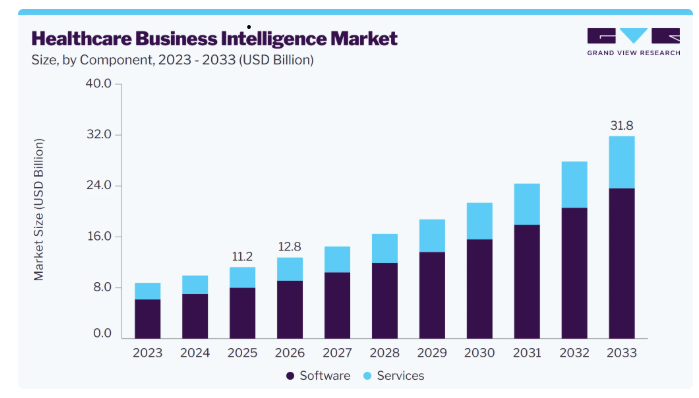
Healthcare organizations are generating more clinical, financial, operational, and patient data than ever before. The challenge is no longer simply collecting information, but converting it into insights that can improve decisions, control costs, and support better patient outcomes. This shift is accelerating the Healthcare Business Intelligence Market, which was valued at USD 11.2 billion in 2025 and is projected to reach USD 31.8 billion by 2033, expanding at a 14.0% CAGR from 2026 to 2033.
The Market at a Glance
2025 Market Size: USD 11.2 Billion
2026 Market Size: USD 12.8 Billion
2033 Market Forecast: USD 31.8 Billion
Growth Rate: 14.0% CAGR, 2026–2033
Leading Region: North America
North America Share: 46.4% in 2025
Fastest-Growing Region: Asia Pacific
What Is Driving Healthcare BI Adoption?
Healthcare business intelligence is increasingly being used to answer critical questions around costs, patient outcomes, operational efficiency, risk, and resource utilization.
Three developments are particularly important:
- Healthcare Is Becoming More Data-Driven
The growing adoption of electronic health records is creating larger volumes of structured healthcare data. BI platforms help organizations organize this information into dashboards, visualizations, and analytical reports that can support faster decision-making.
Hospitals and healthcare providers can analyze patient trends, readmission patterns, financial performance, claims, and operational indicators to identify areas requiring attention.
Download a free sample report or claim your copy of this full market intelligence report
- AI Is Moving BI Beyond Traditional Reporting
Artificial intelligence is changing the capabilities of healthcare BI platforms.
Modern systems increasingly combine:
- Machine learning
- Predictive analytics
- Natural language processing
- Real-time analytics
- Automated reporting
- Risk identification
These capabilities can help healthcare organizations identify at-risk patients, forecast hospital admissions, optimize treatment strategies, and automate administrative workflows.
In May 2025, Innovaccer launched Innovaccer Gravity, a cloud-agnostic healthcare intelligence platform designed to unify EHR, claims, financial, operational, HR, and supply-chain information within a single environment.
- Cost Pressure Is Increasing the Need for Analytics
Healthcare organizations are under continuous pressure to manage expenses while maintaining or improving patient care. BI tools can support revenue-cycle management, claims processing, financial analysis, risk assessment, and operational planning.
This makes analytics increasingly relevant not only to clinical teams but also to administrators, payers, manufacturers, and other healthcare stakeholders.
Where Is the Market Concentrated?
Software Takes the Lead
The software segment accounted for more than 71.1% of revenue in 2025 and is expected to register the fastest CAGR over the forecast period.
Healthcare BI software helps organizations analyze clinical and financial information, monitor performance, identify trends, and support data-driven decisions.
The services segment also presents growth opportunities as organizations seek support for:
- Data warehouse development
- Database design
- Data modeling
- Data visualization
- Infrastructure modernization
- Customized analytics solutions
Cloud Is Becoming the Preferred Environment
The cloud-based segment represented 48.6% of revenue in 2025 and is expected to grow at the fastest rate during the forecast period.
Why does cloud matter?
Accessibility: Data and analytics can be accessed across different locations and users.
Scalability: Organizations can expand storage and processing capabilities as data volumes increase.
Agility: Cloud platforms support faster deployment and modernization of analytics environments.
On-premises solutions remain relevant where organizations require greater customization, but high infrastructure costs, implementation challenges, governance requirements, and training needs can restrict adoption.
Financial Analytics Still Leads Applications
The financial analysis segment held a 36.7% revenue share in 2025, supported by applications covering costs, cash flow, claims, sales, profitability, revenue-cycle management, and risk assessment.
At the same time, patient care is expected to register the fastest CAGR. Healthcare organizations are increasingly using data to reduce readmissions, improve clinical care, optimize staffing, and manage patient expenses.
This represents an important shift: BI is moving from primarily supporting business operations toward becoming a tool for both financial intelligence and patient-centered decision-making.
Payers Represent a Major End-Use Segment
The payers segment accounted for more than 38.5% of revenue in 2025.
Healthcare payers are using BI solutions to improve provider-network management, control operational costs, increase competitiveness, and identify potentially fraudulent claims.
Healthcare manufacturers, meanwhile, are expected to experience the fastest growth. Increasing adoption of SaaS solutions can help manufacturers reduce maintenance and development costs while supporting data-driven operations.
AI-Powered Healthcare BI Is Already Being Applied
AI integration is becoming more practical across healthcare organizations.
Cedars-Sinai's CS Connect, developed in partnership with K Health, uses AI to support patient intake, symptom triage, and preliminary treatment suggestions. Cleveland Clinic has also partnered with Palantir Technologies on an AI-driven Virtual Command Center designed to centralize clinical and operational information for areas such as OR scheduling, bed management, and staffing.
These implementations illustrate how healthcare BI is increasingly connecting data, AI, and operational decision-making.
North America Leads; Asia Pacific Gains Momentum
North America dominated the market with a 46.4% revenue share in 2025. Strong healthcare IT infrastructure, increasing cloud adoption, and widespread use of BI solutions support regional growth.
The U.S. represented the largest market in North America, while Canada is benefiting from rising healthcare costs, EHR adoption, government initiatives, and increasing demand for data-driven healthcare management.
Asia Pacific is expected to record the fastest CAGR of 14.7% from 2026 to 2033.
The regional opportunity is supported by:
- Growing awareness of BI technologies
- Government digital-health initiatives
- Mobile healthcare solutions
- Healthcare IT investments
- EHR adoption
- Increasing use of advanced analytics
China held the largest market revenue share in Asia Pacific in 2025. Japan is benefiting from an aging population and increasing healthcare expenditure, while India's expanding digital healthcare ecosystem, telemedicine adoption, and emphasis on data-driven healthcare are supporting market development.
What Could Limit Market Expansion?
The major restraint is high initial investment and ongoing costs.
Healthcare organizations may need significant resources for infrastructure, implementation, training, integration, governance, and maintenance. Data privacy and security requirements also add complexity, particularly because regulations such as HIPAA and GDPR place strict requirements on healthcare information.
Despite these challenges, the increasing availability of cloud-based solutions is creating an opportunity to make BI more scalable and accessible.
Competitive Landscape
The healthcare business intelligence industry remains fragmented, with global technology companies, healthcare technology providers, analytics firms, and emerging players competing through platform development, partnerships, collaborations, and innovation.
Innovation remains high as companies focus on AI, machine learning, predictive analytics, real-time insights, and interoperable data environments. Collaboration between healthcare providers and technology companies is also increasing as organizations seek better data-sharing capabilities.
Key Companies
Microsoft, Oracle, SAP, Salesforce, Inc., and Perficient Inc. are among the companies profiled in the healthcare business intelligence market.
The future of the healthcare business intelligence market will increasingly depend on how effectively organizations combine cloud infrastructure, EHR data, AI, predictive analytics, and intuitive visualization. As healthcare systems continue their digital transformation, business intelligence is becoming an increasingly important layer for turning complex healthcare data into measurable operational and clinical value.
About us:
Grand View Research, a market research and consulting company, provides syndicated research reports, customized research reports, and consulting services. Grand View Research database is used by the world's renowned academic institutions and Fortune 500 companies to understand the global and regional business environment. Our database features thousands of statistics and in-depth analysis on 46 industries in 25 major countries worldwide.

 English
 Arabic
 French
 Spanish
 Portuguese
 Turkish
 Dutch
Dutch
 Italiano
 Russian
 Romaian
 Portuguese (Brazil)
 Greek
Greek
