
Wearable Computing Devices Market Projected to Reach USD 274.2 Billion by 2036, China Growing at 9.0% CAGR, USA at 8.8%, UK at 7.6%
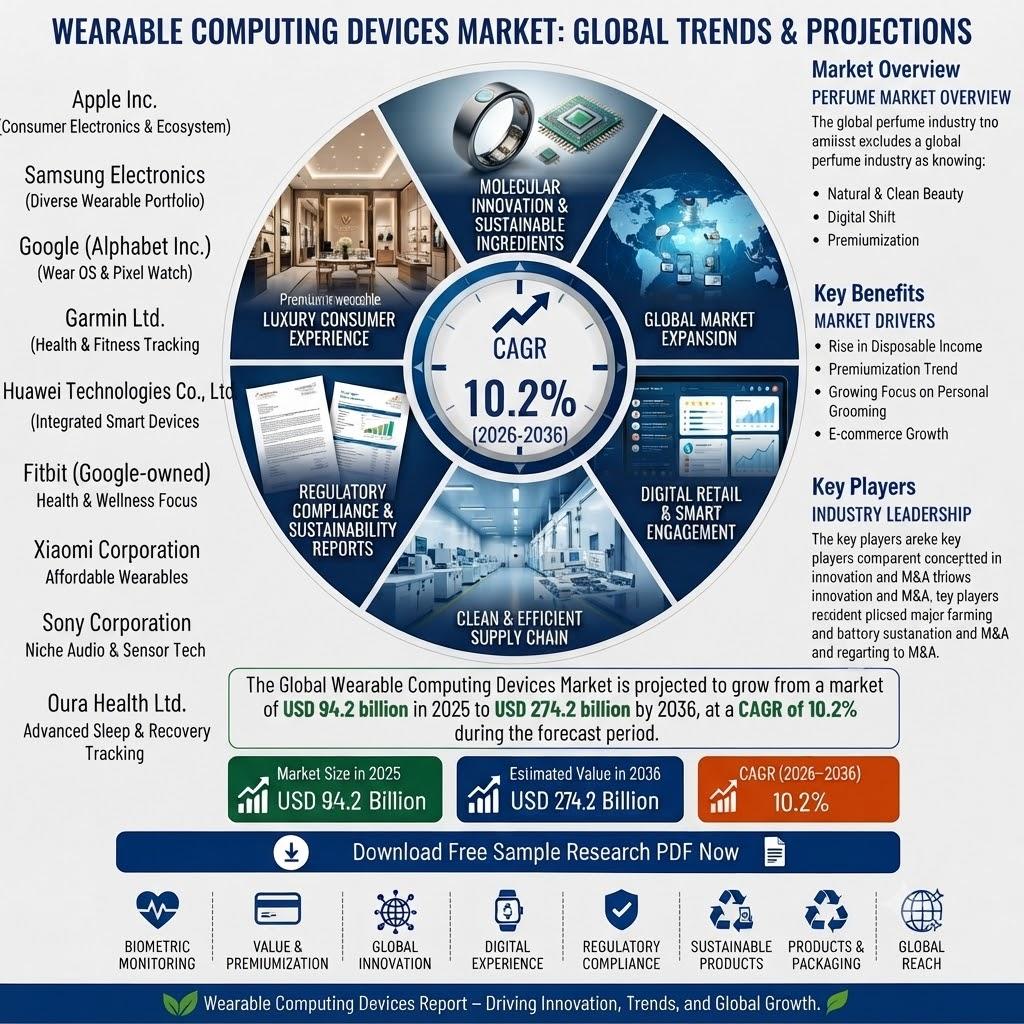
The global wearable computing devices market is estimated at USD 103.8 billion in 2026 and is projected to reach USD 274.2 billion by 2036, expanding at a 10.2% CAGR during the forecast period. Fact.MR estimates an absolute dollar opportunity of USD 170.4 billion between 2026 and 2036, as wearable technologies move beyond fitness tracking into healthcare monitoring, enterprise augmented reality, industrial applications, and hands-free computing.
Wearable computing devices include smartwatches, fitness trackers, head-mounted displays, ear-worn devices, smart clothing, body cameras, and industrial exoskeletons. Demand is being shaped by better biometric sensors, device miniaturization, digital healthcare adoption, and the growing use of connected devices in workplaces. At the same time, battery limitations, privacy concerns surrounding continuous biometric data collection, and fragmented healthcare reimbursement remain constraints on wider clinical adoption.
Get detailed market forecasts, competitive benchmarking, and pricing trends: https://www.factmr.com/connectus/sample?flag=S&rep_id=14535
Smartwatches maintain a commanding position
Smartwatches are expected to account for approximately 64% of the wearable computing devices market in 2026, making them the leading product category. Their combination of fitness tracking, health monitoring, notifications, payments, and smartphone connectivity continues to support widespread consumer adoption. Medical features are also expanding the role of smartwatches from lifestyle products toward health-monitoring platforms.
Fitness and wellness applications are projected to hold approximately 58% share in 2026. Activity tracking, heart-rate monitoring, sleep analysis, and other health-related functions remain key reasons consumers purchase wearable devices. The growing integration of wearable data with digital health platforms is also creating opportunities for recurring software and subscription-based services.
Enterprise applications are opening another growth avenue. Manufacturing and logistics companies are deploying AR head-mounted displays for hands-free operations, training, maintenance, inspection, and workflow support. These applications are helping shift wearable computing from primarily consumer-focused electronics toward business-critical equipment.
Shambhu Nath Jha, Principal Consultant at Fact.MR, highlights the importance of healthcare reimbursement expansion, smartwatch medical-feature approvals, and enterprise AR adoption in manufacturing and logistics for companies evaluating this market.
China leads country-level growth
China is projected to register the fastest country-level growth at a 9.0% CAGR through 2036. Strong smartwatch adoption, domestic technology brands, and expanding industrial AR deployment are supporting the country's position. Huawei and Xiaomi are important participants in the Chinese wearable ecosystem, while enterprise AR adoption is creating additional demand beyond consumer electronics.
The United States follows with an 8.8% CAGR. The market benefits from established smartwatch adoption, healthcare-related wearable features, and enterprise AR deployments. Apple's health-focused wearable capabilities and Microsoft's HoloLens-based enterprise applications illustrate the broader shift toward combining wearable hardware with healthcare and industrial use cases.
South Korea is expected to grow at 7.8% CAGR, supported by Samsung's health-platform expansion and enterprise AR adoption. The United Kingdom is projected to expand at 7.6%, while France and Germany are each forecast to grow at 7.5%. Japan is expected to register a 7.0% CAGR, with an aging population and growing demand for remote health monitoring contributing to market development.
Europe's wearable market is increasingly influenced by regulatory and reimbursement frameworks. EU Medical Device Regulation approvals are supporting the commercialization of clinical-grade wearable technologies, while enterprise AR adoption across manufacturing is creating another source of demand. Germany's industrial base gives it a particularly relevant position in workplace wearable applications.
Competitive landscape
The competitive environment includes consumer electronics companies, sports technology specialists, digital health providers, and enterprise technology companies. Key companies profiled by Fact.MR include Apple Inc., Samsung Electronics, Google (Alphabet Inc.), Garmin Ltd., Huawei Technologies Co., Ltd., Fitbit, Xiaomi Corporation, Sony Corporation, and Oura Health Ltd.
Apple maintains a strong position in premium smartwatches through the Apple Watch and Apple Health ecosystem, while Samsung competes through Galaxy Watch devices and its broader Android ecosystem. Garmin remains prominent in sports and outdoor wearables, while Huawei and Xiaomi compete aggressively across Asian markets. Oura has established a specialized position around health tracking and smart-ring technology.
Competitive differentiation increasingly depends on sensor accuracy, health functionality, operating-system integration, battery performance, regulatory approvals, and the ability to connect hardware with broader digital platforms. In healthcare and enterprise applications, regulatory compliance and long-term platform compatibility can become as important as consumer-facing product features.
Healthcare and enterprise applications create new revenue pools
Wearable computing is increasingly moving toward continuous monitoring rather than occasional data collection. Health-related features such as sleep monitoring, heart-rate tracking, and other biometric measurements are expanding the addressable use cases for wearable devices. Regulatory approvals can further strengthen this transition by enabling selected devices to participate in clinical and reimbursement pathways.
Enterprise AR provides a separate opportunity. Manufacturing companies are using wearable displays to give workers hands-free access to instructions, inspection information, and remote assistance. Logistics, industrial maintenance, and training applications can similarly benefit from wearable interfaces that reduce dependence on conventional screens.
This convergence of consumer electronics, healthcare technology, and industrial computing is creating a broader competitive field. Device manufacturers increasingly need capabilities across hardware, software, sensors, data platforms, and regulatory compliance to capture opportunities across multiple application segments.
Market Snapshot
The wearable computing devices market is valued at USD 103.8 billion in 2026 and is forecast to reach USD 274.2 billion by 2036 at a 10.2% CAGR. Smartwatches account for approximately 64% of the product market in 2026, while fitness and wellness applications hold about 58% share. China leads country-level growth at 9.0%, followed by the United States at 8.8% and South Korea at 7.8%.
To View Related Reports
https://afgbfh.blogspot.com/2026/09/smart-agriculture-solution-market.html
https://sportgalax.com/read-blog/24372
About Fact.MR
Fact.MR is a market research and consulting company providing market intelligence, competitive analysis, and forecasting across global industries. Its research covers emerging technologies, evolving consumer trends, industrial developments, and changing business environments. Fact.MR delivers data-driven insights designed to support strategic planning, investment decisions, and market-entry initiatives.

 English
 Arabic
 Spanish
 Portuguese
 Deutsch
 Turkish
 Dutch
Dutch
 Italiano
 Russian
 Romaian
 Portuguese (Brazil)
 Greek
Greek
