
Antibody Drug Conjugates Contract Manufacturing Market: The Growing Role of Bioconjugation
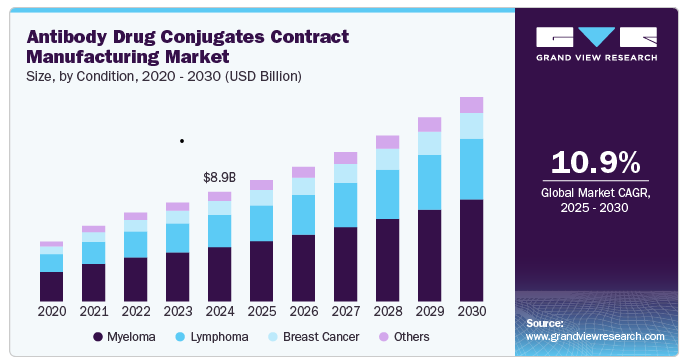
The antibody drug conjugates contract manufacturing market is gaining momentum as pharmaceutical and biotechnology companies increasingly rely on specialized manufacturing partners to support complex oncology therapies. Antibody Drug Conjugates Contract Manufacturing Market valued at USD 8.9 billion in 2024, the market is projected to reach USD 16.5 billion by 2030, expanding at a 10.9% CAGR from 2025 to 2030. Asia Pacific led the market with a 40.9% revenue share in 2024, while rising cancer prevalence, expanding ADC research, and the complexity of manufacturing are strengthening outsourcing demand.
Why ADC Manufacturing Is Moving Toward Specialized Partners
Antibody-drug conjugates combine monoclonal antibodies with cytotoxic payloads to deliver treatment more selectively to cancer cells. Although this approach offers the potential for targeted therapy and reduced systemic toxicity, manufacturing ADCs involves multiple technically demanding steps.
Companies must manage:
Complex conjugation processes
Specialized bioconjugation methods are required to connect antibodies, linkers, and payloads while maintaining product quality and consistency.
High-potency compounds
The handling of cytotoxic payloads requires containment capabilities, specialized equipment, skilled personnel, and strict quality controls.
Regulatory requirements
ADC production involves biologic and small-molecule components, creating stringent manufacturing and compliance requirements.
Scalability challenges
As ADC candidates move from research and clinical development toward commercialization, manufacturers need reliable processes capable of supporting larger production volumes.
These requirements make contract manufacturing an attractive option, particularly for biopharmaceutical companies that do not have the infrastructure or expertise to manage ADC production internally.
Download a free sample report or claim your copy of this full market intelligence report
Cancer Burden Is Expanding the ADC Opportunity
The growing global cancer burden is one of the strongest demand drivers for ADC development and manufacturing.
An aging global population is contributing to increasing cancer incidence. According to the source, more than half of cancers diagnosed in the UK occur among people aged over 70, while the global population aged 60 and above is expected to increase from 1 billion in 2020 to 2.1 billion by 2050.
As pharmaceutical companies pursue more targeted oncology therapies, the number of ADC development programs is expanding. This growing research pipeline creates additional requirements for manufacturing capabilities covering development, conjugation, analytical testing, formulation, and commercial production.
Myeloma Leads, While Lymphoma Gains Momentum
The condition landscape provides another clear indication of where manufacturing demand is concentrated.
Myeloma
The myeloma segment accounted for 49.61% of revenue in 2024, making it the largest condition segment. Growing interest in targeted therapies, including ADC approaches involving B-cell maturation antigen targets, is encouraging investment in specialized manufacturing.
The expanding pipeline of myeloma-focused ADC candidates is also increasing demand for CMOs with capabilities in high-potency API handling, bioconjugation, and scalable production.
Lymphoma
Lymphoma is expected to register the fastest CAGR during the forecast period. Pharmaceutical and biotechnology companies are investing in targeted therapies to address unmet medical needs, creating additional demand for specialized ADC manufacturing services.
Linker Technology Is Reshaping Manufacturing Requirements
The linker is a critical component of an ADC because it influences stability, drug release, efficacy, and targeted delivery.
Cleavable linkers held the largest share at 56.1% in 2024. Their ability to release the payload within cancer cells can improve therapeutic activity while helping minimize off-target toxicity.
Advances in acid-sensitive, glutathione-sensitive, and enzyme-cleavable technologies are increasing the need for manufacturers with specialized linker-payload and conjugation capabilities.
At the same time, non-cleavable linkers are expected to experience attractive growth as developers pursue next-generation ADCs with improved safety and pharmacokinetic characteristics.
Technology Is Making ADC Production More Sophisticated
Innovation is occurring across nearly every stage of ADC manufacturing.
Key areas include:
- Site-specific conjugation
- Advanced linker-payload technologies
- Improved bioconjugation methods
- High-throughput analytics
- Single-use bioprocessing
- Manufacturing automation
- AI and machine learning for process optimization
These technologies can improve yield consistency, scalability, stability, and cost efficiency. As ADC development becomes more sophisticated, specialized CMOs with advanced infrastructure are becoming increasingly valuable to drug developers.
From Individual Services to Integrated Manufacturing
The market is also moving toward broader end-to-end service models.
Contract manufacturers are expanding beyond individual production activities to provide integrated capabilities covering ADC development, payload-linker synthesis, conjugation, formulation, fill-finish, and analytical testing.
This approach can simplify supply chains for biopharmaceutical companies while reducing the number of external partners involved in development and production.
The growing preference for integrated services is particularly important for companies progressing ADC candidates through increasingly complex development stages.
Asia Pacific Holds a Strong Manufacturing Position
Asia Pacific accounted for 40.93% of revenue in 2024, supported by comparatively lower manufacturing costs, skilled labor availability, supportive regulatory reforms, tax benefits, and the presence of cGMP-compliant facilities.
China represented the largest market within Asia Pacific in 2024. Investments in biopharmaceutical innovation, government support, and growing demand for targeted cancer therapies are encouraging domestic CMOs to expand capabilities across antibody development, payload-linker synthesis, and conjugation.
India is also becoming an attractive outsourcing destination. Its established pharmaceutical industry, skilled workforce, biologics investments, and emphasis on cost-effective manufacturing are supporting ADC contract manufacturing expansion.
North America Is Accelerating
Although Asia Pacific held the largest share in 2024, North America is expected to register the fastest CAGR during the forecast period.
The U.S. benefits from a strong pharmaceutical and biotechnology ecosystem, advanced manufacturing technologies, and established regulatory infrastructure. Increasing outsourcing by drug developers is creating opportunities for specialized CDMOs capable of supporting complex ADC programs.
Canada is also expanding its biopharmaceutical capabilities, supported by research strengths and initiatives aimed at developing the biotechnology sector.
Europe Builds on Its Biopharmaceutical Infrastructure
Europe's ADC contract manufacturing market is supported by strong pharmaceutical infrastructure, specialized manufacturing capabilities, and increasing investment in targeted cancer therapies.
Germany held the largest European market share in 2024, supported by its pharmaceutical manufacturing base and regulatory expertise. The UK is also expanding through government support for biopharmaceutical innovation, advanced bioprocessing capabilities, academic collaborations, and investments in high-containment manufacturing facilities.
A Market Defined by Innovation and Specialized Expertise
The antibody drug conjugates contract manufacturing market is in a medium growth stage with an accelerating pace. Innovation is high, M&A activity is moderate, and regulatory influence remains significant.
As ADC pipelines expand, outsourcing is becoming increasingly strategic rather than simply a cost-saving measure. Pharmaceutical companies need manufacturing partners that can combine high-potency handling, advanced conjugation, regulatory expertise, scalability, and integrated services.
With the market projected to grow from USD 10.9 billion in 2026 to USD 16.5 billion by 2030, continued ADC research and the rising need for specialized manufacturing infrastructure are expected to keep contract manufacturing at the center of the industry's expansion.
Key Companies
Sterling, Recipharm AB, Lonza, Catalent, Inc., Sartorius AG, and WuXi Biologics are among the leading companies operating in the antibody drug conjugates contract manufacturing market.
About us:
Grand View Research, a market research and consulting company, provides syndicated research reports, customized research reports, and consulting services. Grand View Research database is used by the world's renowned academic institutions and Fortune 500 companies to understand the global and regional business environment. Our database features thousands of statistics and in-depth analysis on 46 industries in 25 major countries worldwide.

 English
 Arabic
 French
 Spanish
 Portuguese
 Turkish
 Dutch
Dutch
 Italiano
 Russian
 Romaian
 Portuguese (Brazil)
 Greek
Greek
