
Best DEX for Ethereum: A Guide to Decentralized Trading
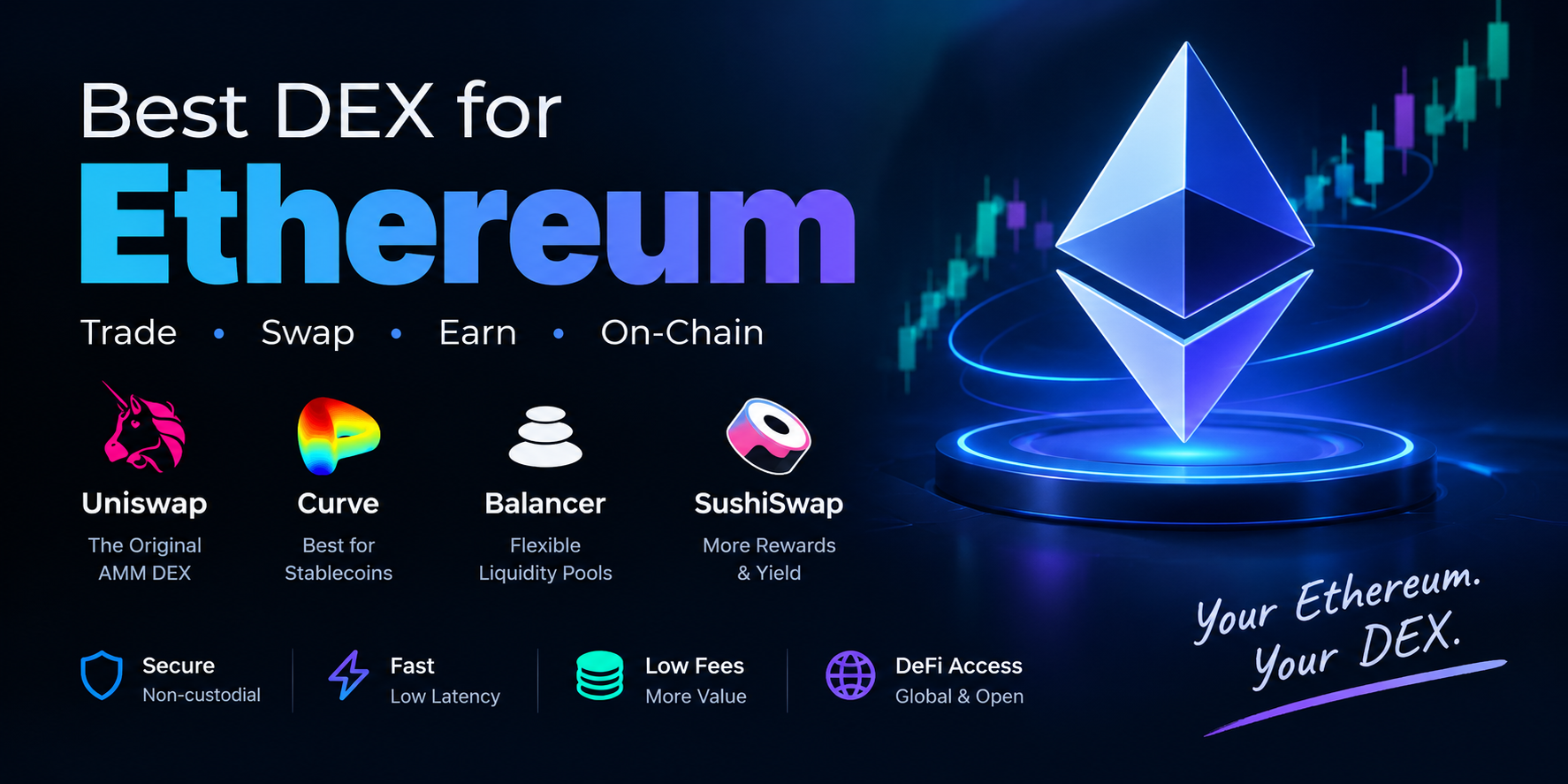
Finding the best DEX for Ethereum depends on factors such as liquidity, supported tokens, trading fees, security features, and ease of use. Decentralized exchanges (DEXs) allow users to swap Ethereum-based assets directly from compatible wallets without relying on a traditional centralized exchange.
What Is a DEX for Ethereum?
A decentralized exchange is a blockchain-based trading platform that facilitates cryptocurrency swaps through smart contracts. Instead of depositing assets into an exchange-controlled account, users generally connect a self-custody wallet and authorize transactions themselves.
Ethereum has one of the largest decentralized finance ecosystems, making it home to several established DEX platforms. Users can trade ETH and thousands of ERC-20 tokens while maintaining control of their wallet assets.
Key Factors When Choosing the Best DEX for Ethereum
When comparing Ethereum DEX platforms, liquidity is one of the most important considerations. Higher liquidity can help reduce price impact, particularly when executing larger swaps.
Trading costs are another factor. Ethereum transactions require network gas fees, while DEX protocols may also charge swap fees. The total cost can therefore vary depending on network congestion, transaction size, and the protocol being used.
Security should also be considered. Users should review a protocol's smart-contract history, audits, reputation, and security disclosures. No smart contract or DeFi platform is completely free from technical risk.
The user interface and wallet compatibility matter as well. A DEX that supports commonly used wallets and provides clear transaction information can make swapping easier for both experienced and newer users.
Popular DEX Options on Ethereum
Several established protocols are commonly used for Ethereum-based swaps. Uniswap is widely recognized for its automated market-maker model and broad token ecosystem. It provides decentralized token swapping and liquidity features across supported networks.
Curve is another prominent DeFi protocol, particularly known for markets involving stablecoins and similar-value assets. Its design focuses on efficient swaps within those asset categories.
Balancer offers customizable liquidity pools and supports different pool structures. This makes it useful for users and liquidity providers looking for more flexible portfolio and pool configurations.
Sushi is another decentralized trading protocol that has historically supported token swaps and liquidity-related DeFi features across multiple networks.
The most suitable option can vary according to the token pair, liquidity available at the time, network selected, and transaction costs.
How to Use an Ethereum DEX
To use a DEX, users typically need a compatible self-custody wallet containing ETH or another supported token. After connecting the wallet to the DEX, they select the asset they want to sell and the asset they want to receive.
Before confirming a transaction, users should check the exchange rate, minimum received amount, network fee, and token contract information. Wallet approval transactions may also be required when swapping certain ERC-20 tokens.
Once the transaction is submitted, the Ethereum network processes it. The resulting tokens are generally sent directly to the connected wallet after successful confirmation.
Final Thoughts
The best DEX for Ethereum is not necessarily the same for every trader. Liquidity, fees, token availability, security considerations, wallet compatibility, and current Ethereum gas costs should all be evaluated before completing a swap. Comparing these factors can help users choose a DEX that fits their particular trading requirements while retaining control over their assets.
best DEX for Ethereum || best DEX for Base || best DEX for large swaps || bridge ETH to Base || bridge ETH to Arbitrum || where to stake ETH || best ETH staking ||

 English
 French
 Spanish
 Portuguese
 Deutsch
 Turkish
 Dutch
Dutch
 Italiano
 Russian
 Romaian
 Portuguese (Brazil)
 Greek
Greek
