
Polymers Market to Reach USD 1,183.91 Billion by 2036 as South Korea Leads at 6.8% CAGR
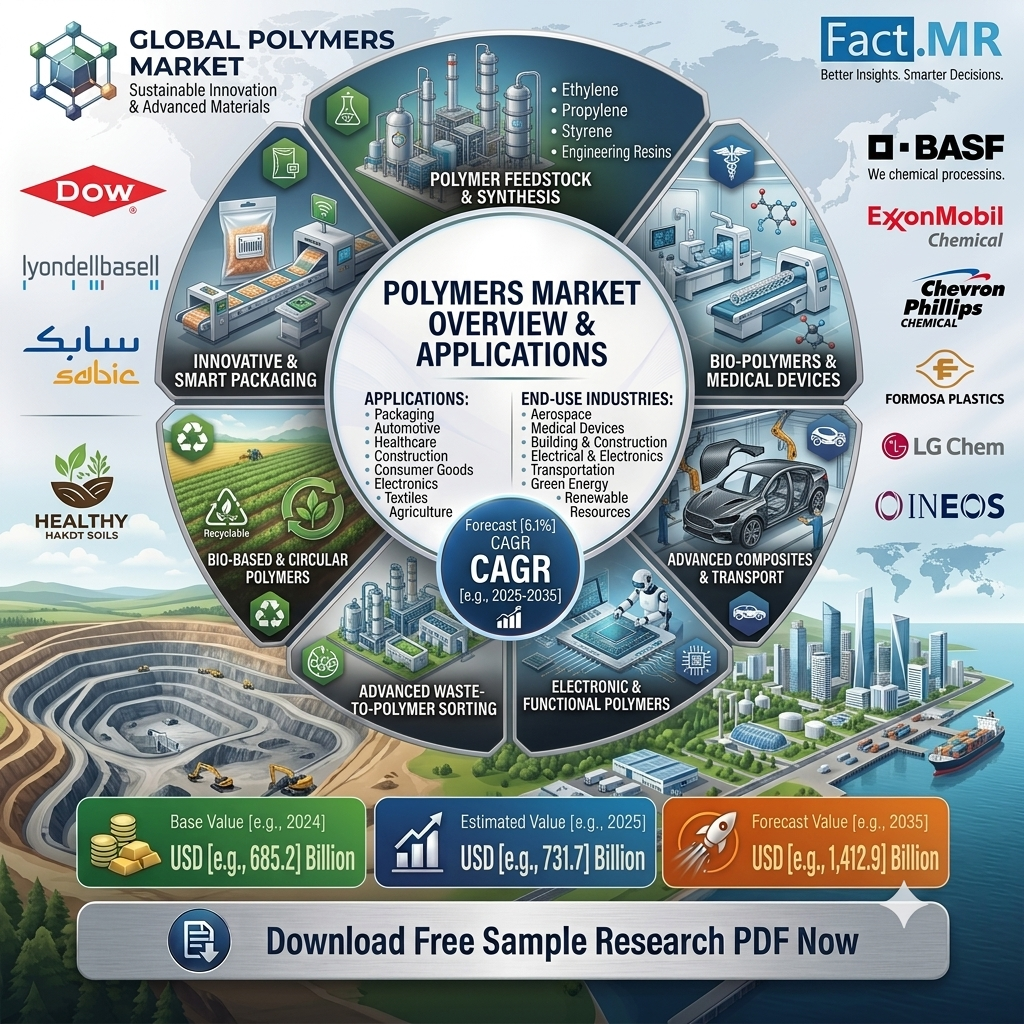
The polymers market is forecast to expand from USD 719.93 billion in 2026 to USD 1,183.91 billion by 2036, registering a 5.1% CAGR over the forecast period. Fact.MR attributes this expansion to the continued use of polymers across packaging, automotive, construction, electronics, and other industrial applications, while regulatory requirements, recycled content mandates, and advances in sustainable materials are reshaping the industry.
Packaging, automotive lightweighting, and construction remain important sources of polymer demand. Packaging manufacturers are seeking lightweight and durable materials that support e-commerce and consumer goods protection, while automotive producers are increasingly using polymers to reduce vehicle weight and improve fuel efficiency. Construction activity in emerging markets is also supporting demand for materials such as PVC pipe, HDPE geomembranes, polystyrene insulation, and polyurethane sealants.
Get detailed market forecasts, competitive benchmarking, and pricing trends:
https://www.factmr.com/connectus/sample?flag=S&rep_id=11202
Thermoplastics Retain Dominant Position
By type, thermoplastics account for a 55.0% share of the polymers market in 2025. Their ability to be repeatedly melted and reshaped, combined with processing flexibility and recyclability characteristics, supports their widespread use across manufacturing industries. Thermoplastics are used in applications ranging from packaging and automotive components to construction products, electronics, and consumer goods.
Their processing advantages also align with growing sustainability requirements. Manufacturers are increasingly considering recyclability and material efficiency when selecting polymer solutions, allowing thermoplastics to remain central to production strategies where performance and processing flexibility are required.
Packaging represents another major area of polymer demand, accounting for a 35.0% share in 2025. The segment benefits from consistent requirements for product protection, lightweight shipping formats, and packaging solutions that can accommodate expanding e-commerce and omnichannel distribution systems. Consumer goods companies are also looking for packaging materials that combine product safety with sustainability objectives.
The wider packaging sector is being influenced by regulatory changes surrounding recycled content. Fact.MR highlights the EU Packaging and Packaging Waste Regulation, which establishes recycled-content requirements for PET bottles and is encouraging brand owners to secure certified recycled resin supplies. These requirements are increasing attention toward recycled polymers and circular production models.
South Korea, Germany, and France Show Growth Potential
South Korea is projected to record the fastest growth among the highlighted countries, with polymer demand advancing at a 6.8% CAGR from 2026 to 2036. The country's established chemical industry infrastructure, mature polymer manufacturing capabilities, and research and development base are supporting continued development of advanced polymer technologies. Strong integration between chemical producers and end-user industries is also supporting application expansion.
Germany follows with a projected 6.2% CAGR through 2036. Chemical industry leadership, automotive sector demand, and sustainability initiatives are supporting polymer consumption across manufacturing applications. German companies are also incorporating advanced polymer technologies into integrated production systems while placing greater emphasis on material performance and environmental considerations.
France is expected to register a 5.0% CAGR during the same period. Its established chemical industry, broad industrial applications, and continued material technology development are supporting polymer demand. Industrial integration programs and application-focused material development are contributing to continued use of polymers across manufacturing and consumer applications.
The United States and Japan also represent important markets covered by the report. The USA is projected to grow at a 5.4% CAGR through 2036, supported by shale gas cost advantages, established polymer production infrastructure, and manufacturing sector development. Japan is expected to advance at a 5.8% CAGR, driven by advanced material technology, automotive requirements, and increasing use of high-performance polymer applications.
Competitive Landscape
Competition in the polymers market includes major chemical and materials companies with extensive production capabilities, technology portfolios, and established relationships across end-use industries. Key companies profiled by Fact.MR include BASF SE, Dow Inc., LyondellBasell, DuPont, SABIC, ExxonMobil Chemical, Covestro AG, Eastman Chemical, Arkema, and Evonik Industries.
Competitive activity is increasingly influenced by the need to balance virgin polymer production with recycled content integration. Resin producers are investing in technologies and supply systems that can respond to changing regulatory requirements while maintaining material performance and reliable supply. Chemical recycling initiatives are also becoming part of long-term strategies for increasing material recovery and supporting circular polymer value chains.
Recycling and Bio-based Technologies Shape the Market
The polymers market is entering a period of structural change as circular economy principles, bio-based feedstocks, and advanced recycling technologies gain greater importance. Fact.MR identifies regulatory requirements as a major influence on product development, with recycled-content targets and extended producer responsibility schemes encouraging producers to develop more sustainable material solutions.
Polymer manufacturers are also integrating advanced processing technologies, including precision molding, additive manufacturing compatibility, and chemical recycling systems. These technologies can improve processing efficiency, support complex product designs, and enhance material recovery across the polymer lifecycle. Bio-based polymers are gaining attention as manufacturers explore renewable feedstocks and materials with reduced carbon-footprint potential.
Fact.MR also highlights chemical recycling initiatives from major industry participants. BASF's ChemCycling program, Dow's partnership with Mura Technology, and LyondellBasell's MoReTec platform represent investments aimed at expanding chemical recycling capabilities and supporting commercial-scale circular polymer production.
As packaging, automotive, construction, and electronics manufacturers continue to depend on polymers, demand is expected to remain closely linked to material performance, processing efficiency, sustainability requirements, and regulatory developments. The full Fact.MR report provides detailed forecasts, segment analysis, country-level outlooks, and competitive assessment through 2036.
Top Reports:
https://adamaamresearch.blogspot.com/2026/10/fluoropolymers-market-heading-toward.html
https://social.mytamam.com/blogs/44942/Fluoropolymers-Market-to-Reach-USD-30-24-Billion-by-2036
https://zeuspage.org/blogs/65473/Fluoropolymers-Market-Worth-USD-30-24-Billion-by-2036-India
https://kaamkaaziclub.com/read-blog/64052
About Fact.MR
Fact.MR is a market research and consulting company providing market intelligence, competitive analysis, and forecasting across global industries. Its research supports businesses with data-driven insights into emerging markets, technology trends, competitive dynamics, regional opportunities, and changing demand patterns.

 English
 Arabic
 French
 Spanish
 Portuguese
 Turkish
 Dutch
Dutch
 Italiano
 Russian
 Romaian
 Portuguese (Brazil)
 Greek
Greek
