
Airborne LiDAR Market Growth Accelerates with Expanding Applications in Mapping, Mining, and Forestry
FOR IMMEDIATE RELEASE
Global Airborne LiDAR Market Set for Robust Growth as Demand for High-Precision Mapping and Geospatial Intelligence Accelerates
Rising Adoption Across Defense, Infrastructure Development, Mining, Forestry, and Smart City Projects Creates Significant Growth Opportunities for Airborne LiDAR Technologies
The global Airborne LiDAR market is entering a transformative growth phase as governments, infrastructure developers, environmental agencies, and private enterprises increasingly adopt advanced remote sensing technologies to improve mapping accuracy, operational efficiency, and decision-making capabilities. Industry analysts indicate strong market expansion driven by technological innovation, increasing drone deployment, and growing demand for real-time geospatial intelligence.
Airborne LiDAR, short for Light Detection and Ranging, has become a critical technology for organizations seeking highly accurate three-dimensional mapping data. By utilizing laser pulses emitted from aircraft, helicopters, and unmanned aerial vehicles (UAVs), Airborne LiDAR systems generate detailed terrain models and spatial information that support numerous industrial applications.
The increasing need for precise surveying and mapping solutions is expected to drive substantial market growth over the coming years. The technology is rapidly becoming indispensable for infrastructure planning, environmental monitoring, transportation development, disaster management, and defense operations.
𝐃𝐨𝐰𝐧𝐥𝐨𝐚𝐝 𝐅𝐫𝐞𝐞 𝐏𝐃𝐅 𝐁𝐫𝐨𝐜𝐡𝐮𝐫𝐞 @https://www.maximizemarketresearch.com/request-sample/28798/
Airborne LiDAR Technology Redefining Modern Geospatial Intelligence
The growing complexity of modern infrastructure projects has increased the need for accurate terrain data and advanced spatial analytics. Traditional surveying methods often require extensive manpower and longer project timelines. Airborne LiDAR significantly improves efficiency by enabling rapid data collection over large geographic areas while maintaining exceptional accuracy.
Organizations are increasingly leveraging Airborne LiDAR systems to create digital elevation models, terrain maps, and three-dimensional representations of landscapes. These capabilities support informed planning and operational decisions across multiple industries.
As governments worldwide invest in transportation networks, renewable energy projects, and smart city development, demand for advanced geospatial technologies continues to rise. Airborne LiDAR is emerging as a preferred solution due to its ability to capture high-resolution data in challenging environments.
Growing Infrastructure Investments Creating New Opportunities
Infrastructure modernization remains one of the strongest growth drivers for the Airborne LiDAR market. Governments and private investors are allocating significant resources toward highways, railways, airports, power transmission systems, and urban development projects.
Accurate terrain mapping plays a critical role during project planning and execution phases. Airborne LiDAR technology helps engineers identify topographical challenges, optimize construction plans, and reduce project risks.
The increasing adoption of digital engineering practices is also encouraging the use of LiDAR-generated datasets. Construction firms are utilizing these insights to improve project efficiency while reducing operational costs.
As urbanization accelerates globally, city planners are relying on advanced mapping solutions to support sustainable development strategies. Airborne LiDAR enables the creation of highly detailed urban models that improve planning accuracy and resource management.
UAV Integration Revolutionizing Data Collection
One of the most significant developments shaping the market is the integration of LiDAR systems with unmanned aerial vehicles. UAV-based LiDAR solutions offer enhanced flexibility, lower operational costs, and improved accessibility to difficult terrain.
Drone-enabled LiDAR platforms allow organizations to conduct surveys in remote forests, mountainous regions, mining sites, and disaster-affected areas without exposing personnel to unnecessary risks.
The combination of advanced sensors, GPS technology, and sophisticated data processing software has significantly improved the performance of UAV-based mapping solutions. As drone regulations continue to evolve and commercial adoption increases, market participants are expected to witness substantial opportunities.
Organizations across agriculture, forestry, energy, and environmental monitoring sectors are increasingly investing in drone-based LiDAR technologies to enhance operational efficiency and decision-making.
Defense Sector Continues to Drive Market Expansion
Defense and security agencies remain among the largest adopters of Airborne LiDAR technology. Military organizations use LiDAR systems for terrain analysis, mission planning, surveillance operations, and border monitoring.
The technology provides highly detailed spatial information that supports tactical planning and improves situational awareness. Advanced terrain intelligence enables defense personnel to assess potential operational challenges and optimize mission outcomes.
As geopolitical tensions continue to influence defense spending across various regions, investment in advanced surveillance and reconnaissance technologies is expected to remain strong. This trend is likely to create significant growth opportunities for Airborne LiDAR solution providers.
𝐃𝐨𝐰𝐧𝐥𝐨𝐚𝐝 𝐅𝐫𝐞𝐞 𝐏𝐃𝐅 𝐁𝐫𝐨𝐜𝐡𝐮𝐫𝐞 @https://www.maximizemarketresearch.com/request-sample/28798/
Mining Industry Increasingly Embracing Airborne LiDAR
Mining companies are increasingly recognizing the value of LiDAR technology for exploration, site planning, and operational monitoring. Accurate terrain data allows organizations to identify mineral-rich areas, optimize extraction activities, and improve safety management.
Airborne LiDAR enables mining operators to conduct detailed topographic surveys over extensive geographic regions within a relatively short timeframe. This capability supports improved project planning and resource allocation.
Additionally, environmental compliance requirements are encouraging mining firms to adopt advanced monitoring technologies. LiDAR-generated datasets help organizations assess environmental impacts and implement sustainable operational practices.
Forestry and Agriculture Applications Expanding Rapidly
Forestry management has emerged as another significant application area for Airborne LiDAR technology. Forest managers utilize LiDAR data to assess tree height, canopy density, biomass distribution, and overall ecosystem health.
The technology supports sustainable forest management by providing accurate insights into vegetation conditions and land-use patterns. Governments and environmental organizations are increasingly using LiDAR data to support conservation initiatives and climate monitoring programs.
Agriculture is also benefiting from LiDAR-enabled precision farming practices. Farmers and agribusinesses use spatial intelligence to optimize irrigation systems, monitor crop health, and improve resource utilization.
As food security concerns grow and sustainable farming practices gain importance, demand for advanced agricultural monitoring solutions is expected to increase significantly.
Environmental Monitoring Becoming a Strategic Priority
Climate change and environmental sustainability have become central concerns for governments and organizations worldwide. Airborne LiDAR technology provides valuable tools for monitoring natural resources and assessing environmental risks.
Researchers use LiDAR-generated data to analyze coastal erosion, flood risks, watershed conditions, and ecosystem changes. These insights support informed environmental policies and disaster preparedness initiatives.
The increasing frequency of extreme weather events has highlighted the importance of accurate terrain data for emergency response planning. Airborne LiDAR enables authorities to develop effective mitigation strategies and improve disaster resilience.
Technological Innovations Strengthening Market Competitiveness
Continuous technological advancements are enhancing the capabilities of Airborne LiDAR systems. Modern solutions offer improved accuracy, faster data acquisition rates, and enhanced processing capabilities.
Artificial intelligence and machine learning technologies are further transforming the industry by enabling automated data analysis and feature extraction. These innovations reduce processing time while improving the quality of actionable insights.
Cloud-based platforms are also facilitating more efficient storage, sharing, and analysis of geospatial datasets. As digital transformation initiatives continue across industries, integrated LiDAR solutions are expected to gain widespread adoption.
Manufacturers are focusing on developing lightweight sensors, improved scanning technologies, and advanced analytics tools to strengthen their competitive positions.
Regional Market Outlook
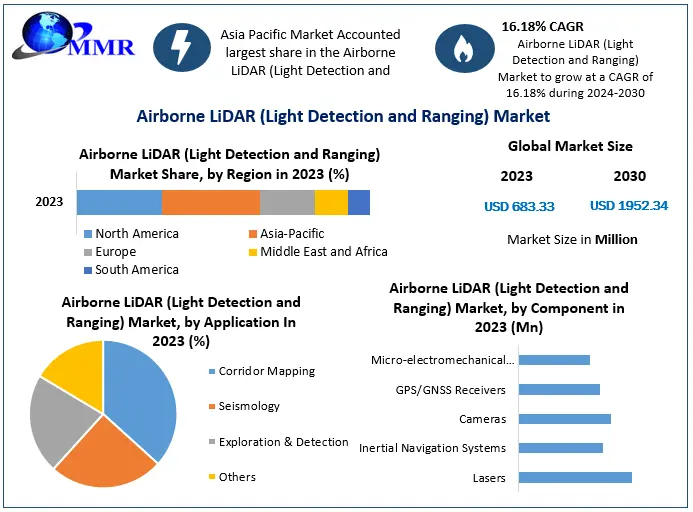
North America continues to maintain a strong position in the Airborne LiDAR market due to substantial investments in defense, infrastructure development, and environmental monitoring initiatives. The region benefits from advanced technological capabilities and strong adoption of geospatial solutions.
Europe is experiencing steady growth supported by smart city initiatives, renewable energy projects, and environmental sustainability programs. Government investments in digital infrastructure are creating favorable market conditions.
The Asia-Pacific region is expected to emerge as one of the fastest-growing markets. Rapid urbanization, industrialization, transportation development, and government modernization programs are driving demand for advanced mapping technologies.
Emerging economies are increasingly recognizing the value of geospatial intelligence for infrastructure planning and resource management, creating long-term growth opportunities for industry participants.
Competitive Landscape
The Airborne LiDAR market remains highly competitive, with technology providers focusing on innovation, strategic partnerships, and product development initiatives. Companies are investing heavily in research and development to enhance system performance and expand application capabilities.
Market participants are also pursuing collaborations with drone manufacturers, software developers, and geospatial service providers to create integrated solutions that address evolving customer requirements.
As digital transformation accelerates across industries, organizations capable of delivering comprehensive data acquisition and analytics solutions are expected to strengthen their market positions.
1.Teledyne Technologies
2. Saab Group
3. Airborne Imaging
4. Leica Geosystems
5. Faro Technologies, Inc.,
6. Flir Systems Inc.,
7. RIEGL Laser Measurement Systems GmbH
8. Merrick & Company
9. Firmatek
10. Lasermap Inc.
11. Dibotics
12. Fugro
13. IGI
14. VelodyneLidar
15. XactSense
16. Quantum Spatial
17. EUROSENSE GmbH
18. COWI A/S
Future Outlook
The future of the Airborne LiDAR market appears exceptionally promising. Increasing demand for accurate spatial intelligence, growing drone adoption, infrastructure expansion, and environmental monitoring requirements are expected to support sustained growth throughout the forecast period.
Organizations across public and private sectors are recognizing the strategic value of high-quality geospatial data in improving decision-making and operational efficiency. As technological advancements continue to reduce costs and enhance capabilities, Airborne LiDAR adoption is expected to expand significantly.
The market is positioned to play a critical role in shaping the future of digital mapping, infrastructure development, environmental management, and smart city planning worldwide.
For full access to the comprehensive strategic report, visit:https://www.maximizemarketresearch.com/market-report/global-airborne-lidar-light-detection-and-ranging-market/28798/
About Maximize Market Research:
Maximize Market Research is a multifaceted market research and consulting company with professionals from several industries. Some of the industries we cover include medical devices, pharmaceutical manufacturers, science and engineering, electronic components, industrial equipment, technology and communication, cars and automobiles, chemical products and substances, general merchandise, beverages, personal care, and automated systems. To mention a few, we provide market-verified industry estimations, technical trend analysis, crucial market research, strategic advice, competition analysis, production and demand analysis, and client impact studies.
Contact Maximize Market Research:
3rd Floor, Navale IT Park, Phase 2
Pune Bangalore Highway, Narhe,
Pune, Maharashtra 411041, India
sales@maximizemarketresearch.com
+91 96071 95908, +91 9607365656

 English
 Arabic
 French
 Spanish
 Portuguese
 Deutsch
 Turkish
 Italiano
 Russian
 Romaian
 Portuguese (Brazil)
 Greek
Greek
