
How Rising Disposable Income Is Supporting the Theme Park Market
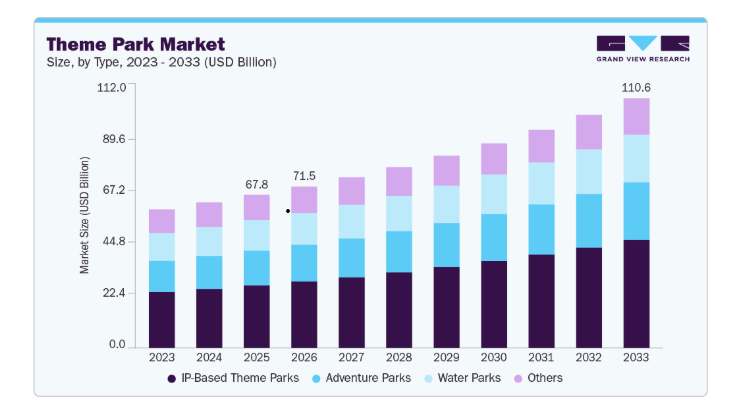
The theme park market is increasingly being shaped by changing leisure preferences, rising disposable incomes, tourism development, and the growing demand for immersive entertainment. The global Theme Park Market was valued at USD 67.9 billion in 2025 and is projected to reach USD 110.6 billion by 2033, expanding at a CAGR of 6.4% from 2026 to 2033. North America represented the largest regional market, accounting for 36.8% of global revenue in 2025, while emerging markets across Asia Pacific and Latin America are creating additional opportunities as middle-class populations and recreational spending expand.
From Traditional Rides to Immersive Entertainment
Theme parks are increasingly moving beyond conventional rides and attractions toward experiences that combine storytelling, technology, and recognizable entertainment properties. The evolution of theme park design is supporting this transformation, with operators adopting augmented reality, virtual reality, AI-driven personalization, AI-based animatronics, and 4D simulation rides.
At the same time, established intellectual properties are becoming an important component of park development. Franchises such as Marvel, Star Wars, Harry Potter, and Nintendo provide existing audience recognition that can support visitor interest and cross-promotional opportunities connected with films, streaming releases, and games.
Download a free sample report or claim your copy of this full market intelligence report
IP-Based Parks Hold a Strong Market Position
IP-based theme parks accounted for 41.0% of market revenue in 2025, making the segment the largest by type. Their strength comes from the familiarity of established brands and the emotional connections audiences already have with their characters and stories.
For park operators, recognized IP can reduce the time and investment required to build awareness around a new attraction. These properties can also support promotional activities across different entertainment platforms, creating opportunities to connect media content with physical visitor experiences.
Alongside IP-based parks, adventure parks are expected to register the highest CAGR during the forecast period. Growing interest in active and outdoor recreation is supporting demand for experiences such as ziplining, obstacle courses, bungee jumping, rock climbing, rope bridges, and treetop trails. These attractions combine physical activity with entertainment and can appeal to families, Millennials, and Gen Z visitors.
Technology Is Changing the Visitor Experience
Technology is becoming closely connected with how theme parks attract and engage visitors. AR and VR attractions can introduce interactive elements, while AI-based systems and 4D experiences can add greater immersion to rides and storytelling.
For younger audiences, the experience can extend beyond the physical attraction itself. App-based gamification, social media challenges, interactive activities, and ride-specific leaderboards can encourage participation and create additional engagement opportunities.
Digital transformation is also affecting park operations. Smart ticketing, mobile applications, and data analytics allow operators to manage visitor interactions while supporting personalized experiences. Mobile platforms are also influencing food and beverage operations through pre-ordering, scheduled pickups, and QR-code ordering.
The Visitor Base Extends Across Generations
The 19-to-35-year-old segment accounted for 21.4% of the market in 2025, while the 36-to-50-year-old group also represented a significant revenue share.
Younger visitors are increasingly attracted to technology-integrated experiences, including VR coasters, AR scavenger hunts, interactive gaming rides, and app-based engagement. The 36-to-50-year-old demographic, meanwhile, often includes parents planning family vacations with school-age or teenage children. The growth of multi-generational travel further increases demand for attractions that accommodate different age groups.
This has encouraged parks to combine thrill rides with family-oriented attractions and leisure areas rather than focusing exclusively on a single visitor demographic.
Integrated Tourism Is Expanding Park Opportunities
The development of theme parks is becoming increasingly connected with broader tourism infrastructure. Integrated resorts that combine entertainment, accommodation, attractions, and other tourism facilities are emerging as an important development model.
Governments and private investors are supporting large-scale projects in several regions, while urbanization and expanding middle-class populations are creating new demand for recreational experiences.
International expansion is also becoming more prominent. In December 2025, Six Flags opened Six Flags Qiddiya City near Riyadh as part of the Qiddiya entertainment destination. The park features 28 rides, including Falcons Flight, described in the provided market content as the tallest, fastest, and longest roller coaster in the world.
North America Remains a Major Theme Park Hub
North America held 36.8% of global theme park revenue in 2025. High discretionary spending, established infrastructure, strong tourism activity, and the presence of major global operators contribute to the region's market position.
The U.S. market is projected to grow at a 6.0% CAGR from 2025 to 2033. Its connection with Hollywood and the broader entertainment industry provides opportunities to translate popular content into physical attractions, while destination tourism and annual pass programs contribute to recurring visitation.
Europe benefits from intra-regional tourism, cultural diversity, and mobility across countries. Heritage-based attractions, seasonal parks, tourism infrastructure, and public-private partnerships are contributing to market development.
In the UK, domestic tourism, staycations, new rides, educational experiences, hotels, and transport connections are supporting park visitation. Germany benefits from engineering and safety capabilities, regional connectivity, repeat local visitors, and growing interest in themed resorts and wellness-oriented offerings.
Asia Pacific Opens New Growth Avenues
Asia Pacific is benefiting from rising middle-class incomes, urbanization, expanding tourism, and a young consumer population. Government investment in tourism infrastructure and integrated resorts is supporting the development of large entertainment destinations.
Japan's market benefits from strong domestic tourism and the popularity of character-based content and anime. Seasonal events, customer service, cleanliness, and operational standards also form part of the visitor experience.
China is experiencing growth supported by government-backed projects, rising consumer spending, and an expanding tourism sector. Local developers and international brands are collaborating on integrated entertainment zones, while digitally fluent consumers are increasingly responsive to app-based engagement, gamification, and social media-driven experiences.
Companies Continue to Expand Through Partnerships and New Parks
Major companies in the theme park industry include The Walt Disney Company, Universal Destinations & Experiences, Merlin Entertainments, OCT Group, and Chimelong Group. Their strategies include new developments, partnerships, collaborations, and new product offerings.
Other companies profiled in the study include Chimelong Group, Dubai Parks and Resorts, Fantawild Holdings, Herschend, and Hershey Entertainment & Resorts.
The Market Is Becoming an Experience Ecosystem
The development of the theme park market increasingly connects physical attractions with digital technology, entertainment franchises, tourism infrastructure, and personalized visitor services. IP-based storytelling remains a major market component, while adventure attractions are creating additional opportunities around active recreation.
As operators expand into emerging markets and invest in technology-enabled experiences, theme parks are becoming broader entertainment destinations rather than collections of rides. The projected increase from USD 67.9 billion in 2025 to USD 110.6 billion by 2033 reflects the continued development of this experience-focused market.
About us:
Grand View Research, a market research and consulting company, provides syndicated research reports, customized research reports, and consulting services. Grand View Research database is used by the world's renowned academic institutions and Fortune 500 companies to understand the global and regional business environment. Our database features thousands of statistics and in-depth analysis on 46 industries in 25 major countries worldwide.

 English
 Arabic
 French
 Portuguese
 Deutsch
 Turkish
 Dutch
Dutch
 Italiano
 Russian
 Romaian
 Portuguese (Brazil)
 Greek
Greek
