
Mobile POS Terminals Market Trends Across Digital-First Customer Experiences
The checkout counter is no longer the only place where a transaction needs to happen. Retailers, restaurants, healthcare providers, and service businesses increasingly want employees to accept payments wherever customers are being served. This shift is turning mobility into an important part of modern payment infrastructure and creating new demand for compact, connected point-of-sale solutions.
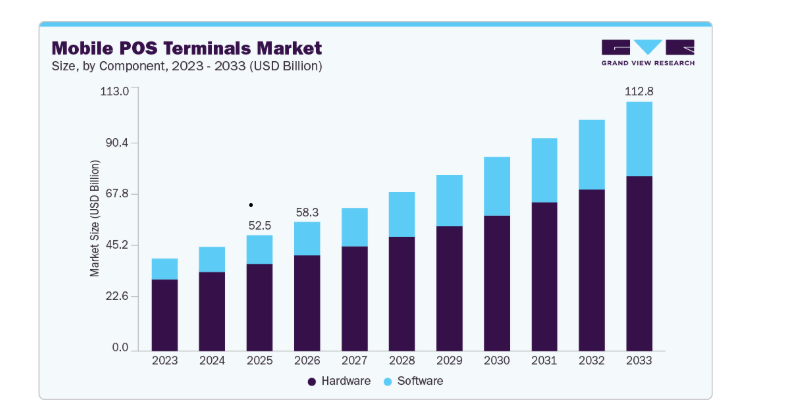
The Mobile POS Terminals Market was valued at USD 52.5 billion in 2025 and is projected to reach USD 112.8 billion by 2033, expanding at a 9.9% CAGR from 2026 to 2033. Asia Pacific led the market with a 31.3% revenue share in 2025, supported by rapid digitalization and expanding cashless payment ecosystems.
Market at a Glance
2025: USD 52.5 Billion
2033: USD 112.8 Billion
2026–2033 Growth: 9.9% CAGR
Largest Region: Asia Pacific — 31.3%
Largest Component: Hardware — 75.3%
Leading Application: Retail
Download a free sample report or claim your copy of this full market intelligence report
From Fixed Checkout Counters to Payments Anywhere
The growing preference for cashless and contactless transactions is changing how merchants think about payment infrastructure. Debit cards, credit cards, mobile wallets, QR codes, and app-based payments have become increasingly important to consumers, while merchants are looking for systems that can process transactions quickly without restricting employees to a fixed checkout station.
Mobile POS terminals address this requirement by combining portability with payment acceptance and cloud connectivity. They can also integrate with inventory management, CRM, analytics, and other business applications, making them more than simple payment devices.
For merchants, the attraction is practical: lower upfront costs, easier deployment, flexible transaction locations, and improved customer movement inside the business.
Hardware Still Generates the Largest Share
Hardware accounted for 75.3% of market revenue in 2025, making physical payment devices the primary revenue contributor.
The continued adoption of NFC-enabled terminals, smart handheld devices, card readers, and multifunctional payment hardware is supporting this position. Merchants are also upgrading legacy systems to accommodate EMV chip cards, QR payments, and digital wallets.
However, the market is gradually becoming more software-driven. The software segment is expected to register the fastest CAGR through 2033 as businesses connect physical stores with e-commerce platforms, marketplaces, delivery services, and social-commerce channels.
This creates a more unified operating environment where pricing, inventory, promotions, and customer information can be managed across multiple sales channels.
Android Is Changing the Device Equation
Android-based smart POS devices are gaining traction as alternatives to traditional proprietary terminals. Their appeal comes from lower costs, customization capabilities, and access to business applications.
The January 2026 launch of MicroTouch's Mach 15.6-inch Android POS system illustrates this direction. The device combines touchscreen functionality, NFC support, powered I/O ports, an optional customer display, and AI-ready performance for retail, quick-service restaurants, self-service, and hospitality applications.
The broader shift is toward multifunctional devices that allow businesses to combine payment acceptance with operational tools on a single platform.
Tap-to-Phone Opens Another Route to Mobile Payments
One of the most notable developments is the growing role of tap-to-phone technology.
Instead of requiring a dedicated card reader, NFC-enabled smartphones can function as payment terminals for contactless card and wallet transactions. This can reduce hardware requirements and make digital payment acceptance more accessible to small merchants, freelancers, delivery workers, and mobile service providers.
The opportunity is particularly relevant for businesses that need rapid deployment or operate outside traditional retail environments.
Retail Leads, While Healthcare Creates a New Growth Opportunity
Retail represented the largest application segment in 2025. Stores are using mobile POS terminals for faster checkout, line-busting, and payment acceptance directly on the sales floor.
The healthcare segment is expected to record the fastest CAGR during the forecast period. Hospitals, clinics, pharmacies, and diagnostic centers can use mobile POS devices at reception areas, bedside locations, pharmacies, and discharge counters.
This application is less about reducing checkout queues and more about making payment collection fit naturally into the patient journey.
“Others” Shows Where Flexibility Matters
The others segment held the largest share by type in 2025, supported by self-service and queue-management applications. Portable kiosks, compact payment scanners, and handheld checkout devices can help businesses manage high customer volumes.
Airports, supermarkets, cinemas, stadiums, and quick-service restaurants can particularly benefit from payment systems that allow transactions to move with customers rather than forcing everyone toward a single counter.
Meanwhile, the tablet segment is expected to grow significantly as cafés, boutiques, salons, restaurants, and pop-up businesses look for affordable and portable alternatives to traditional fixed POS systems.
Asia Pacific Sets the Market Pace
Asia Pacific accounted for 31.3% of global revenue in 2025, supported by rapid digitalization, a large merchant base, and widespread adoption of QR payments, NFC wallets, and app-based transactions.
China led the regional market, benefiting from a highly developed digital-payment ecosystem and strong technology adoption. Japan is also experiencing increasing demand as government initiatives and rising cashless-payment usage encourage merchants to adopt digital payment infrastructure.
North America remains an important market because of its large retail, restaurant, and hospitality sectors. In the U.S., the mobile POS terminals market is projected to grow at an 8.9% CAGR from 2026 to 2033.
Europe is also benefiting from its established contactless-payment ecosystem, while the UK's large SME and independent-merchant base creates opportunities for affordable mobile POS solutions.
The Next POS Is More Mobile, Connected, and Multifunctional
The evolution of the Mobile POS Terminals Market is moving beyond simply replacing a fixed card machine. Modern devices are increasingly becoming connected business tools that combine payments, customer service, inventory access, analytics, and other applications.
As merchants continue adapting to cashless commerce, the competitive focus is likely to remain on portability, connectivity, software integration, contactless acceptance, and ease of deployment. This combination is positioning mobile POS terminals as an increasingly important component of the digital-first commerce environment.
About us:
Grand View Research, a market research and consulting company, provides syndicated research reports, customized research reports, and consulting services. Grand View Research database is used by the world's renowned academic institutions and Fortune 500 companies to understand the global and regional business environment. Our database features thousands of statistics and in-depth analysis on 46 industries in 25 major countries worldwide.

 English
 Arabic
 French
 Spanish
 Portuguese
 Deutsch
 Turkish
 Dutch
Dutch
 Italiano
 Romaian
 Portuguese (Brazil)
 Greek
Greek
